A structured, repeatable system beats reactive buying every time. Portfolio success isn't about capturing every headline suburb—it's about deploying capital strategically, sequencing acquisitions intelligently, and holding your nerve when others chase momentum.
Why a portfolio needs a system
One-off property wins feel rewarding. They create short-term excitement and give you bragging rights at a barbecue. But lasting wealth is rarely built on isolated transactions.
A property portfolio that compounds over time requires structure. Without a framework, most investors either stop after one purchase or accumulate assets that fail to work together. The first scenario leaves growth potential untapped. The second creates borrowing gridlock and cash flow strain.
According to CoreLogic data, national property values grew 6.2% in the year to April 2026, but performance varied significantly by city and asset type. Brisbane recorded 1.8% monthly growth in March, while Sydney and Melbourne dipped by 0.1% and 0.2% respectively during the same period. This fragmentation highlights why relying on broad market momentum is insufficient.
Systematic portfolio construction starts with clarity on roles. Your first property may prioritise growth and equity acceleration. Your second might balance serviceability to preserve borrowing capacity. Your third could introduce geographic diversification or higher yield to improve cash flow resilience.
Without this logic, you end up with three similar properties in adjacent suburbs—all vulnerable to the same economic cycle, all competing for the same refinancing window. Strategy isn't about avoiding risk. It's about spreading it intelligently and ensuring each acquisition advances a measurable outcome.
Buyers Agency Australia works with investors nationally to design portfolio frameworks that fit borrowing capacity, income structure, and long-term goals. A repeatable system removes the emotional weight from each decision and replaces it with evidence-backed selection criteria.

What to buy first and why
Sequencing matters more than most investors realise. Your first property sets the foundation for everything that follows.
If you prioritise cash flow too early, you may lock in a high-yield asset with limited growth potential. That might feel comfortable in year one, but it constrains equity creation and delays your second purchase. Conversely, if you stretch too far on a premium growth play without considering serviceability, you risk being unable to borrow again for years.
A growth-first approach usually makes the most sense for a first investment property. This means targeting locations with tight supply, strong owner-occupier appeal, diverse employment bases, and constrained development pipelines. These assets tend to appreciate faster, building equity that can be accessed for future acquisitions.
According to PropTrack, Sydney dwelling prices are forecast to rise 5–7% in 2026, while regional Queensland centres and parts of Western Australia continue to show strong momentum. The key is not chasing last year's winner but identifying markets entering their growth phase with structural demand tailwinds.
Capital deployment logic also dictates when to buy. If interest rates are elevated—as they were in early 2026 following the RBA's February and March hikes to 4.10%—borrowing capacity tightens. In this environment, your first purchase should prioritise long-term fundamentals over short-term affordability. Waiting for the perfect rate environment often means missing the asset entirely.
Once your first property has accrued equity, you can leverage that position to fund deposit contributions for subsequent purchases. This is where working with a buyers agent creates measurable advantage. Professional guidance ensures your first acquisition is structured to unlock future portfolio expansion, not inadvertently block it.

How to think beyond the next purchase
Most investors fixate on the property in front of them. They ask whether the suburb is good, whether the yield covers costs, whether the price is fair. These are necessary questions, but they're insufficient.
A portfolio thinker asks: how does this asset position me for the next one? Does it improve my borrowing power or limit it? Does it introduce risk diversification or concentrate exposure? Does it align with my 10-year wealth target or simply fill a gap in my current holdings?
Balance is the output of deliberate design. A balanced portfolio typically includes a mix of growth-oriented assets, yield-supporting properties, and geographic spread across at least two states. Australian property markets are not synchronised. Perth can be booming while Melbourne consolidates. Brisbane can enter a buying window while Sydney peaks.
According to Picki's April 2026 analysis, investors building three-property portfolios should aim for interstate diversification by the third acquisition. This hedges against localised downturns and captures different growth cycles across state economies.
Risk management extends beyond geography. It includes tenant profile, asset age, council zoning, body corporate exposure, and maintenance predictability. A portfolio heavy in high-rise apartments may offer strong initial yields but carries higher volatility and weaker resale appeal. Mixing established houses, low-rise units, and emerging suburbs creates more durable performance over full market cycles.
Long-term goals should anchor every decision. If your objective is passive income replacement within 15 years, you'll need multiple properties with compounding equity and rising rents. If your goal is a single high-performing asset to fund retirement, concentration and quality matter more than quantity. Strategy is personal because constraints are personal.
Where strategy beats emotion
Trend-chasing is seductive. Media cycles amplify hype. Social proof creates urgency. FOMO converts caution into impulsive offers.
But disciplined investors outperform reactive ones across every measurable timeframe. They don't ignore hot markets—they assess them critically. They ask whether recent growth is driven by genuine owner-occupier demand or a short-term listing shortage. They distinguish between momentum and fundamentals.
In early 2026, PropTrack reported that national home prices fell 0.1% in April, marking the first monthly decline of the year. Sydney and Melbourne led the softness, down 0.6% each. Meanwhile, Perth gained 2.1%, Brisbane rose 1.1%, and Adelaide increased 1.2%.
A trend-chaser sees Perth's outperformance and rushes to buy. A strategic investor asks: is this the start of Perth's cycle or the tail end? What does the supply pipeline look like? Are rental vacancies still tight? What's driving employment growth?
Strategy also means knowing when not to buy. In a rising rate environment, with inflation at 4.6% as reported in March 2026, borrowing costs increase and serviceability buffers tighten. Stretching to secure an average asset in a hot suburb may leave you cash-poor and unable to weather holding costs. The better move is often patience—holding capital until a genuinely strong opportunity emerges.
This is where engaging a buyers advocate proves invaluable. Buyers Agency Australia filters noise from signal, prioritising opportunities that align with your portfolio structure rather than chasing market narratives. That discipline is what separates wealth accumulation from activity without progress.
Table: Growth vs. Yield – Strategic Portfolio Roles
| Asset Role |
Primary Goal |
Typical Location |
Holding Horizon |
Risk Profile |
| Growth Anchor |
Equity acceleration |
Capital city fringe, infrastructure corridors |
7–15 years |
Moderate |
| Cash Flow Support |
Serviceability, yield |
Regional centres, established suburbs |
5–10 years |
Low to moderate |
| Diversification Play |
Geographic/cycle hedge |
Interstate or emerging market |
10+ years |
Moderate to high |

FAQ
What is the best first property for a portfolio investor?
A growth-focused asset in a supply-constrained market with strong owner-occupier appeal and proven infrastructure investment.
How many properties do I need for a balanced portfolio?
Most investors achieve meaningful diversification and compounding equity with three to five well-selected properties across different markets and cycles.
Should I prioritise yield or growth when starting out?
Growth typically delivers faster equity creation, which funds future acquisitions. Yield becomes more important as your portfolio matures and cash flow needs increase.
How do I know if a suburb is genuinely strong or just hyped?
Look beyond headlines. Check vacancy rates, days on market, employment diversity, historical price performance over five-plus years, and planned infrastructure—not auction clearance rates alone.
When is the right time to buy in a rising rate environment?
When the asset meets your investment criteria and you've stress-tested affordability at current rates. Waiting for perfect conditions often means missing the right property entirely.
Final thoughts
Building a property portfolio without chasing every hot spot requires discipline, structure, and the ability to think beyond the next transaction. One-off wins don't create lasting wealth. Repeatable systems, intelligent sequencing, and evidence-backed decision-making do.
The market will always offer distractions. Your job is to filter them. Focus on assets that advance your portfolio, not just assets that feel comfortable or familiar. Balance growth with serviceability. Diversify across geography and cycle timing. And most importantly, act from strategy, not emotion.
If you're ready to build a portfolio designed for long-term compounding rather than short-term speculation, the next step is clarity. Understand your capacity, define your goals, and engage professionals who prioritise your outcomes over transaction volume. That's how wealth is built—one strategic decision at a time.
 General
Strategic sequencing, disciplined deployment, and long-term thinking create lasting wealth—not reactive bids on headline suburbs.
With the RBA cash rate sitting at 4.35% after three consecutive hikes in 2026, and major tax changes to negative gearing and the CGT discount set to reshape the investment landscape from July 2027, the cost of getting your next purchase wrong has never been higher. This guide breaks down the six most common property investment mistakes Australian investors are making right now, and what a disciplined, strategy-led approach looks like instead.
Introduction: Why 2026 is Exposing Costly Investor Mistakes
Most investors do not lose money on a single bad decision. They lose it across a series of small, compounding errors made under pressure, without a clear plan, or with incomplete information.
The current environment is making those errors far more expensive. The Reserve Bank of Australia raised the cash rate to 4.35% in May 2026, the third hike of the year, unwinding every cut delivered in 2025. At the same time, the May 2026 federal Budget announced that from 1 July 2027, negative gearing on established residential properties purchased after Budget night will be restricted, and the flat 50% CGT discount will be replaced by cost base indexation with a 30% minimum tax on capital gains.
Those two forces combined, tighter borrowing conditions and a changing tax framework, mean that investors who buy without a clear property investment strategy are taking on significantly more risk than they realise. Add to that the noise from social media, headline-chasing media coverage, and a crowded market where competition for quality assets remains fierce, and the conditions for costly mistakes are very much in place.
At Buyers Agency Australia, the team works with investors across the country who arrive having already made one or more of the mistakes outlined below. The pattern is consistent, and most of these errors are entirely avoidable with the right process.
Mistake 1: Buying Without a Clear Investment Strategy
Asking "where should I buy?" before asking "what am I actually trying to achieve?" is one of the most common ways investors end up with the wrong asset in the wrong location.
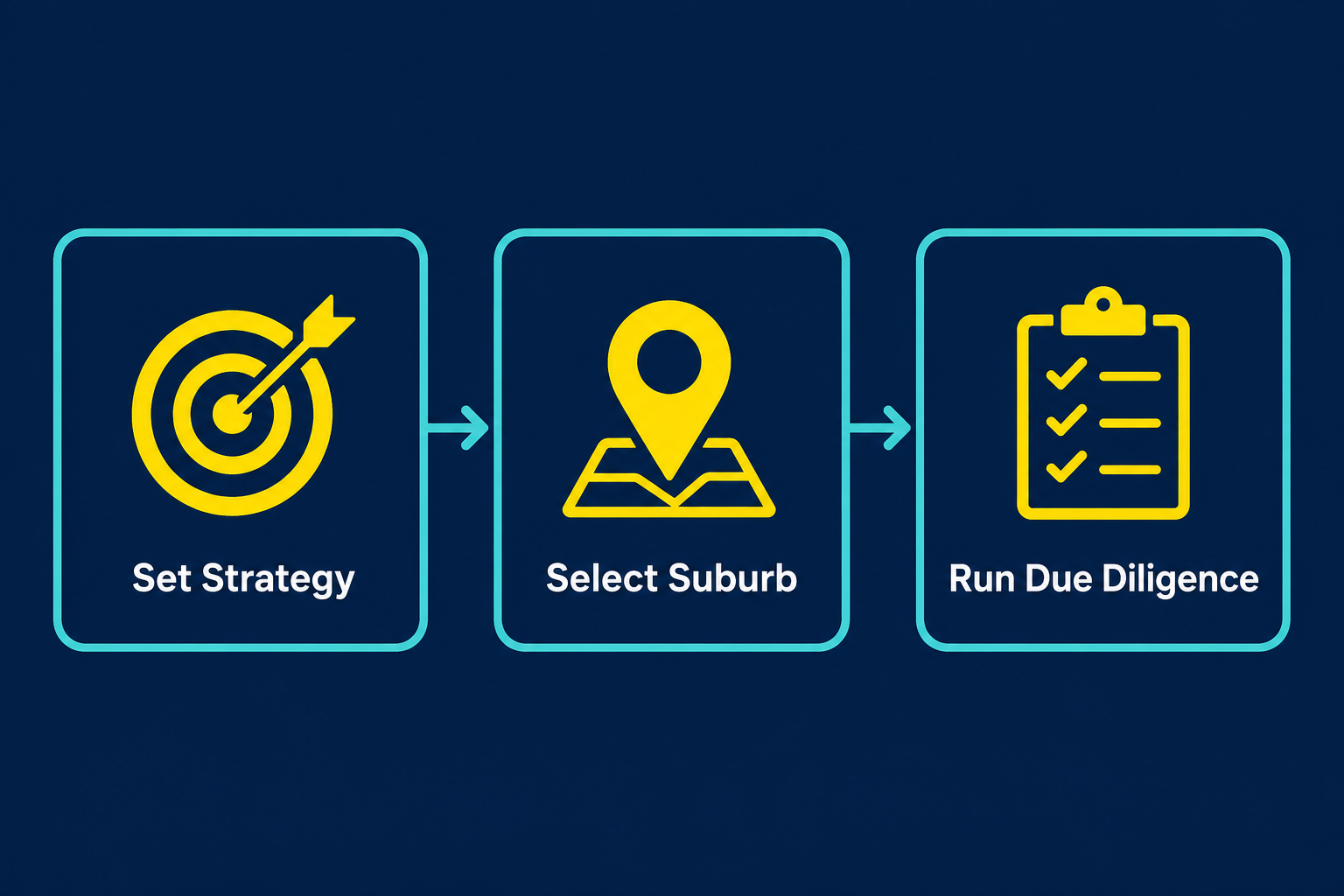
A genuine property investment strategy answers specific questions before you search: Are you prioritising capital growth or rental yield? What is your target hold period? How does this purchase fit within your broader property portfolio? What does your borrowing capacity look like across the next two purchases, not just this one?
Without those answers, decisions get made reactively. Investors buy what is available and justifiable rather than what genuinely fits their goals. According to ATO data, 71% of Australian rental property owners own just one property and only 6% own three or more. That stagnation rarely reflects bad markets. It usually reflects the absence of a forward-looking plan.
Strategy also determines how well a purchase survives changing conditions. In a rising-rate environment, an investor without clear cash flow targets or a defined exit pathway is far more exposed than one who modelled their position conservatively before signing contracts.
Mistake 2: Letting Emotion Override Due Diligence
Fear of missing out remains one of the most reliable ways to overpay for an average asset. When a property feels exciting, when the open home is busy, when the agent signals competition, the emotional response can override objective assessment very quickly.
This is compounded in 2026 by headline-driven investing. As one analysis of common location mistakes put it, by the time a suburb appears in a "top 10" list, the opportunity has typically already peaked and competition has pushed prices to reflect it.
Emotional traps to watch for include:
- Skipping or rushing the building and pest inspection to avoid losing the property
- Accepting vendor narrative about rental demand without checking vacancy data independently
- Bidding beyond your pre-set limit at auction because the atmosphere made it feel reasonable
- Anchoring on recent comparable sales without accounting for the quality difference between properties
Disciplined investors set their maximum price and their non-negotiable due diligence checklist before they inspect. The process should not change based on how a property makes you feel on the day.
Mistake 3: Overlooking Total Purchase Costs and Holding Costs
A property purchase has two financial realities: the price on the contract, and the total cost of ownership. Conflating the two is a reliable way to find yourself in a worse cash flow position than you planned.
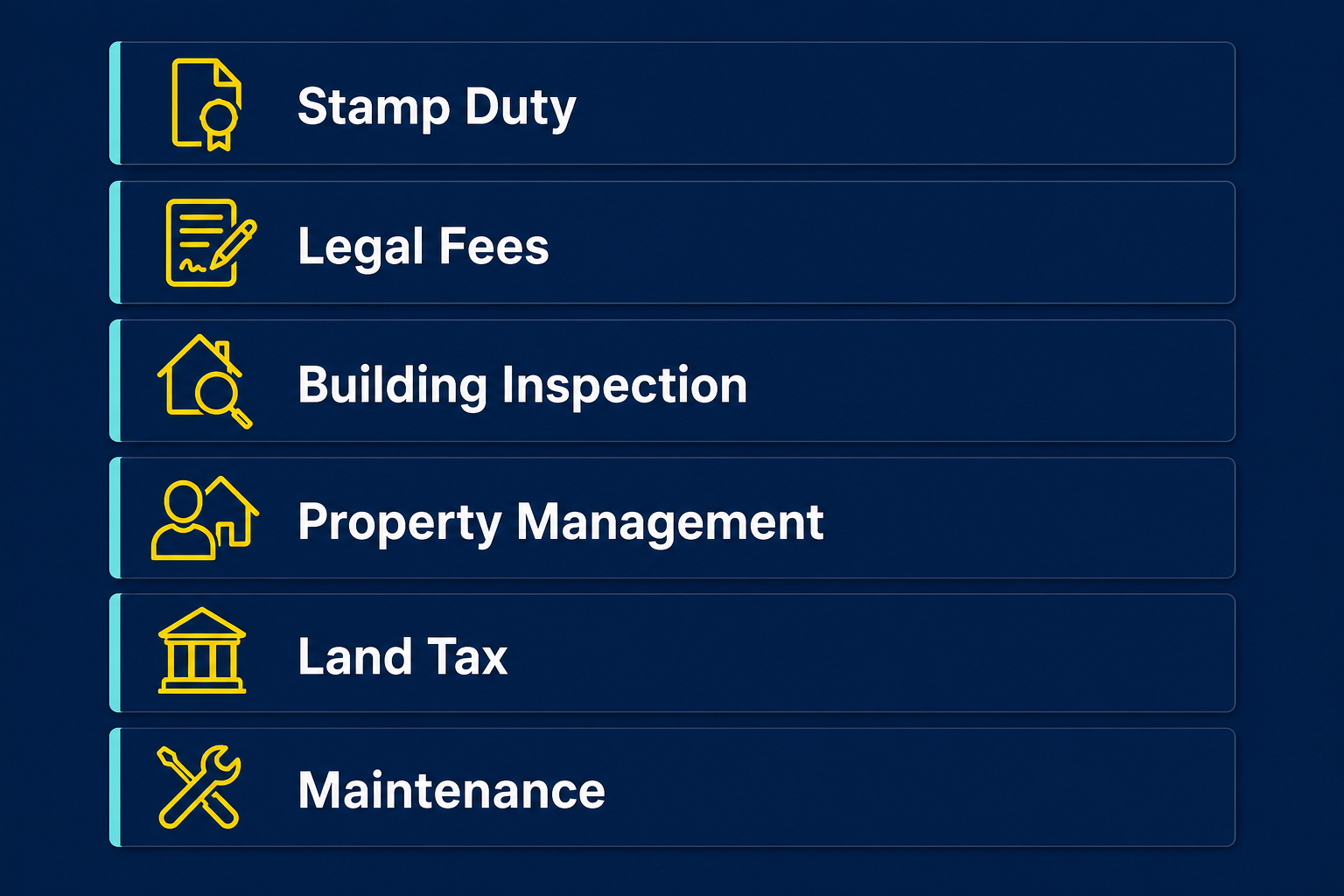
On the acquisition side, stamp duty alone on a $750,000 investment purchase in NSW sits at approximately $28,000, and that amount must be paid in cash at settlement, separate from your deposit. Stamp duty is not immediately tax-deductible; it forms part of your CGT cost base and is only relevant at sale. Conveyancing fees, building inspections, and loan establishment costs add further to your real buy-in figure. You can review state-specific stamp duty obligations through the relevant state revenue offices before budgeting.
On the holding side, investors frequently underestimate:
- Land tax once portfolio thresholds are reached (which can add $2,000 to $15,000 per year)
- Property management fees, typically 7% to 10% of gross rent
- Vacancy periods between tenancies
- Maintenance and capital works that accelerate with older stock
- Insurance, council rates, and body corporate levies where applicable
With the RBA's tightening cycle adding direct pressure to debt servicing costs, investors who modelled cash flow at lower rate assumptions in 2024 or early 2025 may now be carrying properties that are materially more expensive to hold than originally projected. Building a cash buffer of at least three months of holding costs before settlement is a minimum safeguard, not a luxury.
| Cost Category |
Typical Range |
Notes |
| Stamp duty |
3% to 5% of purchase price |
State-dependent; not immediately deductible |
| Conveyancing and legal fees |
$1,500 to $3,000 |
Both purchase and sale |
| Building and pest inspection |
$500 to $1,200 |
Essential; never optional |
| Property management fees |
7% to 10% of gross rent |
Plus letting fee and admin costs |
| Land tax (annual) |
$2,000 to $15,000+ |
Triggered once portfolio thresholds are exceeded |
| Maintenance and capital works |
1% of value per year (estimate) |
Higher for older stock |
Mistake 4: Choosing the Wrong Suburb or Property Type
Suburb selection is where many investors feel confident and where the most costly errors actually occur. The problem is rarely a lack of information; it is how that information is interpreted and which signals are prioritised.
Chasing headlines is the most visible version of this mistake. By the time a market appears in a widely shared growth list, the smart money has often already moved. Competition has increased, yields have compressed, and the asymmetric opportunity that made the location attractive has largely been absorbed into pricing.
The deeper issue is buying a property that does not match your actual investment objectives. A high-yield regional asset may suit an investor focused on cash flow but create problems for someone who needs strong capital growth to unlock equity for their next purchase. An inner-city apartment may seem prestigious but carry body corporate risk, oversupply exposure, or land content that limits long-term growth.
PropTrack data from Q1 2025 shows the median weekly advertised rent across Australia increased 5% year-on-year to $630 per week, but that national average masks significant variation between markets. Choosing a suburb based on broad market commentary rather than suburb-level vacancy rates, population growth drivers, infrastructure pipeline, and comparable sales trends is a structural error that no amount of property management can fix.
For a framework on finding markets that actually fit your goals, the top investment hotspots and strategies for 2026 offer useful context on where conditions are currently supportive.
Mistake 5: Missing Key Due Diligence Checks
Due diligence is not a box-ticking exercise. It is the process through which a competent investor confirms that a property is what it appears to be, at the price being asked, in the context of the suburb it sits in.
Common gaps in the due diligence process include:
- Building and pest inspection: Skipping or downgrading to a cheaper report to save time or money. A structural defect or active termite presence can cost tens of thousands of dollars after settlement.
- Strata records: For units and townhouses, not reviewing the owners corporation minutes for disputes, pending special levies, or deferred maintenance.
- Rental demand verification: Accepting an agent's rental appraisal without checking current comparable listings, days on market for rentals, and the suburb's vacancy rate independently.
- Comparable sales analysis: Relying on the vendor's evidence rather than running your own assessment of recent sales for genuinely comparable stock.
- Exit flexibility: Not considering who buys this type of property in this suburb, what conditions trigger demand, and whether the asset has resale appeal beyond investors.
For investors who want a structured approach before committing, a thorough property investment due diligence checklist covers the key steps across each stage of the purchase process.
Mistake 6: Relying on Outdated or One-Size-Fits-All Advice
Property investment advice that served investors well in 2019 or even 2022 may be actively misleading in 2026. Market conditions, tax policy, lending rules, and suburb dynamics change materially over time, and generic rules of thumb rarely account for the specifics of a current market or an individual investor's situation.
Examples of outdated thinking that create real risk in 2026:
- Assuming negative gearing will remain unchanged as a wealth-building tool, without accounting for the restrictions taking effect from July 2027
- Applying gross yield benchmarks from a lower-rate environment without stress-testing cash flow at current mortgage rates
- Treating a blanket "buy houses over apartments" rule as reliable, when in some markets units are outperforming on both yield and growth due to affordability constraints
- Following suburb recommendations from advisors who have not actively transacted in that market in the past 12 to 18 months
The Australian property market does not move as a single entity. Sydney and Melbourne have both recorded value declines from their recent peaks, while other markets remain more resilient. Advice needs to reflect actual current conditions, not a generalised view of what property typically does over the long run.
For context on how 2026 conditions are reshaping the investor opportunity set, the Australian property market investor guide for 2026 is a useful reference point.
How a Strategy-Led Buyers Agent Can Help Reduce These Mistakes
Each of the six mistakes above shares a common thread: they are most likely to occur when an investor is making decisions alone, under time pressure, and without independent, buyer-side expertise.
A qualified buyers agent works exclusively for the purchaser. Their role is to keep the acquisition aligned to a defined strategy, conduct rigorous due diligence, assess suburb fundamentals without the conflict of a sales commission, and negotiate from a position of market knowledge rather than emotion.
Dragan Dimovski, the principal of Buyers Agency Australia, brings over 20 years of experience to every client engagement. The team's approach begins with a strategy session before any property search begins, ensuring every purchase decision is filtered through the investor's actual goals, cash flow tolerance, and portfolio trajectory.
Beyond the research and negotiation process, buyers agents with strong market networks can also access off-market properties that never reach the public portals. This matters in a competitive market where the best-located, tightly held assets rarely sit on Domain or realestate.com.au for long. If you want to understand what that process looks like in practice, the team's guide on how off-market properties are sourced in Australia is worth reading.
For investors who have already experienced one or more of the mistakes in this guide, the how first-time investors avoid costly mistakes using a buyers agent resource outlines how professional representation changes outcomes at every stage of the process.
If you are ready to book a free strategy session and map out a more disciplined approach to your next purchase, the team can work through your goals, current market conditions, and the options available to you before you commit to anything.
Checklist: What to Review Before You Buy in 2026
Before exchanging contracts on any investment property, run through the following:
Strategy and goals
- Is this purchase aligned to a written investment strategy?
- Does the asset type and location match your growth or yield objective?
- Have you modelled this purchase alongside your next one, not in isolation?
Finance readiness
- Is your pre-approval current and stress-tested at a rate at least 3% above your current variable rate?
- Have you budgeted for stamp duty, legal fees, inspections, and a cash buffer, separate from your deposit?
- Do you understand how this purchase affects your borrowing capacity for the next property?
Suburb and asset selection
- Have you reviewed suburb-level vacancy rates, not just national rental data?
- Have you assessed comparable sales from the past 90 days for genuinely similar stock?
- Does the property type have broad buyer appeal at resale, beyond investor demand?
Due diligence
- Has a qualified building and pest inspector assessed the property?
- For strata properties, have you reviewed the owners corporation minutes and a depreciation schedule?
- Have you obtained your own rental appraisal, independent of the selling agent?
Negotiation and settlement
- Do you have a maximum price set before the first offer or auction, based on comparable evidence?
- Have you factored in any conditions, subject to finance, subject to inspection, that protect your position?
- Is there a clear timeline from exchange to settlement that aligns with your finance approval expiry?
| Review Area |
Key Question |
Done? |
| Strategy |
Does this fit my portfolio plan? |
☐ |
| Finance |
Am I stress-tested at 4.35%+? |
☐ |
| Suburb |
Have I checked vacancy and comparable sales? |
☐ |
| Building |
Is the inspection report from a qualified professional? |
☐ |
| Costs |
Have I modelled stamp duty, land tax, and holding costs? |
☐ |
| Exit |
Who buys this asset and under what conditions? |
☐ |
Conclusion: Smarter Buying Starts Before the Search Begins
The most effective way to avoid costly property investment mistakes is not to buy faster or with more confidence. It is to establish a clear strategy, apply a consistent due diligence process, and make decisions based on current data rather than market narrative.
In 2026, with the RBA cash rate elevated, tax policy shifting, and market performance diverging sharply between cities and suburbs, the gap between a well-researched purchase and a reactive one is wider than it has been for years. Investors who take the time to understand the 2026 market environment and build their process around evidence rather than emotion are the ones who will build lasting portfolio value.
Buyers Agency Australia supports investors at every stage, from initial strategy through to settlement, with a national footprint and the depth of market knowledge to find and negotiate the right assets in the right locations.
If you want a second opinion on your current approach, or you are preparing for your next purchase, map out your next property move with the team in a free strategy session. To get started directly, contact the team and outline where you are in your investment journey.
Frequently Asked Questions
What is the biggest property investment mistake Australians make in 2026?
Buying without a clear investment strategy is the most common and costly mistake, as it leads to mismatched assets, poor suburb selection, and weak cash flow outcomes.
How do interest rate rises affect property investors in 2026?
The RBA's cash rate of 4.35% increases debt servicing costs, reduces borrowing capacity, and can turn a marginally positive cash flow position into a negative one if not modelled carefully.
What due diligence should I do before buying an investment property?
At minimum: a building and pest inspection, independent rental appraisal, comparable sales review, strata records check for units, and a full cost model covering stamp duty, land tax, and holding costs.
How does a buyers agent help investors avoid mistakes?
A buyers agent provides independent research, suburb analysis, and negotiation support without a sales commission conflict, keeping every decision aligned to your strategy rather than the vendor's interest.
Will the 2026 tax changes affect my investment property decision?
Yes. From 1 July 2027, negative gearing on established properties purchased after 12 May 2026 will be restricted, and the 50% CGT discount replaced. Understanding these changes is essential to any current purchase decision.
 General
With the RBA cash rate at 4.35% and sweeping tax changes on the horizon, avoidable mistakes are costing...
Australian property investors in 2026 face a more complex but still opportunity-rich market. The headline cycle has shifted – rate hikes returned, tax changes are coming, and some capital city markets are softening – yet structural undersupply, tight rentals, and long-run demographic tailwinds continue to reward investors who lead with strategy rather than sentiment. This guide breaks down the eight most important trends shaping smart acquisition decisions right now.
Introduction: What Smart Australian Investors Are Prioritising in 2026
The property conversation in 2026 has moved beyond simple questions about interest rates or which city is "hot." Serious investors are asking sharper questions: Which fundamentals actually hold up through a rate cycle? Where does cash flow still make sense without compromising growth? How do I sequence my next purchase within a broader plan?
Those questions matter more than ever. Buyers Agency Australia has observed that the clients who enter 2026 with the clearest investment frameworks are best positioned to act decisively when the right asset appears. The noise around the market is loud; the right property investment strategy cuts through it.
Capital city housing prices rose 7.3% in 2025 before the RBA's rate hike cycle resumed, according to ANZ's February 2026 Australian Housing Outlook. That growth has moderated into 2026 as borrowing capacity tightens, but property hasn't stopped performing for disciplined buyers. The divide is widening between markets and between investors – and that gap is where strategy lives.
1. Growth-Focused Suburbs with Strong Long-Term Fundamentals
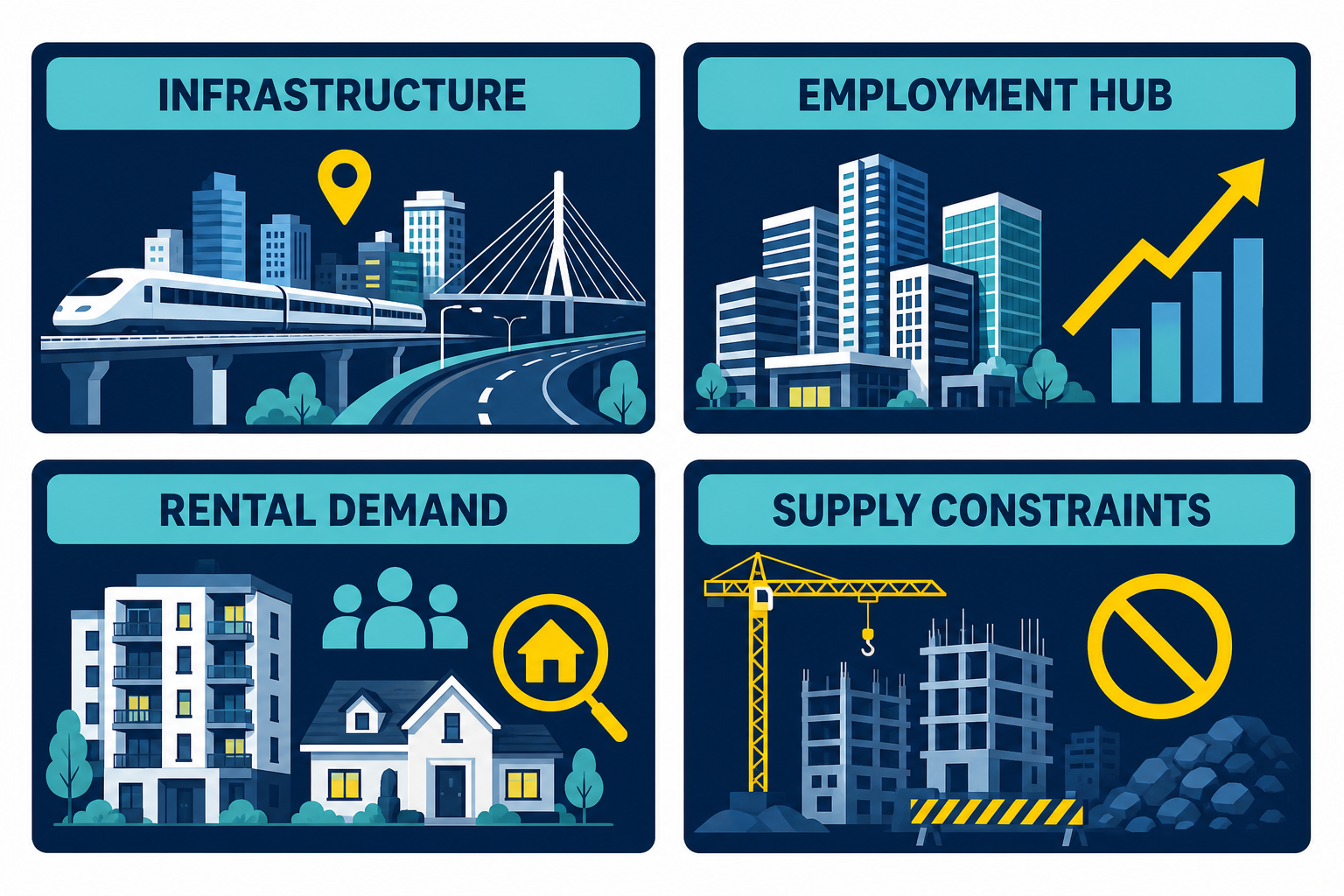
The most consistent investors in 2026 are not chasing suburbs that have already run hard. They are identifying locations where the underlying drivers – employment diversity, infrastructure investment, and amenity – create durable demand regardless of short-term rate noise.
Key indicators worth examining include proximity to major employment hubs, planned transport corridors, hospital and university precincts, and population growth supported by genuine job creation rather than lifestyle migration alone. Perth continued to record some of the strongest listed stock shortfalls nationally, with advertised listings sitting around 40% below the five-year average, maintaining upward pressure on values despite affordability constraints.
Understanding how professional buyers agents analyse growth suburbs using data rather than headlines gives investors a practical framework for filtering noise from signal. The best suburbs in 2026 are not always the most talked-about ones.
2. Cash Flow Remains Important, but Selection Is More Nuanced
With the RBA cash rate sitting at 4.10% as of May 2026, holding costs are a real consideration for every investor. But the response to that pressure is not to chase the highest gross yield at the expense of everything else – it is to select assets where yield and growth potential overlap.
Nationally, rents are up 5.7% over the year to April 2026, according to Cotality's latest rental data, and the vacancy rate remains at 1.6% – well below the historical average of 2.5% to 3.3%. That rental tightness means well-chosen assets can generate meaningful income, but yield alone does not guarantee growth. Investors who understand the capital growth versus cash flow trade-off are better placed to build a portfolio that works across multiple rate environments.
No return can be guaranteed. What can be controlled is the research process, the location selection, and the asset quality that underpins both income and long-run value.
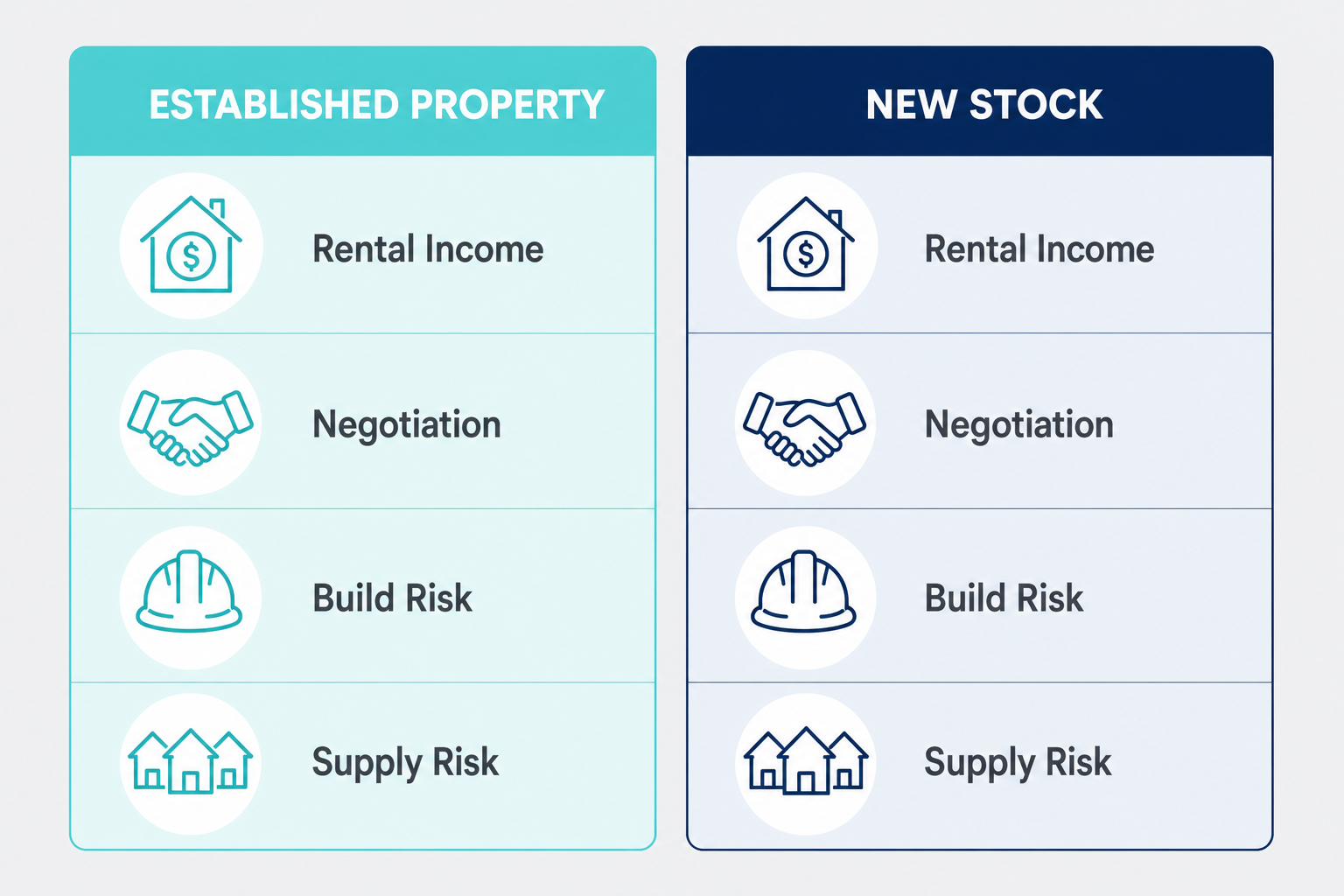
3. Established Properties Versus New Stock
The debate between established and new dwellings has gained fresh relevance in 2026 as build costs remain elevated and construction timelines stay stretched. For most investors with a capital growth focus, established properties continue to represent the preferred path.
Established homes typically offer known condition, immediate rental income, and negotiable pricing – particularly as vendor discounting has widened to a median of 3.1% across combined capitals. New stock, including off-the-plan apartments and house-and-land packages, may suit investors seeking specific depreciation profiles or targeting government incentives, but valuations at settlement, builder risk, and supply concentration in certain corridors deserve careful scrutiny.
| Factor |
Established Property |
New / Off-the-Plan |
| Rental income |
Immediate |
Delayed until completion |
| Negotiation |
Typically flexible |
Limited |
| Depreciation |
Reduced |
Higher in early years |
| Build risk |
None |
Completion and valuation risk |
| Supply risk |
Usually lower |
Higher in certain corridors |
As Buyers Agency Australia approaches property selection, established assets in proven locations remain the starting point for most investor briefs – particularly for those building a property portfolio with repeatable acquisition logic.
4. Unit Markets in Selected Locations Are Attracting Attention
For many years, the conventional investor wisdom favoured houses over units. That preference remains valid in many contexts, but 2026 is producing genuine exceptions. Brisbane units surged 20.3% year-on-year to February 2026, outpacing even Brisbane houses at 14.6%, according to PropTrack and Cotality data.
The structural shift is driven by affordability pressure. As median house prices climb past $1 million in Brisbane, Adelaide, and Perth, well-located units and townhouses are absorbing demand from buyers who cannot reach the house median. Three factors make certain unit markets worth examining: lower entry price within desirable suburbs, tighter vacancy rates in the unit sector specifically (1.5% nationally), and growing tenant demand from smaller households and young professionals.
Selection still matters enormously. Oversupplied corridors, high body corporate levies, short-term let saturation, and poor floor plans can erode returns. The question is not whether to buy a unit but whether the specific building, location, and price point represent a credible case for growth and income.
5. Off-Market Opportunities Still Matter for Serious Buyers
Off-market access is frequently overstated as a guaranteed advantage. In reality, it is one input within a disciplined acquisition process – but a meaningful one when the market is competitive and listed stock sits well below average.
When an investor has a clearly defined brief, a trusted agent network, and the capacity to act quickly on a well-priced property, off-market opportunities can reduce competition and occasionally allow a negotiated outcome that would not be available at public auction. The off-market property landscape is not a secret pipeline of discounted assets – it is a relationship-driven channel that rewards preparation over opportunism.
For investors working within a fixed budget and a specific brief, Buyers Agency Australia maintains active agent relationships across multiple markets to surface properties before they are formally listed. That access matters most when on-market competition is fierce and speed is an advantage.
If you want to understand how that process works in practice, book a free strategy session to discuss your brief and buying timeline.
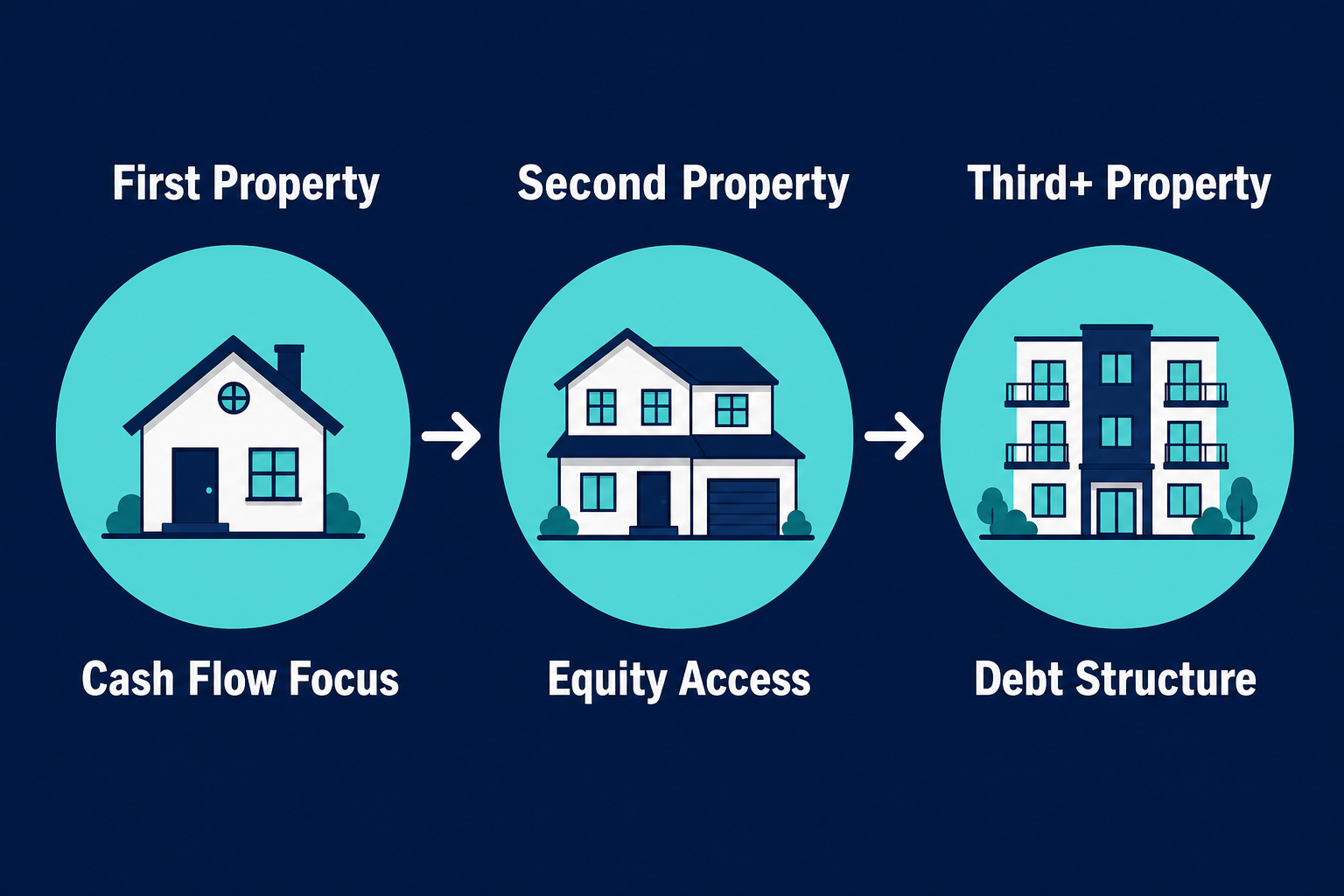
6. Portfolio Sequencing and Equity Recycling
One of the clearest differences between investors who build wealth through property and those who stall is how intentionally they sequence each purchase. A single investment property is a start; a considered portfolio is a plan.
Equity recycling – the practice of drawing on grown equity in existing assets to fund future deposits – requires accurate valuation awareness, lending capacity planning, and a clear view of where each next purchase fits within the overall strategy. The smart investors turning one property into five are not doing so by accident. They are working within structured plans that account for serviceability, cash flow buffer, and hold periods across the portfolio.
In 2026, with serviceability buffers set at 3% above the actual lending rate under APRA guidelines, the capacity to service additional debt is a real constraint. Portfolio sequencing that accounts for cash flow, equity position, and timing is not optional – it is the difference between compounding and stalling.
| Portfolio Stage |
Key Consideration |
Common Mistake |
| First property |
Cash flow sustainability |
Ignoring holding costs |
| Second property |
Equity access and serviceability |
Buying too soon or too late |
| Third+ property |
Debt structure and diversification |
Concentrated market exposure |
Read More: Why Property Investment Strategy Matters More Than Picking The Right Suburb
7. Regional Markets with Clear Demand Drivers
Not all regional markets are equal, and the investors doing well in regional Australia in 2026 are highly selective. The difference between a regional market that outperforms and one that disappoints often comes down to two factors: genuine employment diversity and constrained supply.
Regional values have risen 51.1% over five years nationally, compared to 33.7% across combined capitals, according to Cotality data. That long-run outperformance reflects the structural affordability advantage of regional markets and the genuine migration that followed it. However, some of that growth was driven by pandemic-era migration that has partially reversed, and not every regional market has the job base to sustain price levels or rental demand independently.
Markets anchored by university towns, defence facilities, mining services, health campuses, or logistics corridors tend to show more durable fundamentals than those relying on lifestyle migration alone. Investors entering regional markets in 2026 should assess vacancy rates, days on market, and council planning pipelines before committing. The two-speed property market of 2026 is visible in the regional space as much as the capitals.
8. Due Diligence and Negotiation Are More Important Than Ever
In a market where vendor discounting is widening and buyer sentiment is more cautious, due diligence and negotiation discipline are delivering real results for prepared investors. But the same environment that rewards careful buyers also punishes those who cut corners.
Pre-purchase due diligence in 2026 should cover building and pest inspections, strata records where applicable, title searches, flood and contamination overlays, council zoning and planning notices, and a clear view of comparable sales. Skipping any of these steps in a slower market can leave investors exposed to conditions that would have been priced in during a competitive market.
Negotiation is a skill, not just a tactic. Understanding a vendor's motivation, the days on market, and the local comparable evidence allows a buyer to make a calibrated offer rather than a speculative one. For investors who lack negotiation experience or market-specific knowledge, the cost of overpaying typically dwarfs any advisory fee paid to get the process right.
Dragan Dimovski brings 20+ years of property investment experience to every acquisition, ensuring that due diligence and negotiation are handled with the rigour that protects both the purchase price and the long-term investment case.
How Buyers Agency Australia Helps Investors Act Strategically
The eight trends above share a common thread: they all reward preparation, data literacy, and a clear investment framework. That is exactly what Buyers Agency Australia provides for investors across Sydney, Brisbane, Melbourne, Perth, Adelaide, and beyond.
The team's approach combines data-led suburb analysis, off-market property access, and a structured end-to-end process that covers strategy, research, negotiation, due diligence, and settlement support. Rather than reacting to market headlines, the process starts with each investor's goals, timeline, and risk profile – then works backwards to identify the assets that fit.
For investors looking at their next purchase within a broader portfolio plan, the top investment hotspots and strategies for 2026 offer a useful starting point for market context. And for those wanting to understand whether the Australian property market is positioned for further growth, that deeper analysis is available alongside a personalised conversation about your situation.
Conclusion: Focus on Strategy, Not Headlines
The best property investment decisions in 2026 will not be made by investors who correctly predicted the RBA's next move or picked the suburb that generated the most media coverage. They will be made by investors who understood their own goals, built a coherent property investment strategy around them, and executed that strategy with discipline.
Market conditions change. Interest rates move. New tax rules arrive. What does not change is the underlying logic that well-researched, well-purchased assets in locations with genuine demand drivers compound wealth over time.
If you are ready to map out your next property move with a team that has seen these cycles before, book a free strategy session with Buyers Agency Australia. For direct enquiries, contact the team to discuss your situation and next steps.
Frequently Asked Questions
What is the most important factor in a property investment strategy in 2026?
Location fundamentals – employment, infrastructure, and supply constraints – matter more than timing the market or chasing recent price performance.
Are units a good investment in Australia in 2026?
Selected unit markets, particularly in Brisbane and supply-constrained capital city suburbs, are attracting genuine investor interest as affordability pressure shifts demand.
How does off-market property access help investors?
Off-market access reduces auction competition and can allow negotiated pricing, but it works best within a clearly defined brief and active agent network, not as a standalone strategy.
What is equity recycling in a property portfolio?
Equity recycling involves drawing on grown equity in existing properties to fund deposits for future purchases, allowing portfolio growth without solely relying on savings.
How important is due diligence before buying an investment property?
Essential. Building reports, title checks, zoning overlays, and comparable sales analysis protect against overpaying and reveal risks that are not visible in a listing description.
 General
Australian property investors in 2026 face a more complex but still opportunity-rich market. This guide breaks down the...
The deposit question trips up more aspiring investors than almost any other. The real answer in 2026 is not a single number — it depends on your lender, your existing assets, the property type, and how you plan to structure the purchase across your broader portfolio.
How much deposit do you really need in 2026?
Most first-time investors arrive at this question expecting a clean answer. In reality, deposit requirements for investment properties sit at a crossroads of lender policy, loan-to-value ratio (LVR) rules, regulatory settings, and individual financial position.
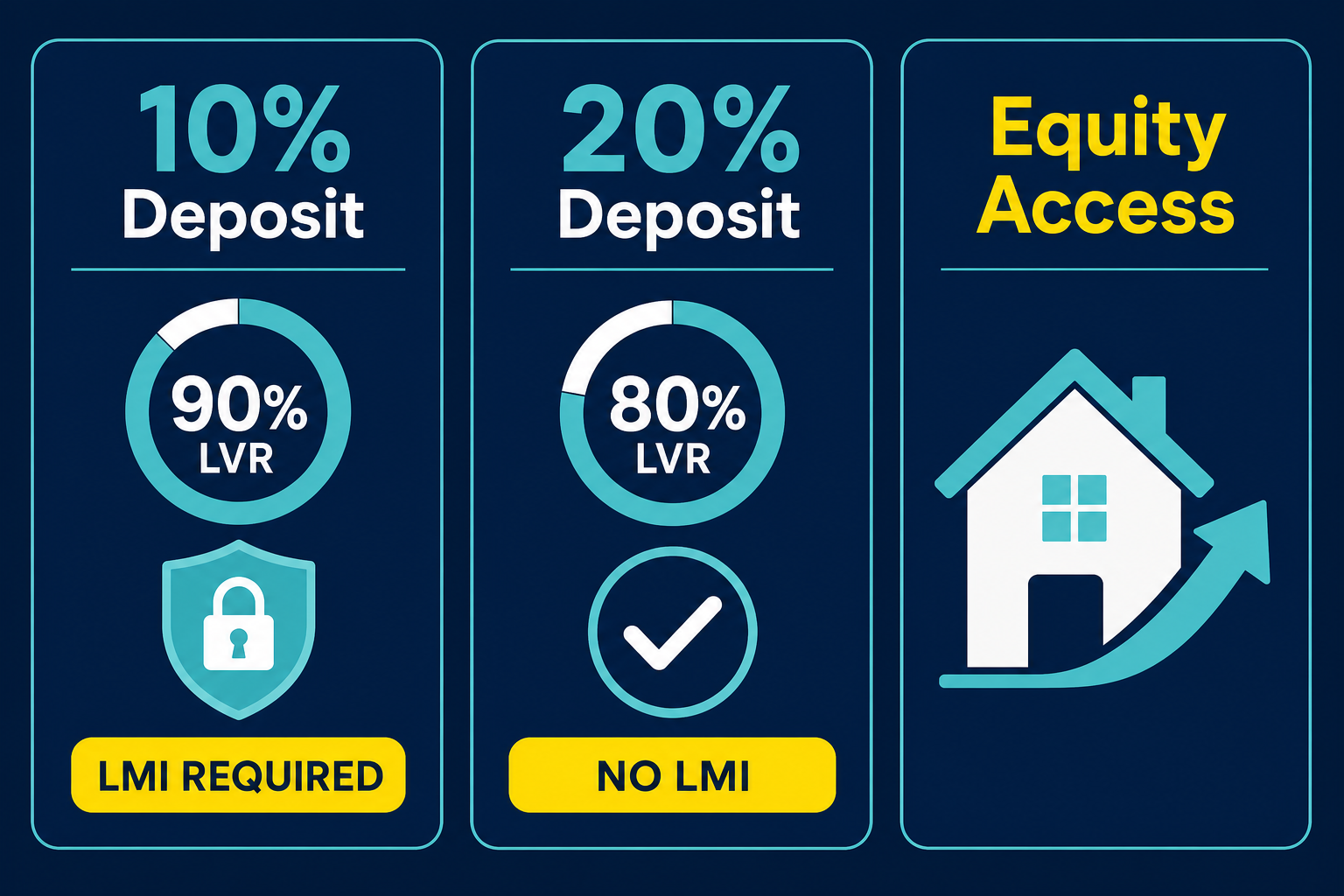
The headline benchmark most lenders work toward is 20% of the purchase price, which delivers an 80% LVR loan and avoids Lenders Mortgage Insurance (LMI). At the national median dwelling value of approximately AUD 922,838 as of early 2026 — according to Cotality's Home Value Index — that translates to a deposit of roughly $185,000 before you account for a dollar of transaction costs.
Investment lending carries additional weight compared to owner-occupied purchases. Lenders treat investment properties as higher-risk assets because, statistically, an investor is more likely to sell an investment property during financial hardship than their family home. That view flows directly into stricter LVR caps, higher interest rates, and tighter serviceability assessments.
From 1 February 2026, APRA also activated a new debt-to-income (DTI) lending cap, limiting banks to writing no more than 20% of new investment loans at a DTI of six times income or higher. The 3% mortgage serviceability buffer has also been retained, meaning lenders assess your ability to repay at a rate roughly three percentage points above your actual loan rate. These settings do not make investing impossible — but they make planning non-negotiable.
For investors considering the deposit question for the first time, understanding how much is genuinely required to buy an investment property is the starting point — not just the percentage, but the full cash requirement including costs.
The main deposit benchmarks investors should know
There are three deposit levels that matter in practice for Australian investment property buyers in 2026:
| Deposit Level |
LVR |
LMI Required? |
Notes |
| 10% of purchase price |
90% |
Yes |
Minimum practical level; LMI premium substantial for investors |
| 20% of purchase price |
80% |
No |
Standard benchmark; cleanest path to approval |
| 20%+ using equity |
Varies |
No (if structured correctly) |
Most common path for existing property owners |
A 10% deposit is achievable with most lenders, but LMI applies and the premium at 90% LVR for an investment loan is meaningfully higher than for an owner-occupier at the same ratio. On a $700,000 investment purchase, LMI at 90% LVR can reach approximately $24,000 — a cost that can be capitalised onto the loan but still increases your total debt and repayments.
A 20% deposit removes LMI entirely and gives lenders more confidence in the application. It also typically unlocks lower interest rates, since most lenders price investor loans at 80% LVR more favourably than higher-LVR tiers.
For investors who already own a property, using equity as the deposit is by far the most common path. The usable equity formula is straightforward: current property value multiplied by 80%, minus the outstanding mortgage balance. If that figure comfortably covers the deposit and costs on the target property, many buyers enter the investment market without saving additional cash at all. This approach is explored in detail in our guide on how property investors use equity to buy multiple properties.
The first home buyer deposit concept is worth clarifying here: government guarantee schemes like the First Home Guarantee allow eligible owner-occupiers to purchase with as little as 5%, but these programs are exclusively for properties you intend to live in. They do not apply to investment purchases.
Why the right deposit amount is not just about the percentage
Two investors with the same deposit percentage can face very different outcomes at the lender's desk. Serviceability — your ability to meet repayments under stress-testing conditions — carries as much weight as deposit size in 2026's lending environment.
Lenders shade rental income, typically accepting only 70–80% of the gross rent when calculating your income for the application. They then apply the 3% serviceability buffer on top of the actual loan rate. For an investor carrying existing mortgage debt, that buffer applies to both the new investment loan and the existing home loan balance, which is why property investors often see their borrowing capacity reduced more significantly than owner-occupiers under current APRA macroprudential settings.
Income stability and structure matter too. A PAYG employee with a clean credit file and no other investment debt faces a simpler serviceability picture than a self-employed investor with complex income or an existing portfolio. Employment type, declared living expenses, and any credit card limits (not just balances) all feed into the calculation.
The source of your deposit also carries weight. Lenders assess whether funds are genuinely saved, gifted, or drawn from equity — and for investment loans, a pattern of consistent saving or demonstrated asset growth tends to support stronger applications. Checking your first home buyer schemes and how they affect your budget can also clarify what options are available at different price points.
For investors with existing portfolios, the DTI cap active from February 2026 means those approaching six times gross income in total debt need to carefully consider which lender to approach and when, since not all institutions will be at the same quarterly allocation at any given time.
Extra costs to budget for beyond the deposit
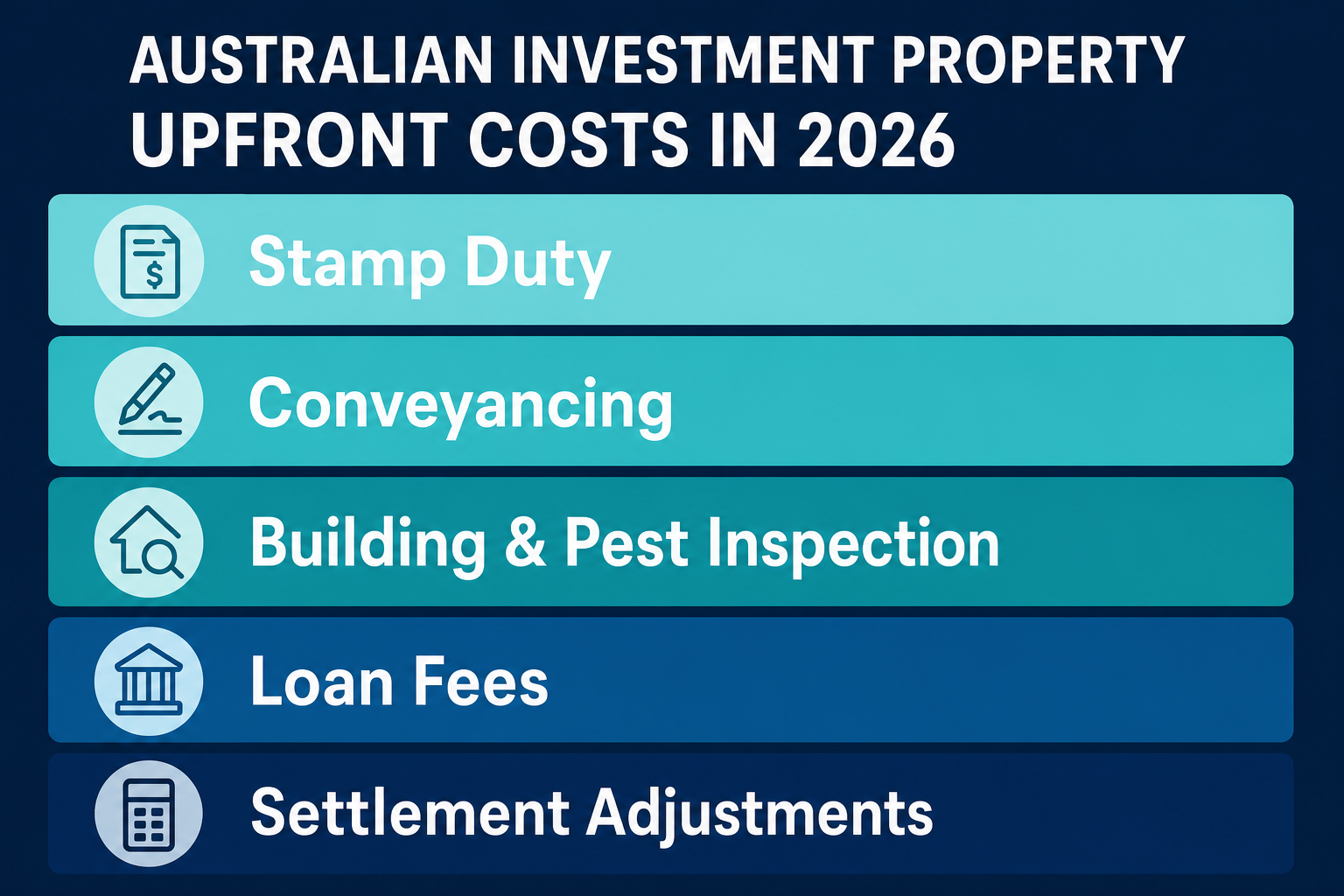
One of the most consistent mistakes first-time investors make is treating the deposit as the total cash required. In practice, a 20% deposit on a $700,000 investment property ($140,000) needs to be accompanied by an additional $30,000 to $40,000 for transaction costs — and that figure is not negotiable.
Here is what to plan for:
- Stamp duty (transfer duty): The single largest transaction cost, typically 3–5% of the purchase price depending on your state. Investment purchases receive no first home buyer concessions. On a $700,000 property in NSW, stamp duty runs to approximately $26,857, while in Victoria the figure on the same price point is higher. Queensland's rates are among the lowest nationally. Use each state's revenue office calculator for an accurate figure before committing.
- Conveyancing and legal fees: $1,500–$3,000 for a standard residential purchase.
- Building and pest inspections: $500–$800, and non-negotiable for established properties.
- Loan establishment fees: Vary by lender and product; often $300–$600.
- Settlement adjustments: Council rates, water rates, and strata levies may be pro-rated at settlement.
- Landlord insurance: Not a settlement cost, but should be in place from day one.
The combined picture on a $700,000 investment property in NSW is typically $165,000 to $175,000 in total cash required — not $140,000. Planning around the headline deposit alone creates a genuine shortfall risk at settlement.
Our property investment due diligence checklist covers what to verify before exchange, including the cost items that can catch first-time investors off guard.
How deposit size can affect your investing options
A larger deposit does more than reduce your borrowing cost. It affects which lenders will consider your application, which property types you can target, and how much flexibility you retain for your next purchase.
Investors with 20% deposits and strong serviceability can typically access the full range of major bank products, which tend to carry the most competitive rates and the most predictable approval pathways. Those entering at 10% with LMI may find their lender choices narrower, especially for properties in regional locations or higher-density apartment markets, where some lenders apply lower LVR caps regardless of deposit size.
A larger upfront equity position also supports borrowing capacity planning for subsequent purchases. If you enter a property at 80% LVR and values rise meaningfully — national home values were approximately 9.9% higher year-on-year as of early 2026 — the equity growth accelerates faster in dollar terms, providing a platform for the next acquisition sooner.
That said, there is a genuine case for entering the market earlier with a smaller deposit in rising markets. Paying a $15,000–$24,000 LMI premium to buy now may compare favourably against waiting two more years as prices continue to rise. The calculus depends on the specific market, the property fundamentals, and whether your serviceability position supports the higher loan balance comfortably. Seeking property investment strategy advice before committing to one approach is time well spent.
| Purchase Price |
20% Deposit |
Estimated Stamp Duty (NSW) |
Additional Costs |
Total Cash Required (approx.) |
| $600,000 |
$120,000 |
~$21,330 |
~$5,000 |
~$146,000 |
| $700,000 |
$140,000 |
~$26,857 |
~$5,000 |
~$172,000 |
| $900,000 |
$180,000 |
~$35,835 |
~$5,000 |
~$221,000 |
Stamp duty estimates are indicative for NSW investor purchases. Other states vary significantly — Queensland and Western Australia are generally lower, Victoria is typically higher at these price points.
How buyers can prepare a stronger purchase plan
Approaching a property purchase with a clear financial map is what separates investors who execute confidently from those who stall. A few practical steps make a measurable difference:
Check your borrowing capacity before you set a price range. A pre-approval conversation with a mortgage broker — not a single lender — gives you a realistic picture of what you can borrow across multiple lenders, not just one institution's policy. This matters especially in 2026, when APRA's DTI cap means different lenders may be at very different points in their quarterly allocation. Our guide on choosing the right mortgage broker for your investment property walks through what to look for.
Clarify your serviceability position in full. List every liability: existing mortgage balances, personal loans, car finance, and every credit card limit you hold. Lenders assess limits, not balances. Reducing or closing unused credit cards before applying can improve your serviceability position noticeably.
Compare suburbs and property types against your deposit capacity. A $700,000 budget in Brisbane faces different stamp duty, different yield conditions, and different growth drivers than the same budget in Sydney or Melbourne. Understanding where your deposit goes furthest in fundamental terms — not just price — is part of building a credible strategy. Our analysis of the best suburbs to invest in Australia in 2026 provides a useful starting framework.
Consider whether off-market opportunities reduce your effective competition. In tight markets, having access to off-market properties before they reach public listing means less auction pressure and more time for due diligence — directly reducing the risk of overpaying under competitive conditions.
If this is your first investment purchase, book a free strategy session to review your numbers, clarify your capacity, and identify the right market and property type for your situation before committing funds.
When to speak with a buyers agent
Deposit planning answers the question of whether you can buy. It does not answer what to buy, where, or at what price — and those decisions carry far more long-term consequence than whether you entered at 10% or 20%.
Buyers Agency Australia works with investors across the full purchase cycle — from initial strategy and suburb selection through to due diligence, negotiation, and settlement. The team is led by Dragan Dimovski, a property expert with more than 20 years of experience, who brings a data-led, investor-first perspective to every engagement.
The value of buyer-side representation shows up clearly during three stages. First, in market selection — identifying the suburbs and asset types where your deposit and borrowing capacity are matched to the strongest risk-adjusted fundamentals, rather than the most advertised opportunities. Second, in off-market sourcing — because a meaningful share of quality investment stock changes hands before it ever reaches a public portal. Third, in negotiation — where disciplined, evidence-based offers consistently produce better purchase prices than emotional, market-pressured decisions.
For investors already in the research phase, the 2026 Australian property market outlook guide provides context on where growth and yield drivers are currently concentrated.
Ready to map out your next property move? Book a free strategy session or contact the team directly to start the conversation.
Frequently Asked Questions
What is the minimum deposit for an investment property in Australia in 2026?
The practical minimum is 10% with LMI applied. Most mainstream lenders cap investment LVR at 80%, requiring a 20% deposit to avoid LMI entirely.
Can I use equity instead of a cash deposit for an investment property?
Yes. If you own a property, usable equity — calculated as 80% of its current value minus your outstanding loan — can typically fund the deposit and costs on a new investment purchase.
Does the First Home Guarantee apply to investment properties?
No. Government low-deposit guarantee schemes are exclusively for owner-occupiers. Investment purchases require a minimum 10% genuine deposit, and no concession schemes apply.
How does the APRA serviceability buffer affect my investment deposit planning?
Lenders assess your repayment capacity at 3% above your actual loan rate. For investors with existing debt, this can significantly reduce maximum borrowing capacity, which affects the price range your deposit can support.
What upfront costs should I budget for beyond the deposit?
Stamp duty (3–5% of purchase price), conveyancing fees ($1,500–$3,000), building and pest inspections ($500–$800), loan fees, and settlement adjustments. Total costs on a $700,000 NSW investment purchase typically add $30,000–$40,000 on top of the deposit.
 General
Investing in Australian property in 2026 requires more than a headline percentage. This guide breaks down deposit benchmarks,...
The 2026 Federal Budget has rewritten two of the biggest tax settings Australian property investors have relied on for decades. If your portfolio is built around negative gearing or long-term capital growth, the rules have shifted and now is the time to understand exactly what changed, what stayed the same, and how to position yourself before the new regime takes hold.
What is changing in 2026 and why investors are paying attention
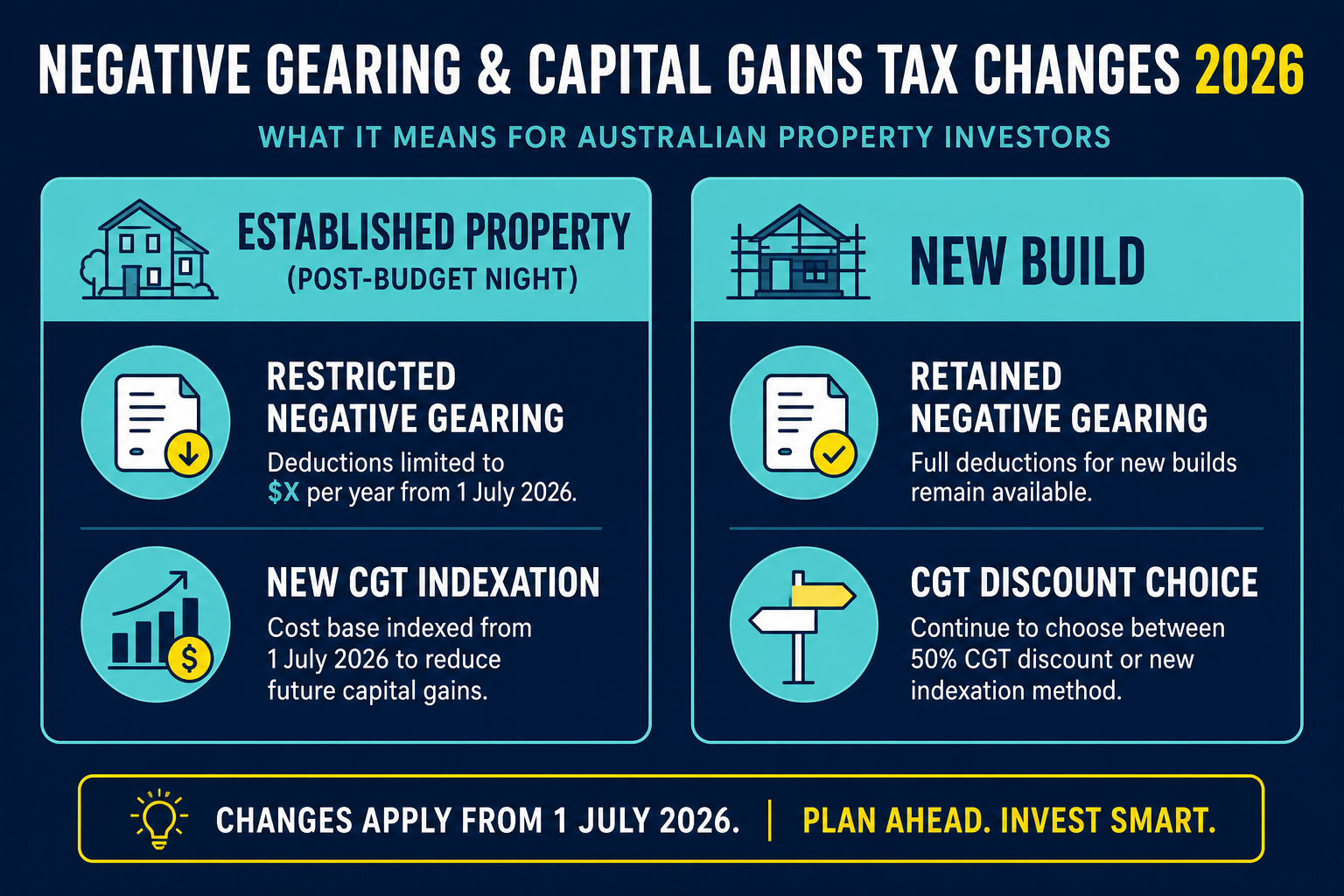
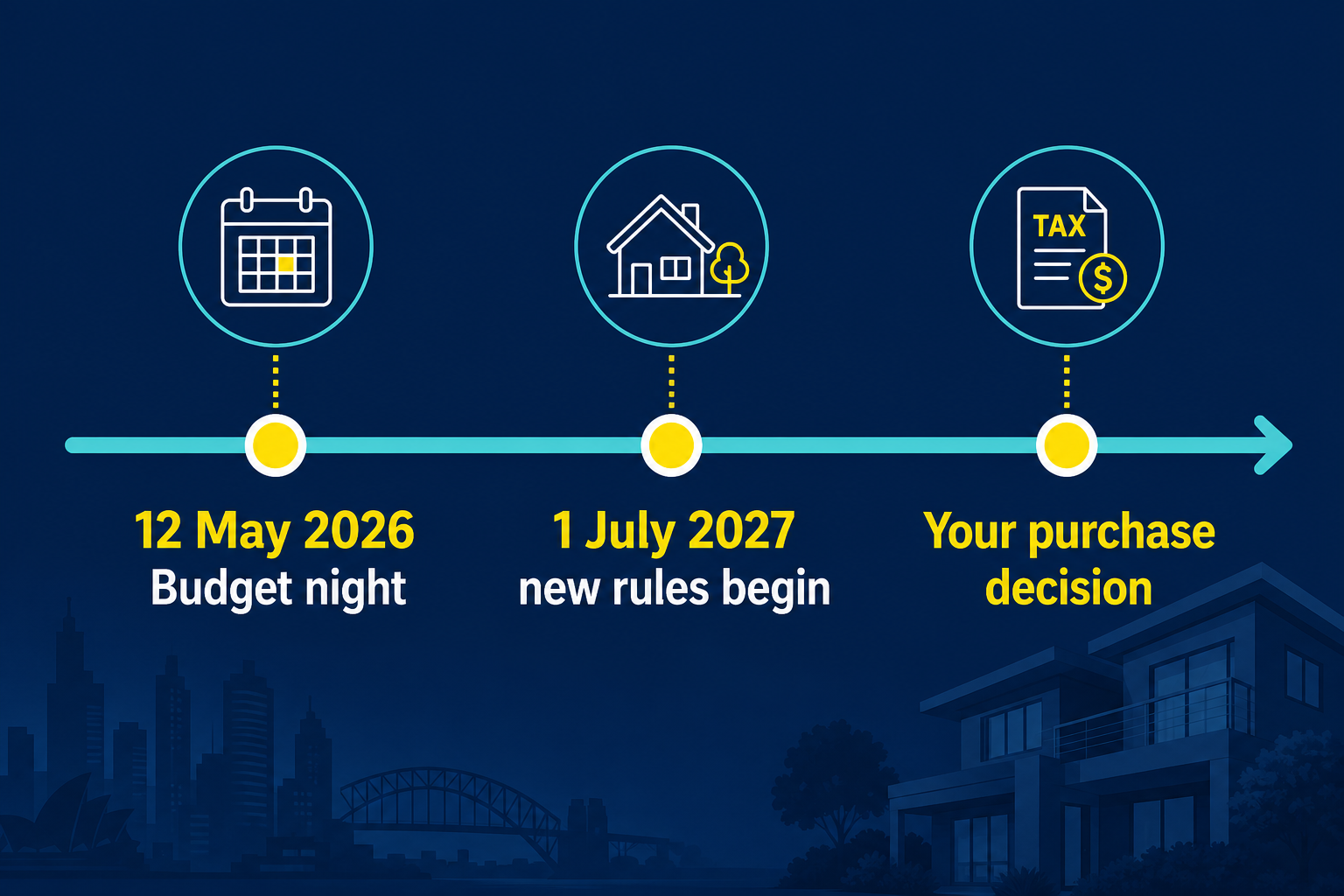
On 12 May 2026, the Federal Government announced two major reforms as part of the 2026–27 Budget. First, negative gearing on established residential properties purchased after Budget night will be restricted from 1 July 2027. Second, the 50% capital gains tax (CGT) discount will be replaced with cost base indexation and a 30% minimum tax on net capital gains, also from 1 July 2027.
These changes are not yet law — the ATO has confirmed the measures are intended to apply from 1 July 2027, subject to Parliament passing the relevant legislation. That distinction matters. Policy announcements and legislated law are not the same thing, and experienced investors know to plan thoughtfully rather than react impulsively to headlines.
Still, the direction is clear. The Federal Budget factsheet on negative gearing and CGT reform frames the changes as targeting housing affordability, with incentives deliberately steered toward new construction rather than established property. For anyone building or reviewing a property portfolio, this deserves careful attention.
Buyers Agency Australia has been fielding questions from investors across Australia since Budget night, and Dragan Dimovski — with 20+ years of property experience — is clear on one thing: the investors who come out ahead will be those who understand the rules and plan accordingly, not those who panic or freeze.
| Key change |
Detail |
| Negative gearing restriction |
From 1 July 2027, rental losses on established residential properties bought after 12 May 2026 can only offset rental income or residential property capital gains — not salary or other income |
| CGT discount replaced |
The 50% discount replaced by CPI indexation plus a 30% minimum tax on net capital gains from 1 July 2027 |
| Existing properties protected |
Properties held before 7:30 pm AEST on 12 May 2026 remain under current rules until sold |
| New builds exempted |
New builds retain full negative gearing and investors can choose between the 50% discount or the new indexation method at sale |
| Main residence unaffected |
The CGT main residence exemption is unchanged |
How negative gearing works in practice
Negative gearing is straightforward in concept. When the costs of owning an investment property — including mortgage interest, rates, insurance, property management fees, and depreciation — exceed the rental income it produces, you are running at a net rental loss. Under the rules that have applied since the mid-1980s, that loss can be deducted against your other taxable income, including your salary.
For a high-income earner on a 47% marginal tax rate, that tax offset provides meaningful cash flow relief while they wait for the property to grow in value. The strategy has always been a bet on capital growth outweighing the annual cash shortfall. According to ATO data analysed by RMIT researcher Liam Davies, approximately 1.1 million Australian taxpayers were negatively gearing property as of the 2022–23 financial year, out of around 2.26 million total property investors.
Under the proposed new rules, that tax offset only works if you have other rental income to absorb it. Net losses from established residential properties bought after Budget night will be quarantined — ringfenced to offset future rental income or capital gains from residential property, not your wages. Those losses can be carried forward indefinitely, so they are not lost entirely, but the immediate annual benefit many investors counted on will no longer apply to new purchases of established homes.
Commercial property, shares, and other asset classes are not affected by the negative gearing changes. New residential builds — including off-the-plan apartments, newly constructed houses, granny flats on vacant land, and significantly renovated properties — retain the full concession.
For investors considering their property investment strategy, this means the asset class and purchase date now carry significant tax consequences that need to be modelled properly.
How CGT is calculated and where it affects long-term strategy
Capital gains tax applies when you sell an asset for more than you paid for it, adjusted for the cost base — which includes purchase price, stamp duty, legal costs, and capital improvement costs. Under the current system, if you hold the asset for more than 12 months, the taxable gain is halved by the 50% CGT discount before it is added to your assessable income.
From 1 July 2027, that discount is replaced for gains accruing after that date. Instead of halving the gain, you will adjust the cost base for CPI inflation — you only pay tax on your real, above-inflation gain. However, a 30% minimum tax rate applies, meaning the strategy of timing a sale into a low-income year to reduce effective CGT no longer works the same way for post-July 2027 gains.
The transitional treatment is important. For properties held before 1 July 2027, gains that accrued up to that date are still eligible for the 50% discount. Only the portion of gain arising after 1 July 2027 falls under the new indexation and minimum tax framework. This split-gain approach means long-held properties are partially insulated.
For portfolio builders thinking about exit timing, the implication is real. Selling before 1 July 2027 captures the full 50% discount on total gains. Selling significantly later means a larger share of the total gain is subject to the new rules. Read More: Property Investors Beware Big Tax Changes Could Be Coming In 2026
New build investors get a structural advantage here — they can choose between the 50% discount or the indexation method at the time of sale, whichever produces a better outcome for their circumstances.
Potential impacts on buying strategy, cash flow, and holding decisions
Several decision points are worth reviewing now, regardless of whether your portfolio is established or you are yet to buy your first investment property.
Asset selection: New builds have moved from broadly comparable to established property to clearly more tax-advantaged under both the negative gearing and CGT settings. If your investment plan has historically favoured established homes for their renovation upside and lower construction risk, the tax gap now needs to be factored into the comparison.
Purchase timing: Properties where contracts were exchanged before 7:30 pm AEST on 12 May 2026 are protected under current rules — including those awaiting settlement. If you were under contract before Budget night, you are not caught by the new restrictions.
Ownership structure: The changes apply to individuals, trusts, and partnerships. Widely held trusts and superannuation funds are excluded from the negative gearing restrictions. This is worth discussing with your accountant, particularly if you hold properties through a discretionary trust — noting that a separate 30% minimum tax on discretionary trust distributions is also proposed from 2028.
Hold versus sell: Investors planning to sell in the medium term need to weigh the benefits of capturing the 50% CGT discount before July 2027 against the costs of exiting too early from a growth cycle. This is not a one-size-fits-all answer; it depends on your marginal tax rate, the size of accrued gains, your holding period, and your overall portfolio position.
For investors still building their property portfolio, the good news is that well-selected properties in strong growth corridors still make compelling long-term sense. The arithmetic has changed, but the fundamentals of location, supply constraints, population growth, and rental demand have not.
Who is most likely to be affected
Impacts vary significantly depending on personal circumstances, so the following scenarios are general observations only — not personal advice.
High-income earners buying established residential property after Budget night face the clearest change. The annual tax offset from negative gearing losses against salary income will no longer apply from 1 July 2027. Carried-forward losses remain usable against future rental income or residential property gains, but the immediate cash flow benefit changes.
Portfolio builders with two or more investment properties buying established homes after Budget night will feel the cumulative effect of both reforms. The Parliamentary Budget Office found that 60% of the benefits of negative gearing go to the top 20% of income earners — this cohort will see the sharpest change in after-tax returns on new purchases.
Investors who purchased before Budget night are in a protected position. Properties held at announcement remain under current negative gearing rules until sold, and the CGT discount applies to gains accrued before 1 July 2027. The key is maintaining strong records and getting a professional market valuation around the 1 July 2027 date to establish the split-gain position.
First-time investors considering an established property purchase need to understand the new holding economics before committing. The investment property advice conversation has shifted — cashflow modelling from day one, without the assumption of a full negative gearing offset, is now the more prudent starting point.
Owner-occupiers are unaffected by these changes. The CGT main residence exemption remains intact.
How to prepare a property plan before making any tax-driven decisions
The strongest response to any policy shift is a well-stress-tested plan — not a rushed decision in either direction. Here are practical steps worth taking now:
1. Revisit your cashflow model without the negative gearing offset. For any established property you are considering buying after Budget night, run the numbers assuming losses can only offset future rental income. If the holding economics still work over a 7 to 10 year horizon, you have a more resilient investment.
2. Get a tax depreciation schedule reviewed. Tax depreciation — claiming the wear and tear of the building and fixtures as a deduction — still applies under the proposed rules. For negatively geared investors carrying losses forward, a current depreciation schedule ensures every legitimate deduction is captured and applied against future rental income.
3. Speak with a qualified accountant about your ownership structure. Whether you hold properties individually, through a trust, or via superannuation changes the applicability of these reforms. Do not assume your current structure is optimal without independent tax advice.
4. Clarify your borrowing capacity with a mortgage broker. If the annual negative gearing benefit has historically supported your serviceability assessment, the change may affect your ability to borrow for subsequent purchases. Understanding this early avoids surprises.
5. Align your purchase decisions with a long-term property investment strategy. Tax settings shift. Growth fundamentals in well-selected markets are far more durable. Properties with strong owner-occupier appeal, infrastructure support, and genuine supply constraints have always been more resilient through policy cycles — and that does not change here.
Buyers Agency Australia works with investors across Australia to build data-led acquisition strategies that account for holding costs, tax environments, and long-term growth factors. If you want to map out your property plan with the new tax settings factored in properly, book a free strategy session with the team.
Common mistakes to avoid when reading tax headlines
Every significant tax announcement generates a wave of commentary — some of it useful, much of it speculative or oversimplified. Here are the traps experienced investors know to sidestep:
Treating announced policy as law. The ATO's own guidance states these measures are not yet law. They are proposed to apply from 1 July 2027, subject to Parliament. Policy can be modified, amended, or delayed through the legislative process. Making irreversible property decisions based on a Budget announcement alone carries real risk.
Assuming all properties are affected equally. The rules draw a hard line between established residential property and new builds. They also draw a hard line at the 12 May 2026 contract date. These distinctions are not minor — they fundamentally change the analysis for each individual situation.
Selling well-held assets out of fear. If you have a property with strong capital growth and years of accrued value, selling prematurely to avoid new CGT rules could cost you more in opportunity than the tax saving delivers. Always model the full picture with your accountant before acting.
Relying on general commentary as personal advice. This article — like any editorial content — is general in nature. It does not account for your income level, existing portfolio, ownership structure, borrowing capacity, or personal financial goals. The right decision for one investor is rarely the right decision for another.
Understanding these traps is part of avoiding the costly mistakes first-time and experienced investors alike tend to make when navigating a changing market environment.
| Strategy check |
Current rules (pre-Budget night purchases) |
New rules (established property, post-Budget night) |
| Negative gearing offset against salary |
Yes |
No (losses quarantined to rental income/gains) |
| Carry-forward of rental losses |
Yes |
Yes |
| 50% CGT discount on sale |
Yes (gains to 1 July 2027) |
No (indexation + 30% min tax post-July 2027) |
| New builds — negative gearing |
Yes |
Yes (retained) |
| New builds — CGT discount |
Yes |
Choice of 50% discount or indexation |
When to seek tailored advice
None of what you have read here replaces advice from a registered tax professional or licensed financial adviser. The interaction between negative gearing rules, CGT calculations, ownership structures, and individual tax positions is nuanced — and the stakes are high enough that guessing is an expensive strategy.
For the property acquisition side of your plan, the Buyers Agency Australia team is available to help you work through market selection, asset type decisions, and holding strategies that account for the current tax environment. The goal is never to make a tax-driven purchase — it is to make a sound property investment that also makes sense under the tax settings that apply.
If you are unsure how to align your next purchase with both your financial goals and the new policy landscape, book a free strategy session and get clarity before you act. For more detailed enquiries, you can also contact the team directly.
Read More: Negative Gearing Australia Explained For Property Investors In 2026
Frequently asked questions
Are properties I already own affected by the negative gearing changes?
No. Properties held before 7:30 pm AEST on 12 May 2026 remain under current negative gearing rules until they are sold.
Do the CGT changes apply to gains I have already accrued?
No. The new CGT framework only applies to gains accruing after 1 July 2027. Pre-July 2027 gains are still eligible for the 50% discount.
Are new build investment properties still negatively geared under the new rules?
Yes. New builds retain full negative gearing and investors can choose between the existing 50% CGT discount or the new indexation method at the time of sale.
Does the CGT main residence exemption change under the 2026 Budget?
No. The main residence exemption is unchanged. These reforms apply specifically to investment assets, not owner-occupied homes.
Should I sell my investment property before July 2027 to use the 50% CGT discount?
This depends entirely on your individual circumstances, accrued gains, marginal tax rate, and long-term plan. Speak with a registered tax adviser before making any sale decision.
 General
The 2026 Federal Budget announces significant changes to negative gearing and CGT for Australian property investors. Here is...
A clear property investment strategy is what separates accidental landlords from investors who build lasting financial independence. This guide breaks down the planning, risk management, and long-term thinking required to grow a property portfolio that performs over decades, not just market cycles.
Wealth starts with the right plan
Most people who enter the property market do so with a vague goal: own an investment property and hope it grows. That approach works occasionally, but it rarely produces the kind of compounding wealth that gives investors real financial choices. The difference between buying a single property and building a deliberate property portfolio comes down to intent, sequence, and structure.
Building a property portfolio means making each acquisition serve a purpose within a broader plan. The first property should set the right foundation — delivering positive cash flow, strong capital growth prospects, or ideally both — so that it opens the door to a second purchase rather than closing it. Buying without that logic often means investors find themselves asset-rich, cash-poor, and unable to move forward.
Residential property accounts for 55.8% of total Australian household wealth, according to recent market data, which explains why it remains the primary vehicle through which most Australians build net worth. But owning property and strategically building through property are two very different things. One is passive. The other requires a plan.
Dragan Dimovski, founder of Buyers Agency Australia and a property expert with 20+ years of experience, describes the planning phase as the highest-leverage point in the entire process. Getting the strategy right early avoids the compounding cost of getting it wrong. The team at Buyers Agency Australia works with investors from that very first planning conversation through to settlement and beyond.
What a property investment plan actually covers
A genuine property investment strategy goes well beyond selecting a suburb. It covers:
- Financial position and borrowing capacity — what you can do now, and what you need to achieve to buy the next asset
- Target asset profile — yield-focused, growth-focused, or balanced
- Hold period and exit horizon — are you building for passive income, capital growth, or eventual sale?
- Portfolio sequencing — in what order should you acquire assets to keep borrowing power intact?
- Tax structure — how ownership is structured affects long-term returns significantly
These elements interact with each other. Skipping the plan and going straight to property search is one of the most common and costly mistakes investors make.
| Strategy Element |
Why It Matters |
Common Mistake |
| Borrowing capacity planning |
Determines how many assets you can acquire |
Buying at full capacity, leaving no room to grow |
| Asset sequencing |
Each property should enable the next |
Buying randomly based on emotion or opportunity |
| Cash flow management |
Keeps the portfolio sustainable between purchases |
Underestimating holding costs and vacancy risk |
| Portfolio diversification |
Reduces exposure to single-market cycles |
Over-concentrating in one city or property type |
| Regular strategy reviews |
Markets shift; your plan should too |
Set-and-forget approach that drifts off course |
Read More: Buyers Agent For Property Investment Complete Guide Australia 2026
How strategy protects decisions
Property markets move in cycles. Brisbane delivered 12.56% median price growth in 2024 while Melbourne recorded a slight decline. Perth has surged more than 26% over the past year, while Sydney has softened from its 2025 peak. These divergences are not anomalies — they are the norm. Every capital city operates on a different timeline, and understanding that reality changes how you allocate capital.
For investors without a strategy, market noise tends to drive decisions. A headline about surging prices in one city triggers FOMO. A correction in another triggers panic selling. Neither response is grounded in the investor's actual position or long-term goals. A documented strategy acts as an anchor that keeps decisions rational when emotions run high.
Timing, risk, and capital allocation
One of the most misunderstood concepts in property investing is timing. Many investors wait for the "right" moment to buy, often sitting on the sidelines for years while capital growth passes them by. The data consistently shows that time in the market outperforms attempts to time it — though that does not mean every property, at every price, in every location, at any point in the cycle is a sound purchase.
The skill is distinguishing between markets where conditions genuinely favour buyers and markets where caution is warranted. That distinction requires data: vacancy rates, days on market, infrastructure pipelines, population growth projections, and rental demand trends. These are the inputs that data-led suburb selection relies on — not gut feel or conversation at a dinner party.
Capital allocation also deserves strategic attention. Investors often fixate on the purchase price while underestimating holding costs: council rates, property management fees, insurance, maintenance, land tax, and periods of vacancy. A property that looks attractive on the gross yield alone can underperform significantly once those costs are factored in. Stress-testing your acquisition against conservative vacancy and interest-rate assumptions before you buy is a non-negotiable part of a sound property investment strategy.
Access to off-market properties can play a meaningful role here too. Properties acquired before they reach public listing often come with less competition, more transparent vendor motivations, and more room to negotiate — giving buyers a stronger starting position that compounds over the life of the hold.
Managing risk across the portfolio
Risk in property is rarely catastrophic if it is understood and managed. The risks that genuinely erode wealth are the quiet ones: overpaying in a competitive market, buying in a location with structural demand weakness, taking on too much leverage without adequate cash buffers, or holding a property that does not suit your tax position.
Geographic diversification reduces single-market exposure. A portfolio concentrated entirely in one city bears the full weight of that city's cycle. Spreading acquisitions across two or three markets — say, a growth-oriented asset in Brisbane and a yield-focused hold in a regional hub — smooths the performance curve and keeps cash flow more consistent across market phases.
The RBA's February 2025 rate cut began the easing cycle that investors had been anticipating, improving serviceability for new and existing borrowers. Risk-aware investors had already built buffers into their plans to absorb the rate environment of 2022 to 2024. Those who hadn't found their options constrained at the exact moment the market presented new opportunities.
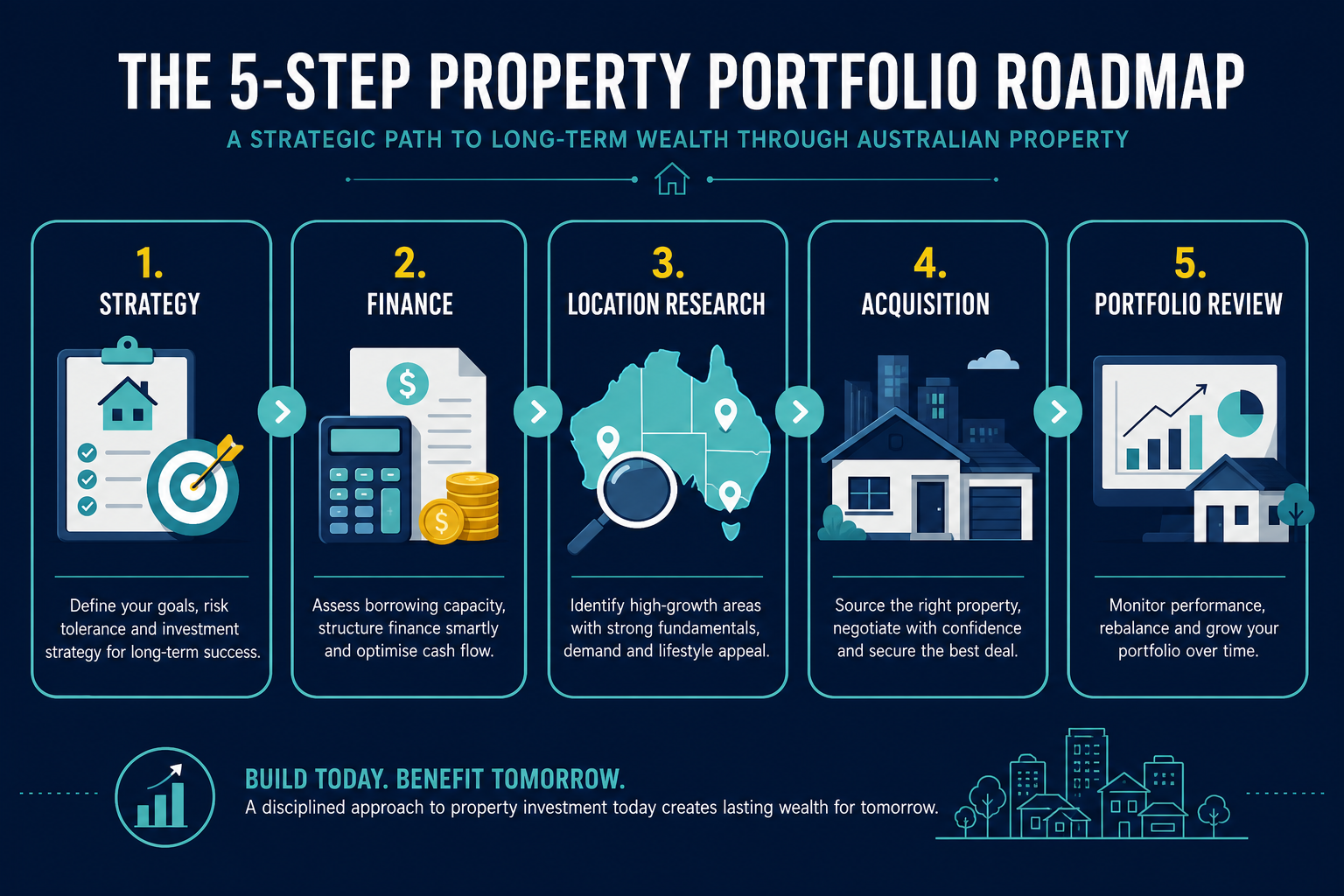
Why long-term thinking matters
Property investment is not a short-term trade. The asset class rewards patience in a way that few others can replicate, because the combination of capital growth, rental income, equity release, and tax benefits compounds over time in ways that are difficult to achieve from cash or more liquid assets.
The national average total return on Australian residential property over the past 20 years — blending capital growth with rental income — has been approximately 477% according to Cotality's Hedonic Total Return Index. That is not a guaranteed future outcome, but it reflects the structural advantage of owning well-selected assets in a market with persistent undersupply, strong population growth, and a policy environment that has historically supported property values.
Patience matters because most of the value in a property investment is back-loaded. The first five years often look modest. The second five years typically see more meaningful equity growth. By year ten or fifteen, the combination of debt reduction, rental growth, and capital appreciation can dramatically change an investor's net position — provided the asset was well-selected and the portfolio was not disrupted by avoidable mistakes.
The cost of short-term thinking
Investors who exit too early, sell in response to short-term downturns, or hold assets selected without adequate research tend to underperform the market average. Transaction costs alone — stamp duty, agent commissions, and capital gains tax — are significant enough that a property typically needs a hold period of seven or more years just to neutralise them. Selling before that threshold rarely makes economic sense unless the asset is fundamentally flawed.
Short-term thinking also manifests in chasing the hottest market rather than buying for fundamentals. Markets that surge dramatically often attract speculation that distorts pricing. The investors who consistently build wealth tend to buy into markets before they peak — which requires research, patience, and the discipline to act when data supports it rather than when sentiment is already euphoric.
For investors building toward a multi-property portfolio, the compounding effect of holding through cycles is one of the most powerful forces available. Each property that grows in value increases the equity available to fund the next acquisition, creating a self-reinforcing cycle that accelerates as the portfolio matures.
Read More: The $700K Vs $1M Property Investment Strategy Which One Builds Wealth Faster In Australia
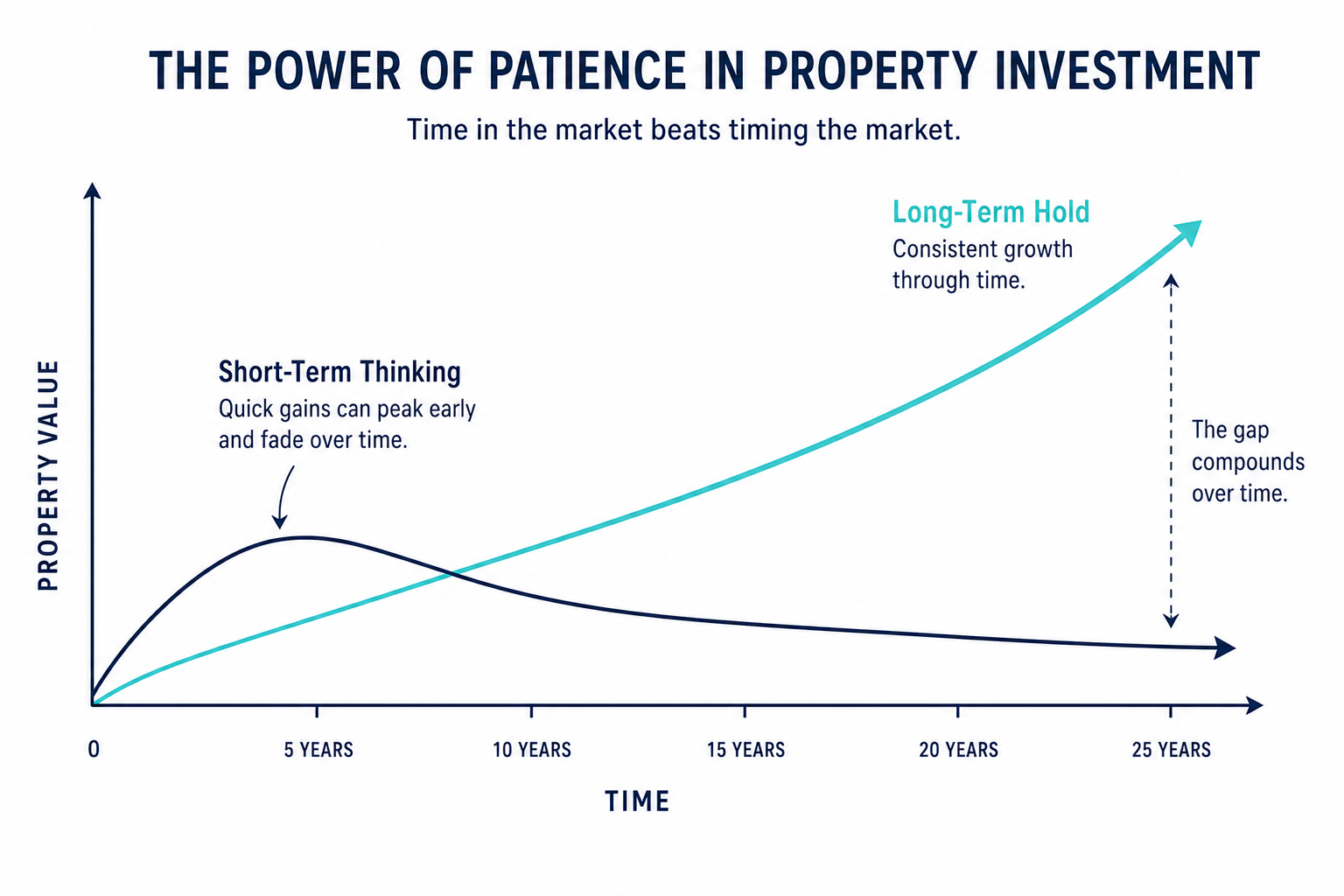
How to keep the plan realistic
A strategy that exists only on paper provides no real protection. The discipline is in returning to the plan regularly, testing it against current market conditions, and adjusting the inputs as your financial position evolves. Life changes — income grows, borrowing capacity shifts, risk appetite changes, family priorities adjust — and a good strategy accounts for that adaptability.
Data and professional advice are the two tools that keep a property plan grounded in reality rather than optimism. Market data from sources like CoreLogic, PropTrack, and the ABS provides the objective foundation for location decisions. A buyers agent or property advisor translates that data into decisions that fit your specific financial position and goals.
Using data to maintain discipline
The most common way property investors drift off strategy is by making decisions based on anecdote rather than evidence. A colleague mentions a suburb that "everyone is buying in." A vendor's agent presents urgency pressure at the inspection. An online forum champions a location based on incomplete analysis. Each of these inputs can override a sound plan if the investor hasn't built clear decision criteria in advance.
Clear criteria look like this: the property must meet a minimum gross yield threshold, be located in a suburb with population growth above a specified rate, have a vacancy rate below a defined level, and sit within a price range that keeps total debt-to-income at a manageable ratio. When a property meets those criteria, you buy. When it doesn't, you pass. Simple frameworks like this prevent emotion from overriding analysis.
The ABS reported the total value of Australian residential dwellings reached $11.366 trillion in the March 2025 quarter, an increase of $130.7 billion in a single quarter. That kind of structural wealth concentration in property means the market is unlikely to collapse dramatically, but it also means individual asset selection matters enormously within it.
| Discipline Habit |
Practical Application |
| Annual strategy review |
Reassess borrowing capacity, portfolio performance, and acquisition targets each year |
| Vacancy rate monitoring |
Track rental demand in target markets quarterly to validate location thesis |
| Cash flow forecasting |
Model holding costs conservatively, assuming 5% vacancy and 0.5% interest rate increase |
| Independent due diligence |
Commission building and pest inspections, independent valuations before every purchase |
| Debt stress-testing |
Confirm serviceability under rate increase scenarios before each new acquisition |
Why professional guidance matters at each stage
Even experienced investors benefit from an independent perspective. The challenge with property decisions is that they are infrequent, high-value, and emotionally loaded — a combination that makes objective thinking difficult. A buyers agent who works through dozens of acquisitions each year brings a calibration that an individual investor simply cannot replicate from periodic personal experience.
Dragan Dimovski and the team at Buyers Agency Australia have built their process around exactly this principle: strategy-first, then search, then negotiation. That sequence keeps every acquisition accountable to the larger portfolio goal rather than becoming an isolated transaction. For investors wanting to see how this plays out in practice, the Brisbane property investment case study using 10-year modelling illustrates how structured thinking translates into measurable outcomes.
If you are building toward financial independence through property — whether that means a second acquisition, a third, or a fully passive income stream — getting the strategy right is where everything starts. Book a free strategy session with Buyers Agency Australia to map out your next property move with clarity and confidence.
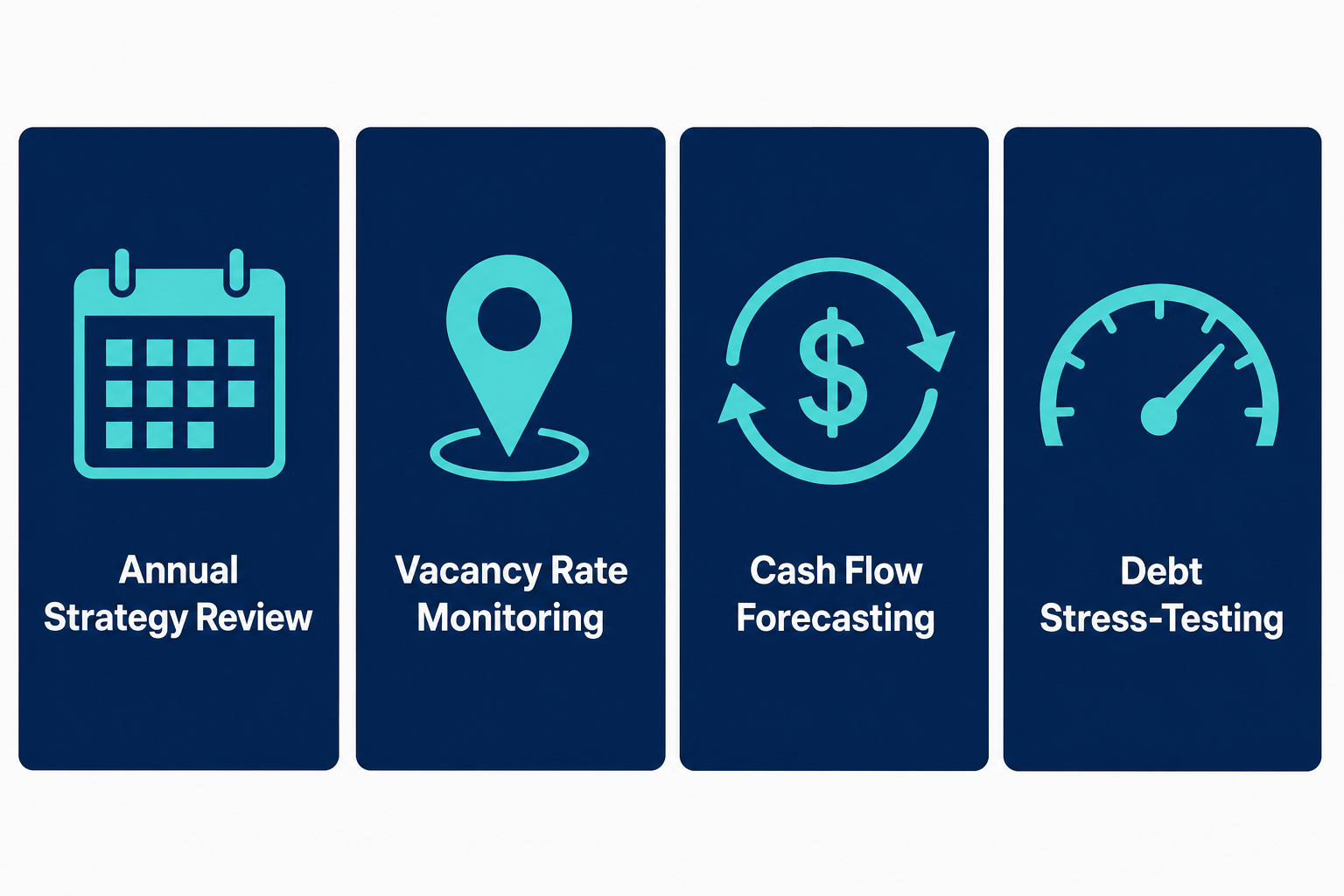
Frequently Asked Questions
What is a property investment strategy?
A property investment strategy is a documented plan covering your financial goals, asset selection criteria, portfolio sequencing, risk tolerance, and target outcomes — so each purchase serves a clear purpose.
How many investment properties do I need to build wealth?
There is no fixed number. Two to three well-selected, high-growth properties held long-term can create significant wealth. Quality and sequencing matter more than quantity.
Should I prioritise capital growth or rental yield?
It depends on your financial position. Investors with strong income and equity often favour growth. Those with tighter cash flow benefit from yield-focused assets that support serviceability for future purchases.
How does a buyers agent support a property investment strategy?
A buyers agent provides independent property research, market data analysis, suburb selection, negotiation, and due diligence — keeping decisions aligned with your strategy rather than driven by vendor or agent pressure.
When should I review my property investment plan?
At minimum, annually. Also review after any significant life event — income change, new equity available, interest rate shifts — or when a target market shows a meaningful change in fundamentals.
 General
A clear property investment strategy is what separates accidental landlords from investors who build lasting financial independence. This...
First home buyer schemes can lower your entry deposit to 5% or even 2%, but they do not change the full financial picture. Monthly repayments, upfront fees, ongoing costs, and cash buffers still drive affordability. This guide walks through what schemes truly unlock, what they leave unchanged, and how to model a realistic budget before you commit.
Schemes can help, but they do not change the full picture
The Australian Government 5% Deposit Scheme now offers unlimited places, no income caps, and higher property price caps effective from October 2025. Eligible first home buyers can purchase with as little as a 5% deposit without paying Lenders Mortgage Insurance, while eligible single parents can enter with as little as 2%.
That shift is significant. According to the Reserve Bank of Australia, the median house price in Australia currently sits at $844,000, meaning a 5% deposit totals $42,200—a figure that last covered a 20% deposit back in 2002.
Meanwhile, the federal Help to Buy scheme launched in December 2025 lets the government co-own up to 40% of a new home or 30% of an existing property, reducing both your deposit and loan size. Applications are capped at 10,000 places per year, and income limits sit at $100,000 for individuals and $160,000 for joint applicants.
State-based support stacks on top. Queensland offers a $30,000 First Home Owner Grant for new builds under contracts signed before June 30, 2026, alongside stamp duty concessions on homes up to $700,000. New South Wales, Victoria, and other states provide similar relief.
Yet none of these schemes change what lenders assess when they calculate your borrowing capacity. The RBA increased the cash rate to 4.35% in May 2026, the third consecutive hike this year, driven by inflation running above the 2–3% target band. That directly lifts mortgage interest rates and shrinks the amount banks will lend you.
Affordability is not about deposit size alone. It is about whether you can service the loan month after month without stress. Schemes lower the entry barrier, but they do not eliminate the stress test. Dragan Dimovski from Buyers Agency Australia reminds every first-time buyer: securing a mortgage is only half the task—holding it safely for years is what matters.

The deposit still drives the search
Your savings determine which properties you can realistically target. According to Finder, the average Australian first home buyer needs to save $134,841 for a 20% deposit. However, 70% of first home buyers in 2025 chose not to wait for 20% and entered the market with smaller deposits, often 10% or less.
The expanded 5% Deposit Scheme means a first home buyer in Brisbane can purchase a $1 million home with a $50,000 deposit, potentially saving up to 10 years off the deposit-saving timeline and avoiding roughly $42,000 in Lenders Mortgage Insurance.
But here is what does not change: property options narrow as deposit size shrinks. A $50,000 deposit combined with a $600,000 borrowing capacity limits you to properties under $650,000. Stretching to $700,000 requires an extra $10,000 deposit plus proof you can service higher repayments.
CommBank data shows the average first home buyer is 33 years old, purchasing with an average loan of around $480,000 and entering with a deposit of around 16%—signalling buyers are finding middle ground between affordability and LMI avoidance.
State stamp duty relief can add tens of thousands to your effective deposit. In New South Wales, first home buyers pay no transfer duty on properties up to $650,000 for established homes. South Australia offers full stamp duty exemption up to $1 million under the Home Buyer Concession Scheme, income thresholds permitting.
The First Home Super Saver Scheme lets you make voluntary contributions into super and withdraw up to $50,000 towards your deposit, taxed at 15% on entry rather than your marginal rate. Combined with federal and state schemes, you can stack savings to stretch your deposit further.
But again, the deposit is the entry ticket, not the full cost. Upfront expenses run 2% to 5% of the purchase price: conveyancing, building inspections, title searches, loan application fees, prepaid insurance, and council rate adjustments. On a $700,000 home, budget an extra $14,000 to $35,000 on top of your deposit.
That is why Buyers Agency Australia starts every engagement with a comprehensive financial review. We model your deposit, borrowing capacity, and cash reserves before identifying suitable properties. That avoids the emotional trap of falling for homes you cannot realistically afford to hold.
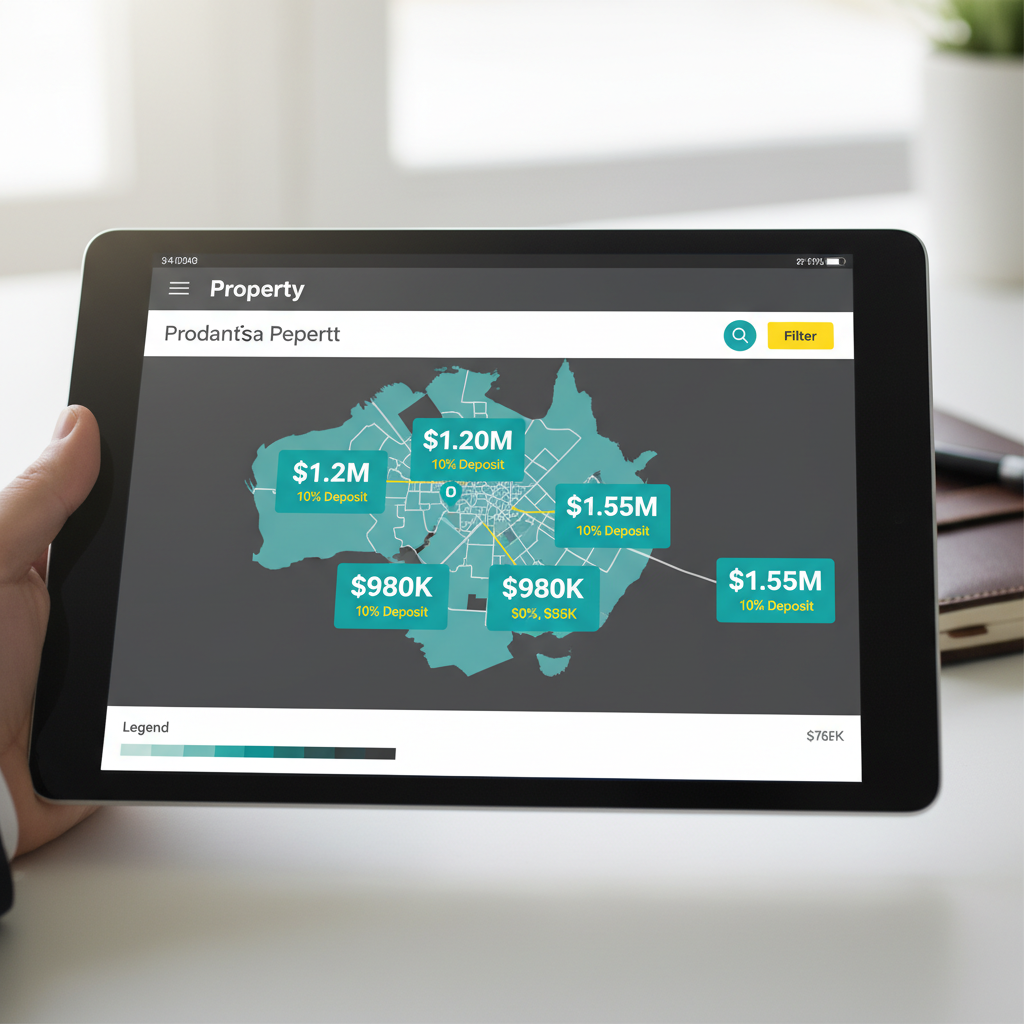
What buyers should model before they start
Affordability is not a single number. It is a combination of monthly repayments, ongoing expenses, and financial buffers. According to industry benchmarks, total housing costs—principal and interest, property taxes, homeowner's insurance, private mortgage insurance if applicable, HOA fees, and utilities—should sit under 33% to 36% of your gross monthly income.
Let's model a real scenario. You purchase a $750,000 property with a 5% deposit ($37,500) under the First Home Guarantee. You borrow $712,500 at a variable rate of 6.5% over 30 years. Monthly principal and interest repayments sit around $4,505. Add property taxes ($250/month), insurance ($150/month), maintenance reserve ($190/month), and council rates ($120/month). Total monthly housing cost: $5,215.
To keep that under 36% of gross income, you need to earn at least $14,500 per month, or $174,000 annually. If you earn $120,000, your housing cost ratio climbs to 52%—well above safe thresholds and vulnerable to rate rises, job loss, or unexpected repairs.
The RBA's May 2026 rate hike added $295 per month to repayments on a $700,000 loan compared to early 2026. That compounds over a year to $3,540 in extra cost. If your budget was tight at 4.10%, it is now underwater at 4.35%.
Housing Australia emphasizes buyers must meet ongoing obligations under the 5% Deposit Scheme, including occupying the property as an owner-occupier. If you breach these obligations, the guarantee may no longer apply, and your lender may require you to pay Lenders Mortgage Insurance or other additional costs.
Beyond monthly repayments, factor in ongoing expenses: property taxes can rise with reassessments, homeowner's insurance premiums increase annually, and maintenance and repairs typically run 1% to 3% of the home's value per year. On a $750,000 property, that is $7,500 to $22,500 annually.
New-construction homes may offer reduced maintenance costs in early years due to builder warranties, but buyers should still budget for landscaping, window treatments, and appliance upgrades not included in the base price.
Closing costs in 2026 typically run 2% to 5% of the purchase price, covering lender fees, title insurance, escrow fees, appraisal, inspection costs, prepaid taxes, and recording fees. If you are buying at auction, expect to pay 5% to 10% of the winning bid on the day, or arrange a deposit bond if your funds are tied up.
Dragan Dimovski and the team at Buyers Agency Australia model these costs for every client before property searching begins. We ensure your deposit, borrowing capacity, and cash reserves align with your 10-year financial goals—not just your ability to settle next month.
How to avoid stretching too far
The expanded First Home Guarantee scheme is injecting tens of thousands of additional buyers into the market in 2026. Research estimates this inflates prices by 3.5% to 9.9% in lower-priced areas, creating artificial demand. When government props disappear, which they always do, values correct.
You do not want to hold a $650,000 property that is really worth $580,000 in three years. Focus on locations with genuine employment drivers, infrastructure investment, and supply constraints—not subsidy-dependent outer suburbs with high investor ownership and no underlying demand.
CoreLogic and PropTrack provide market data on median prices, days on market, clearance rates, and rental yields by suburb. Cross-reference these with ABS employment data and state infrastructure pipelines to identify areas with structural growth drivers.
Stamp duty, conveyancing, building inspections, and selling costs consume 7% to 12% of your purchase price. If you sell within three years due to financial stress or life changes, you may realise a loss even if the property appreciated modestly.
Buying with a 5% deposit leaves you with minimal equity buffer. If property values dip 5% due to market correction, you are in negative equity, owing more than the home is worth. That restricts your ability to refinance, sell, or access further credit.
The Australian Prudential Regulation Authority requires lenders to assess your ability to service a loan at least 3% above the current rate. That protects you from rate shock, but it also means you may not borrow as much as you hoped.
Strategies to avoid overextension include buying below your maximum borrowing capacity, targeting properties with renovation potential to add value, and ensuring your income is stable and likely to grow. Dual-income households should model affordability based on one income in case of job loss or parental leave.
Buyers Agency Australia operates on a transparent, fixed-fee model, ensuring we negotiate hard on your behalf rather than pushing you toward higher-priced properties. Our clients typically save 3% to 7% below asking price through strategic negotiation and access to off-market opportunities.
On a $750,000 purchase, that is $22,500 to $52,500 preserved capital—funds you can redirect towards cash buffers, renovations, or your next investment. We do not sell you property; we help you buy the right property at the right price.
First home buyer schemes open doors, but they do not eliminate risk. Calm, realistic choices backed by robust financial modelling ensure you build equity safely over time rather than stretching into stress.
Frequently asked questions
Can I use the 5% Deposit Scheme and the Help to Buy Scheme together?
No, you must choose one federal scheme. However, you can stack either with state-based grants and stamp duty concessions.
Does the First Home Guarantee cover established homes or only new builds?
The Australian Government 5% Deposit Scheme covers both established and new homes. The Help to Buy Scheme offers higher government contributions for new builds.
Will my repayments change if interest rates rise after I buy?
Yes, if you hold a variable-rate mortgage, your repayments will adjust with RBA rate changes. Fixed-rate loans lock in repayments for a set period.
How much should I save for ongoing costs beyond the deposit?
Budget 1% to 3% of the property's value annually for maintenance, plus property taxes, insurance, utilities, and HOA fees if applicable.
What happens if I cannot meet the obligations under the 5% Deposit Scheme?
If you fail to occupy the property as an owner-occupier or breach other conditions, the government guarantee may be revoked, and your lender may require Lenders Mortgage Insurance or other costs.
Take the next step
First home buyer schemes lower deposit hurdles and remove LMI barriers, but they do not change the fundamentals of affordability. Your ability to service the loan, absorb rate rises, and hold the property through market cycles determines long-term success.
Buyers Agency Australia offers complimentary strategy sessions where we analyse your financial position, model your borrowing capacity, and identify specific markets and property types aligned with your objectives. No obligation, no sales pressure—just honest advice from professionals who have navigated multiple property cycles.
If you are ready to move forward with confidence and clarity, contact the team today. We work with first-home buyers who want expert guidance, property investors seeking long-term wealth, and time-poor professionals requiring end-to-end property search and negotiation.
 General
Federal and state schemes lower deposit hurdles and may waive LMI, but total affordability depends on repayments, fees,...
Professional property buyers agents do more than just open doors. They compress search timelines, secure better purchase terms, and remove the guesswork from one of the most expensive decisions most Australians will ever make.
The value shows up where it counts: in negotiation outcomes, access to properties never advertised publicly, and the confidence that comes from having someone who deals with property transactions every single day on your side.
What a buyers agent actually does
A buyers agent works exclusively for the purchaser, not the seller. Unlike a selling agent whose loyalty and commission are tied to the vendor, a buyers agent is retained to protect your interests, reduce risk, and secure the right property on the best possible terms.
The role covers end-to-end support. That includes defining your brief, identifying suitable properties across on-market and off market properties channels, conducting due diligence, arranging inspections, and negotiating or bidding on your behalf.
Most buyers underestimate how much time the process consumes. Between attending inspections, chasing agents, reviewing contracts, coordinating building reports, and managing offers, the average property search can stretch beyond 18 months for someone working full time.
Buyers Agency Australia compresses that timeline significantly. A 2025 study found that buyers using a buyers agent secured properties an average of 3.2 months faster than those searching independently, saving weeks of weekend inspections and phone tag with listing agents.
That speed comes from daily market engagement. A buyers agent maintains active relationships with selling agents across multiple suburbs, receives early alerts on listings, and knows which properties are about to hit the market before public advertising begins.
For investors and time-poor professionals, that efficiency translates directly into opportunity cost saved. Every month you bring a purchase forward in a rising market compounds into long-term capital growth.
Where negotiation expertise delivers measurable savings
Negotiation is not a skill most buyers practise regularly. The average Australian buys property once every seven to ten years. A professional buyers agent negotiates every single week.
That repetition builds pattern recognition. They know when a vendor is genuinely motivated, how to read days-on-market data, what comparable sales justify as fair value, and how to structure offers that maximise your chances without overpaying.
According to recent industry data, buyers agents save clients 2 to 3 percent on average compared to what they would have paid negotiating independently. On an $800,000 property, that represents $16,000 to $24,000 in savings—more than enough to offset the professional fee.
Beyond purchase price, skilled negotiators also secure better contract terms: longer settlement periods when needed, inclusion of chattels, or conditional clauses that protect the buyer if issues arise during due diligence.
At auction, the advantage is even clearer. A buyers agent removes emotional bidding from the equation, sets a disciplined walk-away price based on independent valuation, and reads the room to know when to step in or hold back.
Off-market access reduces competition and pressure
A significant portion of quality property in Australia never reaches public listing sites. Research from PropTrack indicates that Sydney's off-market segment now accounts for roughly 20 percent of all residential transactions, with that share rising in tightly held suburbs.
Sellers and their agents often prefer private sales to avoid public marketing costs, maintain discretion, or transact quickly with a known, qualified buyer. Buyers agents tap into that hidden layer through established relationships and regular communication with listing agents across target areas.
For buyers, off-market opportunities mean fewer competing bidders, less auction pressure, and more room to negotiate fair value. You're not caught in a Saturday morning bidding war against ten other families. You're presented with an option, given time to assess it properly, and able to make an informed decision without the crowd watching.
That advantage is particularly valuable in high-demand markets like Melbourne's inner east, Sydney's lower north shore, and Brisbane's inner-ring suburbs, where stock is scarce and competition is intense.

Where the real value shows up
The return on engaging a buyers agent is not limited to purchase price. It extends across time saved, stress reduced, risk avoided, and decision quality improved.
Time saved across every stage
Property search is time-intensive. Even a conservative estimate puts total search time—including online browsing, inspections, travel, phone calls, contract review, due diligence coordination, and negotiation cycles—at 80 to 120 hours for the average buyer.
For a professional earning $80 per hour, that represents $6,400 to $9,600 in opportunity cost. For someone running a business or managing a demanding career, the real cost is higher: time taken from revenue-generating work, family commitments, or personal wellbeing.
A buyers agent absorbs that workload. They handle property research, liaise with selling agents, arrange and attend inspections on your behalf, coordinate reports, and manage all communication through to contract exchange. You're involved only at decision points.
The Buyers Agency Australia team has seen clients complete purchases within four to eight weeks from brief to settlement, compared to the 12 to 18-month timeline typical of independent buyers.
Stress reduction and decision confidence
Property buying involves high-stakes decisions under pressure. Auctions move fast. Private treaty negotiations require quick responses. Contract terms are dense and legally binding. Building reports reveal risks that need pricing or risk assessment.
For first-home buyers especially, the process can feel overwhelming. A buyers agent provides structure, clarity, and professional judgement at every stage.
They explain what matters in a contract, translate building and pest findings into actionable advice, and help you weigh trade-offs between properties with confidence. That reduces decision fatigue and the anxiety that comes from wondering whether you missed something important.
Clients consistently report that the biggest value was not just the financial outcome, but the peace of mind that came from having an expert in their corner who had seen hundreds of transactions and knew what to watch for.
Risk mitigation through disciplined due diligence
Every property carries risk. Title restrictions, unapproved works, strata issues, flood overlays, bushfire zones, drainage problems, structural movement, and hidden defects can all impact value, insurability, and long-term cost.
A buyers agent runs a consistent due diligence checklist, gathers documents early, and interprets findings with a clear lens: proceed, negotiate a price adjustment, or walk away.
Avoiding a single $20,000 structural issue or special levy often covers a significant share of the buyer's agent fee. When you factor in the cost of mistakes—overpaying, buying in the wrong area, or inheriting problems that erode equity—the protective value becomes clear.

Why fixed-fee support changes the experience
Fee structure matters. Traditional percentage-based models create a misalignment: the higher the purchase price, the higher the agent's commission. That incentivises recommending more expensive properties, even when a more affordable option would meet your needs.
Buyers Agency Australia operates on a transparent, fixed-fee model. The fee is agreed upfront, independent of purchase price, and covers the full scope of service from search to settlement.
That structure keeps focus where it belongs: finding the right property at fair value, not chasing a higher sale price to inflate commission. Clients buying in high-value markets like Sydney or Melbourne can save tens of thousands compared to percentage-based fee structures, while still receiving comprehensive support.
The fixed-fee model also provides certainty. You know exactly what you'll pay before the search begins, with no surprises and no hidden costs. That transparency aligns with the result-oriented, data-driven approach that Buyers Agency Australia is built on.
What's included in professional buyer support
A full-service buyers agent provides:
- Detailed brief consultation to define goals, budget, and lifestyle needs
- Suburb and market analysis based on 10-year portfolio modelling and growth projections
- Access to on-market, pre-market, and off-market listings through agent networks
- Property shortlisting, inspections, and independent valuation
- Due diligence coordination: contract review, building and pest, strata records, title search
- Negotiation strategy and execution, or professional auction bidding
- Settlement support and coordination with conveyancers, lenders, and other advisers
Every stage is managed with the same level of rigour, ensuring nothing falls through the cracks and every decision is backed by evidence.
Who gets the most from working with one
While buyers agents add value across all buyer types, three groups see the most significant return.
Property investors building long-term wealth
Investors require more than just a property—they need an asset that delivers rental yield, capital growth, and tax efficiency. A buyers agent with property investment advice expertise analyses vacancy rates, infrastructure pipelines, demographic trends, and supply dynamics to identify growth corridors before the broader market catches on.
Buyers Agency Australia's approach includes 10-year portfolio modelling, helping investors understand how each purchase fits into a long-term wealth creation strategy. That forward planning, combined with access to off-market stock and disciplined negotiation, gives investors a measurable edge.
First-home buyers navigating complexity
For first-home buyers, the process is unfamiliar, high-stakes, and emotionally charged. A buyers agent provides education, structure, and reassurance at every step.
They explain government schemes, help assess affordability realistically, identify suburbs that balance lifestyle and budget, and ensure you don't overpay or overlook risks. That guidance is especially valuable in competitive markets where auction clearance rates regularly exceed 70 percent and emotion can drive overbidding.
With first home buyer advice tailored to your circumstances, you enter the market with confidence and a clear plan, avoiding costly mistakes that can take years to recover from.
Time-poor professionals who need efficiency
Busy professionals—doctors, lawyers, executives, business owners—often lack the time to manage a property search while maintaining their careers. Saturdays are consumed by inspections. Evenings are spent reviewing contracts. The process drags on for months.
A buyers agent compresses that timeline, handles all coordination, and presents only the options that meet your brief. You're involved at decision points, not in the day-to-day grind. That efficiency allows you to maintain focus on work and family while still securing the right property.
FAQ
How much does a buyers agent typically cost?
Most buyers agents charge between 1 and 2 percent of the purchase price, or a fixed fee ranging from $10,000 to $20,000 depending on scope and market.
Do buyers agents have access to properties I can't find myself?
Yes. Many properties are sold off-market or pre-market through private agent networks, and buyers agents receive early alerts before public advertising.
Can a buyers agent really save me money?
Industry data shows buyers agents save clients 2 to 3 percent on average through superior negotiation, often covering their fee and delivering net savings.
Are buyers agent fees tax-deductible?
For investment properties, buyers agent fees are generally tax-deductible as part of the property's cost base for capital gains tax purposes. Owner-occupiers cannot claim the deduction.
How long does it take to secure a property with a buyers agent?
Most clients secure a property within four to eight weeks, compared to 12 to 18 months for independent buyers, depending on market conditions and brief specificity.

Making the value visible
The return on professional buyer support is measurable. Negotiated savings, costs avoided, time saved, and risk mitigated all add up to a clear business case.
When you factor in the opportunity cost of time, the risk of overpaying, and the stress of navigating a complex process alone, the value proposition becomes compelling. A buyers agent delivers expertise, access, and outcomes that independent buyers simply cannot replicate.
Buyers Agency Australia has built a national presence by focusing on transparency, fixed-fee certainty, and long-term wealth creation. Whether you're an investor building a portfolio, a first-home buyer stepping into the market, or a professional who values efficiency, the support is designed to deliver measurable results.
Ready to see what professional buyer support can deliver? Book a consultation with Buyers Agency Australia today.
 General
Understand the practical value a buyers agent delivers through expert negotiation, off-market access, reduced decision fatigue, and a...
Suburb selection gets most of the attention in Australian property investment — but the investors who genuinely build wealth rarely credit a single postcode. What separates a thriving property portfolio from a stagnant one is almost always strategy: the decisions made before the search even begins. Structure, finance, risk tolerance, and long-term goals matter far more than whether you bought in Paddington or Parramatta.
Suburb Choice Is Only One Part of the Picture
Ask most Australian investors what drives property wealth and they'll point to location. And location does matter — but it is one input in a much larger equation. The real variables that determine whether an investment property succeeds over a decade are financing structure, entry timing relative to your own financial position, cash flow sustainability, and how each purchase fits the broader trajectory of your property portfolio.
Consider two investors entering the Brisbane market in the same year with the same suburb in mind. One has a carefully structured loan that preserves borrowing capacity for a second purchase within three years. The other maxes out their serviceability on a single asset and can't move again for seven years. Same suburb, very different outcomes. That difference has nothing to do with postcodes.
According to ABS and CoreLogic data, Australia's residential real estate market was valued at approximately $11.3 trillion as of mid-2025 — a market large enough to contain both excellent and poor investments within the very same street. The investors who navigate it well do so through disciplined planning, not lucky suburb picks.
Here's what the full picture actually includes:
| Strategic Factor |
Why It Matters |
| Loan structure and serviceability |
Determines how quickly you can buy again |
| Cash flow vs. capital growth balance |
Affects holding power and portfolio scale |
| Entry price relative to market value |
Impacts equity position from day one |
| Asset class and property type |
Shapes risk profile and tenant demand |
| Tax position and ownership structure |
Influences net return significantly |
A buyers agent for property investment who starts with strategy — rather than a property list — gives investors a genuine structural advantage that suburb research alone cannot replicate.

The Traps of Buying on Headlines
Property markets generate headlines the way stock markets do: momentum attracts attention, and attention fuels more momentum. By the time a suburb appears in a weekend magazine feature as the next hotspot, the sharpest investors have usually already bought, and the cycle is closer to its peak than its start.
Emotional and reactive buying is one of the most consistent wealth-destroyers in Australian real estate. Investors who chase the suburb of the moment often overpay at the top of a local cycle, stretch their finances to secure a property before prices rise further, and then find themselves holding a negatively geared asset with no capacity to buy again.
Fear of missing out is a real force in any property cycle. Investor lending as a share of total new loan commitments reached 40.6% in late 2025, a level not seen since December 2016 — and in heated markets, that kind of investor enthusiasm can compress yields and inflate entry prices faster than fundamentals justify.
Other common reactive traps include:
- Buying in a single market only because it is familiar, regardless of where the cycle sits
- Ignoring cash flow in favour of growth stories that may take a decade to materialise
- Selecting property type by trend rather than by what suits the local rental market
- Underestimating holding costs when making purchase decisions under time pressure
- Skipping due diligence on zoning, flood risk, and infrastructure plans because the suburb "feels right"
None of these mistakes are unique to inexperienced investors. Many sophisticated buyers make them when they skip the strategy layer and move straight to the search.
This is precisely why property investment advice that starts with your financial position — not a suburb shortlist — is so valuable at the consideration stage.
What a Real Strategy Includes
A genuine property investment strategy is not a summary of what suburb to buy in. It is a structured plan that connects your current financial position to a specific long-term wealth target, with every property decision mapped along that path.
The core elements look like this:
1. Portfolio stage and sequencing
Are you on your first investment, or building toward a third or fourth asset? The answer determines whether you should prioritise capital growth to build equity, or cash flow to maintain serviceability for your next move. Most investors need both across a portfolio — but the sequencing matters enormously. Understanding capital growth versus cash flow trade-offs is central to making that call intelligently.
2. Borrowing capacity and loan structure
Your borrowing capacity is not a fixed number — it shifts with lender policy, interest rate movements, and how your existing loans are structured. A smart strategy accounts for this and protects your ability to keep buying. How buyers agent fees compare to the cost of overpaying makes clear that financial structuring decisions at purchase have long compounding consequences.
3. Cash flow targets and holding sustainability
An investment property you cannot hold through a softening rental market or a vacancy period is a liability, not an asset. Strategy means knowing your cash flow floor — the minimum yield that keeps the property serviceable without eroding your lifestyle or derailing your next purchase.
4. Risk profile and timeline
A 35-year-old building toward early retirement has a very different risk tolerance than a 52-year-old looking to replace employment income within eight years. Strategy maps assets to timelines, not just to growth projections.
5. Tax structure and ownership entity
Negative gearing, depreciation schedules, and ownership structure — individual, joint, company, or trust — can dramatically shift the net return on any investment. This is a strategy question, not an afterthought.
Investors who build a thriving property portfolio from a clear plan rather than a reactive purchase sequence are far better positioned to reach their goals without unnecessary detours.
Here is a simple framework to think about strategic alignment:
| Investor Stage |
Primary Focus |
Secondary Focus |
| First investment |
Borrowing capacity, entry price |
Cash flow sustainability |
| Second investment |
Equity access, serviceability |
Capital growth potential |
| Third+ investment |
Portfolio balance, risk management |
Passive income targets |
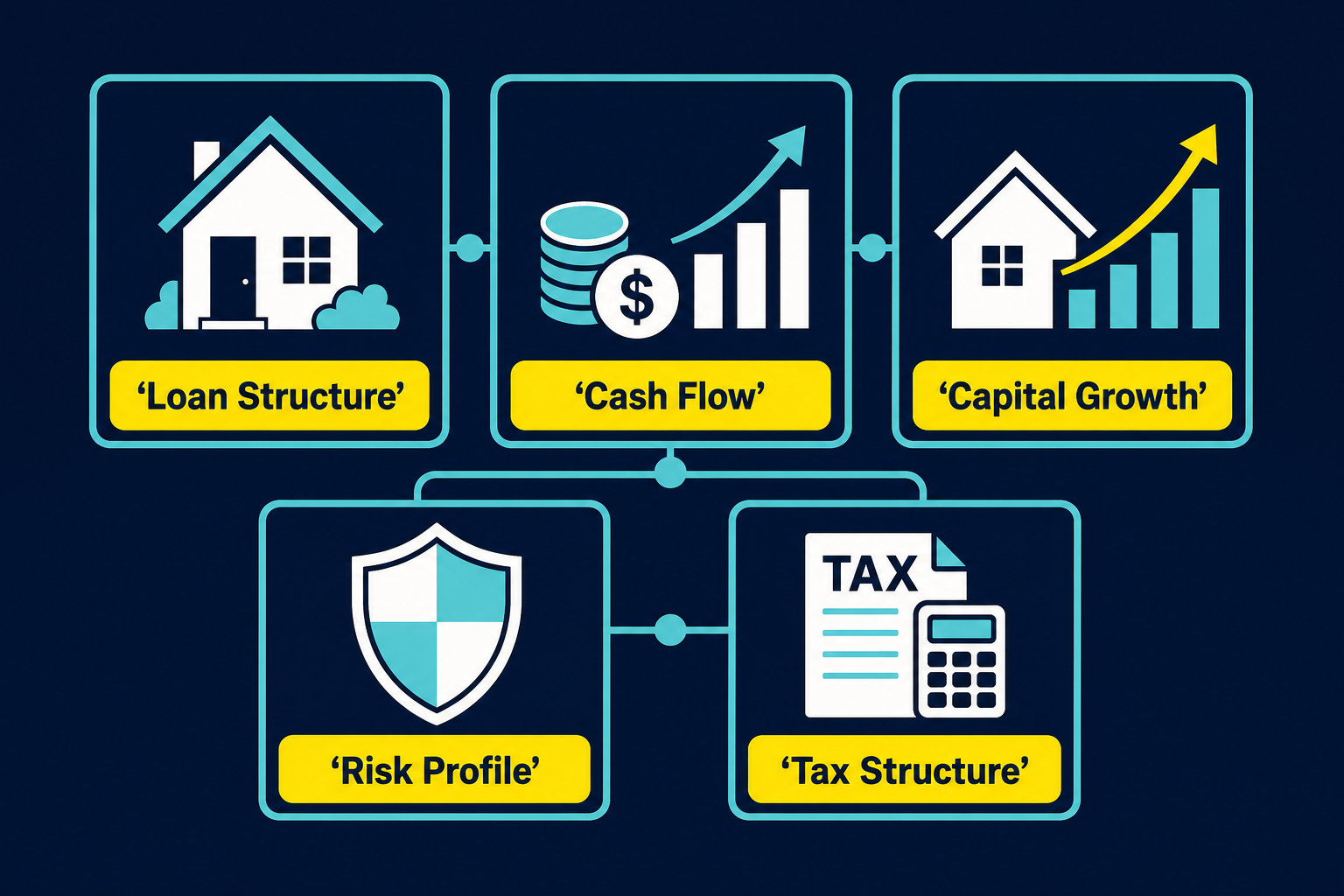
How Buyers Agency Australia Approaches Planning
Buyers Agency Australia takes an approach that most buyers agents don't: every client engagement begins with financial modelling, not property searching. That difference is significant.
Dragan Dimovski, founder of Buyers Agency Australia and a property expert with 20+ years of hands-on investment experience, built his own successful portfolio using a methodology that starts with the end in mind. How much passive income does the client need? What does their balance sheet look like in ten years? What tax structures suit their situation? Only once those questions are answered does the property search begin.
This approach produces a ten-year portfolio model for each client — a living roadmap that shows which type of property to buy, in which sequence, and why. It accounts for cash flow, serviceability, expected capital growth, and risk tolerance at every stage. The model is updated as financial circumstances evolve, keeping the strategy current rather than static.
The practical outputs of this process include:
- A clear picture of how many properties are needed to reach a specific income or wealth target
- Identification of which markets suit each stage of the portfolio — growth-oriented capitals like Brisbane or cash flow-supportive regional markets
- Off-market access to investment-grade properties that most buyers never see
- Negotiation support that targets purchase prices below market value, preserving equity from settlement day
- End-to-end guidance from strategy session through to settlement, with ongoing support as the portfolio grows
This is why clients who have worked with Buyers Agency Australia frequently cite the clarity of the plan — not just the property secured — as the most valuable part of the service.
The team's work across Brisbane, Sydney, Melbourne, and national markets is backed by the kind of data-led research and agent relationships that take years to build. See how that plays out in practice through the Brisbane property investment case study using 10-year modelling, which shows exactly what structured planning looks like across a real investment horizon.
For investors wondering where the top property investment hotspots and strategies for 2026 sit, the starting point is always the same: get the strategy right first, then find the property that fits it.
Frequently Asked Questions
Is suburb selection still important in property investment?
Yes, but it follows strategy — not the other way around. A well-chosen suburb in the wrong portfolio context can still underperform relative to your goals.
What should a property investment strategy cover?
At minimum: your portfolio stage, borrowing capacity, cash flow targets, risk profile, timeline, and tax structure — before any property search begins.
How does cash flow fit into a long-term investment strategy?
Cash flow determines holding power and serviceability for future purchases. Without enough of it, even a great growth asset can force a poorly timed sale.
Can I buy interstate without having a clear strategy?
Technically yes, but the risks multiply significantly. Interstate buying without a strategic framework and local market intelligence is one of the most common sources of investor regret.
What is 10-year portfolio modelling?
It is a structured financial projection that maps out property acquisitions, equity growth, cash flow, and income targets across a decade — giving investors a clear plan rather than a series of ad hoc decisions.
Final Thoughts
A property investment strategy is not a luxury reserved for investors with large portfolios. It is the foundation that every first, second, and third purchase should be built on. Suburb selection matters — but it is a tactical decision that should always sit inside a clearly defined strategic framework.
The investors who build real, compounding wealth through Australian property are almost always the ones who planned before they searched. They knew their income targets, understood their borrowing position, sequenced their assets deliberately, and made suburb decisions as a result of strategy — not as a substitute for it.
If you are ready to build a portfolio with genuine structure behind it, book a free strategy session with Buyers Agency Australia and map out your next property move with confidence. Or contact the team to start the conversation today.
 General
Choosing the right suburb gets all the attention, but property investment strategy is what separates investors who build...
Brisbane's property market has delivered extraordinary growth over the past five years, with median house values rising more than 76% between June 2020 and June 2025 according to Cotality data. But strong city-wide numbers mask a more complicated reality: performance varies sharply between suburbs, property types, and price points. Knowing that Brisbane is growing is not the same as knowing where to buy, what to pay, or how to structure a purchase that actually builds wealth. That gap between market awareness and market execution is exactly where a buyers agent in Brisbane makes a measurable difference.
Buyers Agency Australia works with investors across the country to close this gap, combining data-driven suburb selection, off-market access, and end-to-end transaction support under a transparent fixed-fee model. The result is a process that removes guesswork and positions each purchase around long-term portfolio performance rather than short-term market excitement.
Why Brisbane investors still need a strategy
Demand alone does not protect an investor from a poor purchase. Brisbane recorded second-fastest population growth among Australian capital cities in 2024-25, adding around 58,200 residents to reach approximately 2.83 million, according to ABS data. That inflow is real and it does sustain underlying demand. But it does not distribute evenly across suburbs, asset types, or price brackets.
The investor who buys in the wrong suburb, at the wrong price point, or into an oversupplied segment can hold a technically Brisbane property while watching peers in better-located stock outperform significantly. According to the Australian Tax Office, approximately 60% of property investors own just one investment property — and many never buy a second because the first one did not perform as expected. The selection decision is almost always where the outcome is determined.
Brisbane's current market adds another layer of complexity. Listings in early 2026 remained around 15% below year-prior levels, reinforcing supply constraints that support prices — but also intensifying competition for well-located stock. Affordability pressure is concentrated at the sub-$1.1 million median house level, where multiple-offer scenarios are common and emotional decision-making under pressure is a real risk for self-directed buyers. First-time investors in particular face costly mistakes when they enter a market this competitive without structured support.
A clear investment strategy — built before the search begins — is what separates disciplined capital allocation from reactive buying. It answers the questions that the market itself cannot: what growth drivers actually matter for your goals, which suburbs carry genuine rental demand rather than cyclical noise, and where your capital is most exposed to downside risk.
| Factor |
Self-Directed Buyer |
Buyers Agent-Guided Buyer |
| Suburb selection |
Online research and familiarity |
Data-led analysis of growth drivers, vacancy, and demand |
| Access to stock |
Public listings only |
On-market and off-market pipeline |
| Negotiation |
Emotional and reactive |
Evidence-based and structured |
| Due diligence |
Variable, often incomplete |
Systematic across financials, planning, and risk factors |
| Strategy alignment |
Inferred from preferences |
Built against explicit portfolio goals |
What an agent adds to the search
The search itself is where most of the value is created or lost. A buyers agent brings three things to the search that most investors cannot replicate independently: suburb-level analytical depth, off-market property access, and negotiation experience that operates without emotional attachment.
Suburb selection and risk control
Suburb selection in Brisbane is not simply a matter of identifying growing areas. It requires understanding which growth drivers are structural versus speculative, which infrastructure projects are funded and under construction versus aspirational, and which demographic compositions support long-term rental demand from owner-occupier quality tenants. Brisbane's Cross River Rail project is reshaping demand along station precincts in Woolloongabba, Boggo Road, and Dutton Park — but the price uplift in those corridors is already partially priced into public listings. Finding the next value corridor before the market consensus catches up requires ongoing access to planning data, sales evidence, and local agent networks.
Risk control is equally important. Flooding overlays, flood-affected title history, body corporate financial health for strata properties, zoning constraints, and infrastructure noise or traffic exposure are all factors that do not appear in a REA listing but can materially affect resale appeal and rental yield. A systematic due diligence process runs these checks before an offer is placed, not after.
Dragan Dimovski, who founded Buyers Agency Australia with over 20 years of investing and advisory experience, built the firm's approach around exactly this kind of evidence-based selection. His process focuses on established properties in high-growth corridors that offer strong rental demand and genuine resale depth — not just areas generating current media attention.
Off-market access and deal flow
Off-market and pre-market property access represents a genuine structural advantage in Brisbane's current environment. When public listings are constrained and competition for anything well-located is intense, gaining access to properties before they reach REA or Domain reduces price competition and broadens the search universe significantly. Access to off-market and under-market deals is built through agent relationships cultivated over years — not a service that can be replicated by a buyer who enters a new suburb relationship cold.
For Brisbane investors sourcing from interstate or overseas, this matters even more. A buyers agent with established local agent networks in specific Brisbane corridors receives calls about properties before marketing campaigns launch. That timing advantage can mean the difference between a competitive offer situation at market price and a private negotiation with a motivated seller.
Read More: How Off Market Properties Change The Way Melbourne Buyers Search

How the right purchase affects returns
The connection between purchase quality and investment returns is more direct than most investors appreciate. Every dollar overpaid at acquisition represents borrowing capacity that cannot be redeployed, equity that was never created, and a holding cost burden that compresses cash flow from day one. Conversely, a well-negotiated purchase in a suburb with genuine rental demand and capital growth fundamentals compounds across the holding period in ways that make the advisory cost look insignificant within the first cycle.
Brisbane's rental market currently supports that compounding thesis. Annual rent growth of 6.7% across Greater Brisbane is equal-highest among major capitals based on Cotality data from early 2026, with vacancy rates running well below the national average. That rental performance is not uniform — it is concentrated in suburbs with strong transport access, amenity depth, and constrained supply of rental stock. Buying into those specific locations, rather than into the broader market, is what links search quality directly to performance.
Buyers Agency Australia's Brisbane investment approach uses 10-year portfolio modelling to assess whether a specific property will meet cash flow, capital growth, and risk-adjusted return targets — not just whether it looks appealing at current conditions. That modelling discipline prevents the common investor mistake of buying a property that performs well in the current rate environment but strains the portfolio when conditions shift.
Negotiation also affects return quality in ways that are hard to model until they compound. Skilled negotiation on price, settlement terms, and contract conditions can recover the cost of a buyers agent fee many times over in a single transaction. An unconditional offer structured around the seller's specific motivation — timing, tenancy, estate circumstances — regularly achieves outcomes that public auction processes cannot.
See also: Top Property Investment Hotspots and Strategies for Brisbane in 2026
| Investment Outcome Driver |
Impact Without Agent |
Impact With Agent |
| Purchase price |
Full market or auction premium |
Negotiated discount or off-market deal |
| Suburb fundamentals |
Self-assessed, variable quality |
Data-verified growth and demand drivers |
| Rental yield at entry |
Market average, unfiltered |
Above-average yield in demand-verified locations |
| Portfolio fit |
Ad hoc, preference-led |
Strategy-aligned, modelled over 10 years |
| Risk exposure |
Incomplete due diligence common |
Systematic pre-purchase risk assessment |
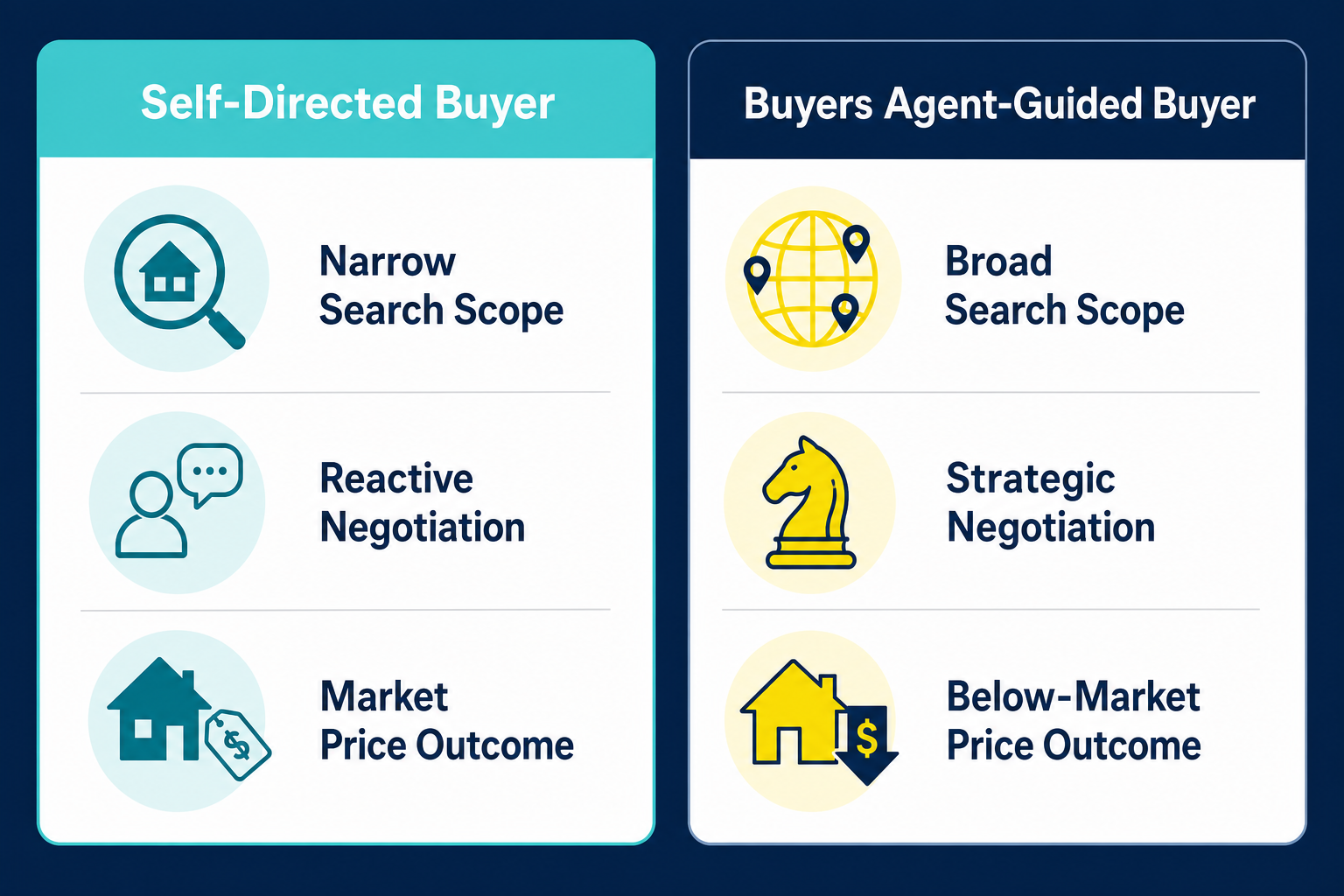
What to look for in support
Not all buyer-side representation is equal. The quality of advice an investor receives depends heavily on the experience, independence, and process discipline of the individual or firm engaged. Knowing what to look for makes the evaluation clearer.
Buyer-only representation
A buyers agent must work exclusively for the buyer — with no selling agency relationships, developer referral arrangements, or dual-agency conflicts. This is the foundational requirement. If the agent also sells properties or receives commissions from developers for directing clients, the advice is structurally compromised regardless of their intentions. Property investment advice from an agent without conflicts of interest is a non-negotiable starting point.
Strategy before search
Any serious advisory process starts with portfolio strategy, not property search. That means understanding the investor's current financial position, existing portfolio, borrowing capacity, tax situation, risk tolerance, and long-term goals before a suburb or property type is even discussed. An agent who starts by asking what you want to spend and where you want to buy is skipping the work that determines whether the purchase will actually serve your goals.
Fixed-fee transparency
Fee structure matters because it determines whose interest the agent is serving. A percentage-of-purchase-price fee creates an incentive toward higher purchase prices. A fixed-fee model, like the approach Buyers Agency Australia uses, aligns the agent's interest with the buyer's — the goal is the right property at the right price, not the most expensive property the client will accept.
Demonstrated local market depth
General market awareness is not the same as suburb-level conviction. An effective buyers agent in Brisbane should be able to explain, specifically and with data, why a particular suburb corridor is preferred over alternatives — what the vacancy rate is, what the infrastructure pipeline looks like, where rental demand is coming from, and what the resale comparable evidence shows. Vague optimism about Brisbane as a whole is not analysis.
End-to-end process coverage
The best outcomes come from support that runs from initial strategy through to settlement and beyond. That includes due diligence management, solicitor and conveyancer coordination, building and pest inspection oversight, and post-settlement connection to property management. Book a free strategy session to understand exactly how this kind of structured support applies to your specific investment goals before committing to any approach.
Frequently Asked Questions
What does a buyers agent in Brisbane actually do for an investor?
A buyers agent manages property search, suburb analysis, off-market access, due diligence, negotiation, and settlement coordination — all on behalf of the buyer, not the seller.
Is using a buyers agent worth the cost in Brisbane's current market?
In a market where listings are constrained and competition is high, professional negotiation and off-market access typically recover the fee cost — often many times over — through better purchase prices and stronger-performing suburbs.
What is the difference between a buyers agent and a selling agent in Brisbane?
A selling agent is appointed by and legally obligated to the vendor. A buyers agent works exclusively for the purchaser, with no incentive to maximise price — only to secure the right property on the best possible terms.
How do buyers agents access off-market properties in Brisbane?
Through long-standing relationships with local selling agents, developers, and private sellers who share pre-market and off-market opportunities with trusted buyer-side contacts before any public campaign begins.
What should I ask a buyers agent before engaging them in Brisbane?
Ask about their fee structure, whether they work exclusively for buyers, how they select suburbs, what their due diligence process covers, and how many Brisbane transactions they have completed in the past 12 months.
The difference a structured approach makes
Brisbane's fundamentals remain compelling. Population growth, constrained supply, infrastructure investment tied to the 2032 Olympics, and rental conditions that are tight by any historical standard all support a long-term case for well-selected Brisbane property. But the investors who will benefit most are not the ones who simply entered the market — they are the ones who entered the right part of the market, at the right price, with a purchase that was built around a real portfolio strategy.
That is the specific outcome a buyers agent provides. Not just access to properties, but the analytical work and process discipline that determines whether any given property will serve an investor's goals over a 10-year horizon. Dragan Dimovski and the Buyers Agency Australia team have built their practice around this approach — strategy first, search second, and execution that is accountable to clear financial outcomes.
If you are weighing up your next Brisbane acquisition or planning a broader portfolio strategy, map out your next property move with a free strategy session, or contact the team directly to discuss your specific situation.
 General
Discover what a buyers agent in Brisbane can change for property investors — from suburb selection and off-market...