How First-Time Investors Avoid Costly Mistakes Using a Buyers Agent
First-time property investors in Australia avoid costly mistakes by using buyers agents who provide expert due diligence, negotiation power, off-market access, and emotional detachment—potentially saving tens of thousands of dollars and years of stress.
Stepping into the property market as a first-time investor feels like walking through a minefield blindfolded. You're competing with seasoned investors who know every trick, every suburb's fundamentals, and every red flag hidden in strata reports. Meanwhile, you're scrolling through listings at midnight, second-guessing every decision, and wondering if you're about to make a $50,000 mistake.
Here's the thing: most first-time investors don't fail because they lack ambition or capital. They fail because they don't know what they don't know. A buyers agent for investors changes that equation by bringing 20+ years of boots-on-the-ground experience to your corner—someone who's already made the mistakes so you don't have to.
The Real Cost of DIY Property Investing
Why Most First-Time Investors Lose Money
Let's be honest: buying your first investment property without professional guidance is risky business. Research from Property Update shows that 20% of property investors sell within the first 2 years, and 50% exit within 5 years. These aren't people who got unlucky with the market. They're investors who made avoidable mistakes during acquisition.
The most expensive errors first-time investors make include:
- Emotional purchasing: Buying a property you'd personally love rather than one that meets investment-grade criteria
- Location misjudgment: Chasing hot tips instead of researching 10-year infrastructure plans and employment hubs
- Overpaying: Lacking negotiation power or market data to determine true property value
- Skipping due diligence: Failing to review strata reports, building inspections, zoning changes, and flood risk
- Overleveraging: Borrowing maximum capacity without buffers for vacancies, rate rises, or repairs
The Hidden Costs You Didn't Budget For
First-time investors often focus solely on the purchase price and forget ongoing costs. Strata levies, land tax, council rates, insurance, property management fees, and maintenance can add $15,000–$25,000 annually to your holding costs.
Without proper cash flow modeling, you're walking a financial tightrope. One vacancy period or unexpected repair bill becomes a crisis. This is where professional guidance from firms like Buyers Agency Australia makes the difference—they model 10-year portfolio scenarios before you sign a contract.
The Emotional Trap: Buying with Your Heart
About 90% of your home-buying decision is emotional. That makes sense when choosing where you'll raise a family. But when buying investment property, emotion is your enemy.
First-time investors fall in love with properties featuring renovated kitchens, ocean views, or trendy neighborhoods. None of these guarantees strong rental yield or capital growth. An experienced buyers agent keeps you focused on data: vacancy rates, median household income, infrastructure investment, and historical growth patterns.
What Does a Buyers Agent Actually Do for Investors?
Beyond Property Search: Strategic Portfolio Planning
A buyers agent doesn't just find properties. They build investment strategies aligned with your financial goals, risk tolerance, and timeline. This means understanding whether you need capital growth properties in Sydney's middle-ring suburbs or high-yield assets in Brisbane's growth corridors.
At Buyers Agency Australia, the process starts with a comprehensive financial assessment and 10-year portfolio modeling. You'll understand exactly what you can afford, how equity release works, and which markets align with your wealth-building timeline.
The Due Diligence Machine
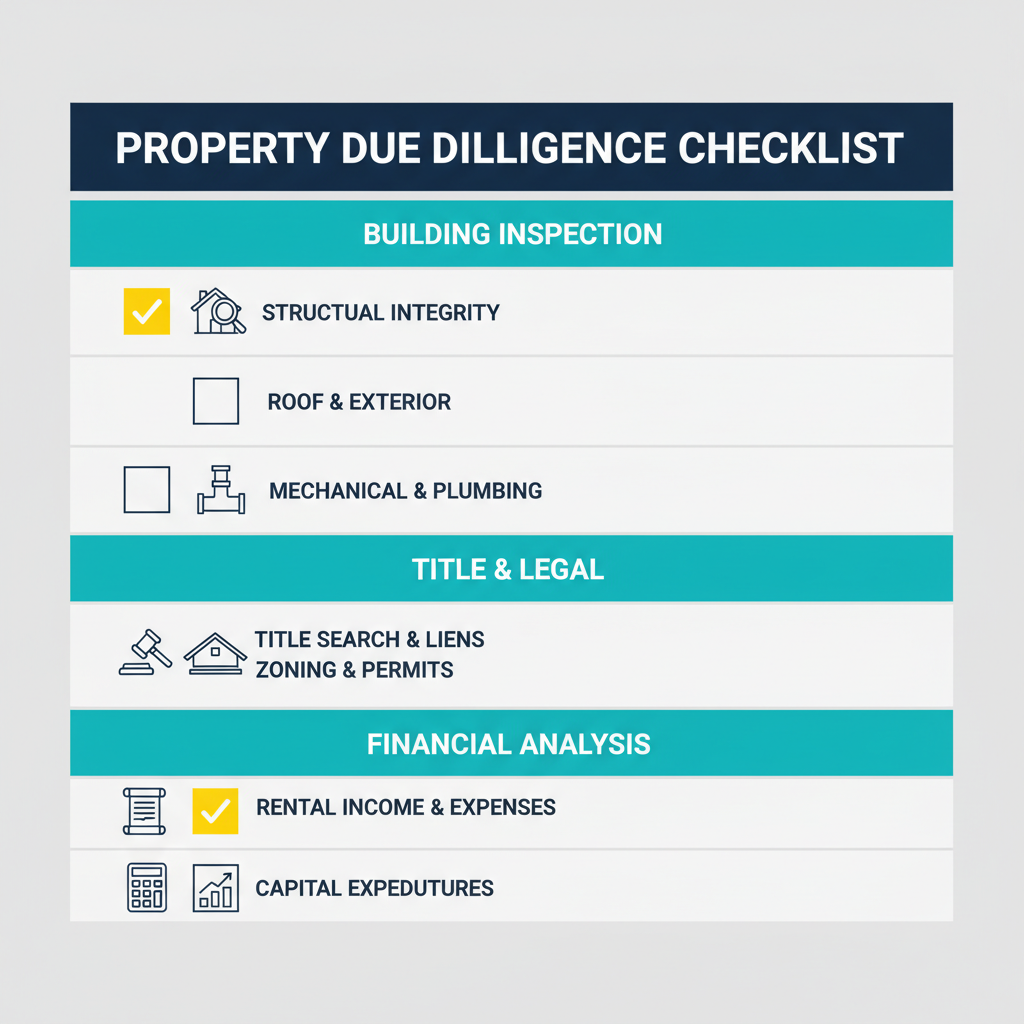
Due diligence when buying investment property in Australia goes far beyond a building inspection. A comprehensive property due diligence checklist includes:
- Title search: Confirming ownership, mortgages, easements, and encumbrances
- Zoning verification: Ensuring current use complies with council regulations
- Planning permits: Checking for approved developments that could impact property value
- Strata reports: Reviewing body corporate financials, levies, and defect history
- Building and pest inspections: Identifying structural issues, asbestos, and termite damage
- Flood and fire risk assessment: Understanding natural hazard exposure
- Rental appraisal: Confirming realistic rental income expectations
- Capital gains potential: Analyzing historical growth patterns and future infrastructure projects
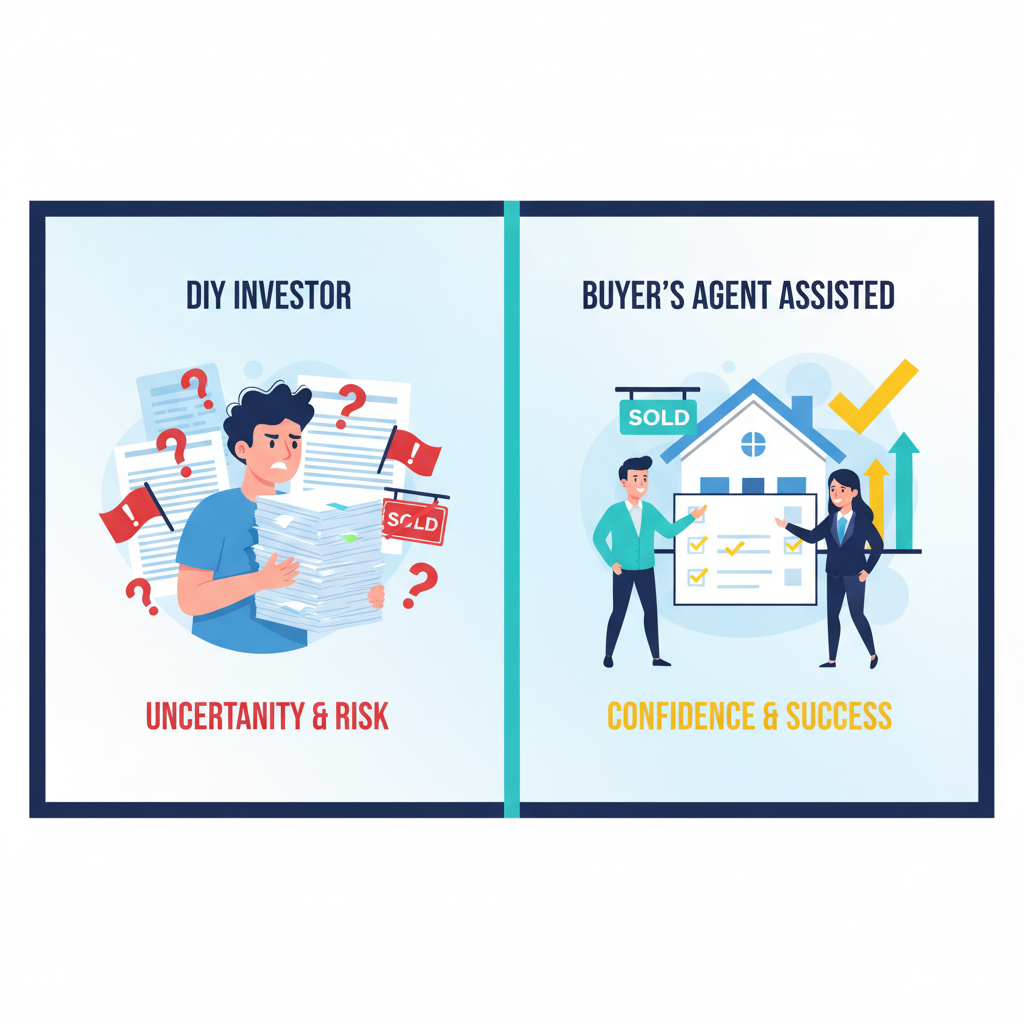
Professional buyers agents coordinate all these checks, interpret technical reports, and flag issues you'd never spot as a first-time investor. They've seen every trick dodgy vendors use and know which red flags justify walking away.
Negotiation Power You Can't Replicate
Here's an uncomfortable truth: selling agents hold all the knowledge, and most buyers play a hopeful guessing game. You don't know how long the property's been listed, how motivated the vendor is, or what comparable properties sold for off-market.
Buyers agents have these relationships and data points. They negotiate from a position of strength, often securing properties 5-15% below asking price. On a $700,000 property, that's $35,000–$105,000 saved—far more than typical buyers agent fees.
Accessing the Off-Market Advantage
Off-market properties represent 20% of Australia's total property market—approximately 100,000 transactions annually that never appear on Domain or realestate.com.au. These hidden opportunities offer:
- Reduced buyer competition
- Better negotiating leverage
- Access to premium stock vendors prefer to keep private
- More time for thorough due diligence
- Potential to purchase 10-20% below comparable market values
Most first-time investors never access this market because they lack agent relationships. Professional buyers agents like Buyers Agency Australia live in this space, maintaining networks across all major Australian capital cities.
The 7 Biggest Mistakes First-Time Investors Make
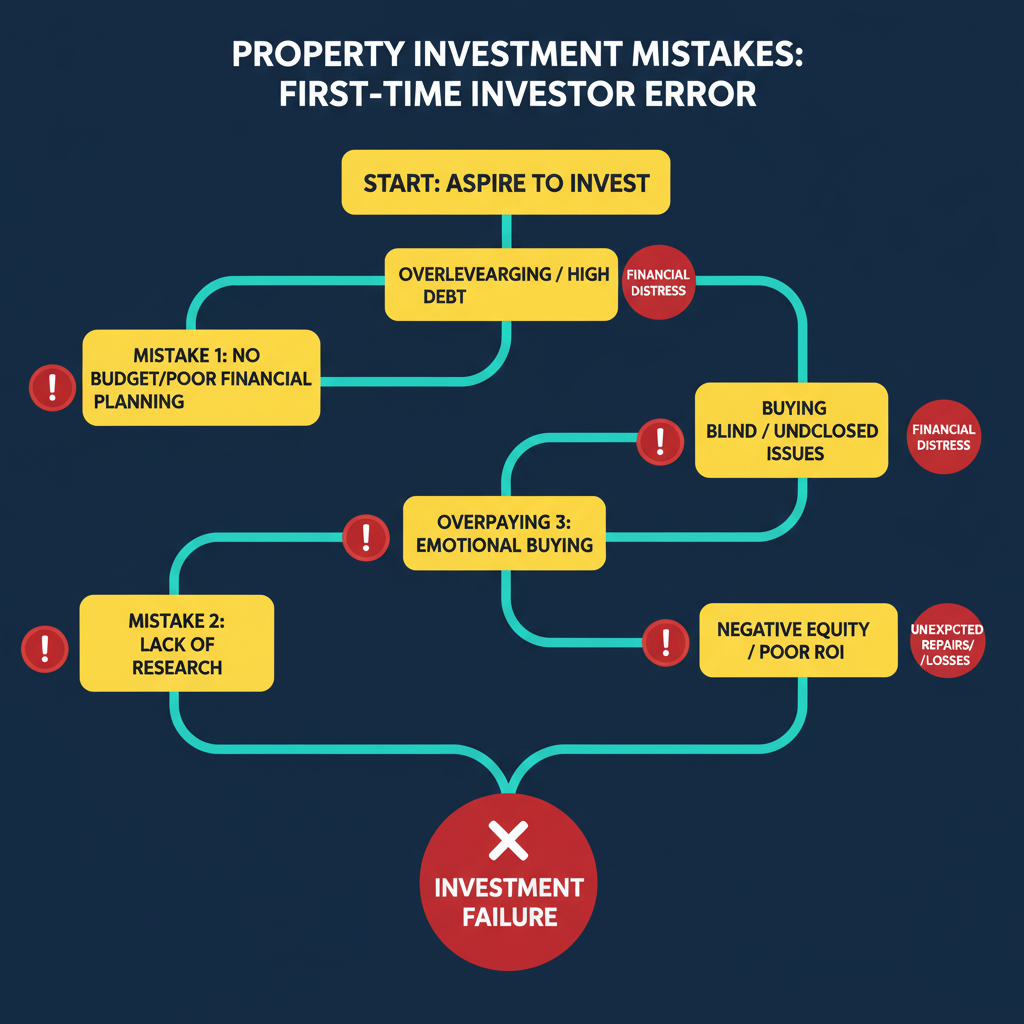
Mistake 1: No Clear Investment Strategy
One of the biggest first-time property investor mistakes is jumping into the market without a clear purpose. Are you targeting capital growth or rental yield? Is your priority passive income or equity accumulation for portfolio scaling?
Your goals should shape every decision—from property type and location to financing structure. Without clarity, you'll get distracted by market noise or emotional decisions.
Mistake 2: Buying in Your Own Backyard
First-time investors often stick to suburbs they know rather than researching locations with strong fundamentals. Just because you love living in Melbourne's inner east doesn't mean it's the right investment market in 2026.
Look for suburbs with reliable infrastructure, growing job hubs, population growth, and diverse tenant demand. Focus on long-term potential rather than short-term hype. Professional buyers agents analyze data across all capital cities to identify the best opportunities regardless of your current location.
Mistake 3: Falling for 'Hot Spot' Marketing
By the time a suburb appears on

 General
First-time property investors in Australia use buyers agents to avoid costly mistakes including emotional purchases, skipping due diligence,...
How We Buy Off Market Properties in Australia That Most Buyers Never See
Off-market properties represent 15-20% of all Australian property transactions worth billions in hidden opportunities that most buyers never access. These exclusive deals are purchased privately without public advertising, offering reduced competition and below-market-value pricing through strategic networks and industry relationships.
If you're searching for property in Australia's competitive market, you've probably lost out to buyers who somehow secured properties you never even knew existed. These aren't magic deals or insider scams. They're off-market properties, and accessing them requires the right strategy and connections.
The truth is, the best properties rarely hit Domain or realestate.com.au. Sellers with quality assets prefer private sales to avoid the circus of public campaigns, and savvy buyers use professional buyers agents to unlock these hidden opportunities. With around 20% of Australian property transactions happening off-market, you're competing with one hand tied behind your back if you're only searching online.
What Off Market Property Actually Means in Australia
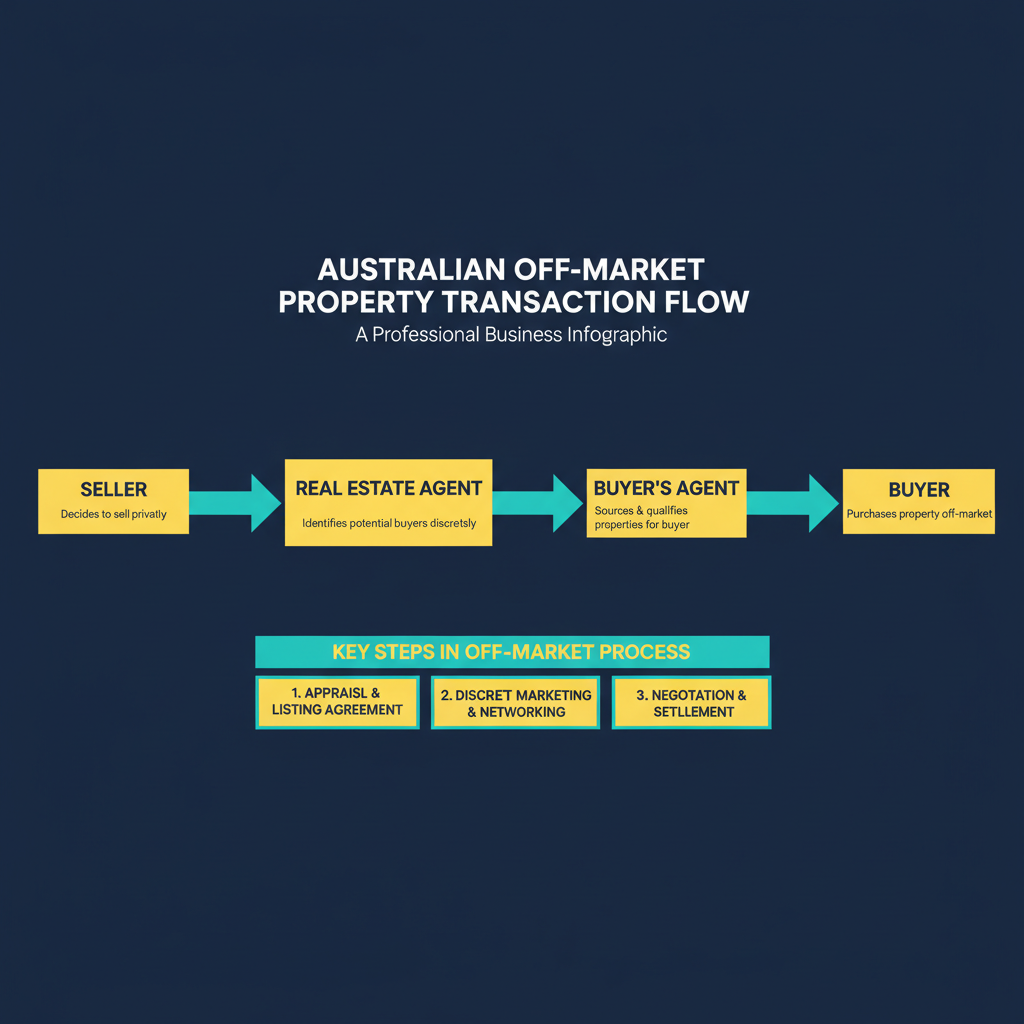
Off-market property refers to homes or investment assets sold without public advertising on major platforms like Domain or realestate.com.au. These transactions happen through private networks, direct relationships with selling agents, or exclusive buyer databases.
Unlike traditional listings, off-market properties skip open homes, public inspections, and advertising campaigns. The seller either contacts their agent privately to gauge buyer interest or a buyer's agent approaches the owner directly to initiate a sale.
Two Types of Off-Market Listings
Not all off-market deals are created equal. Understanding the difference helps you target the right opportunities.
True off-market properties are never advertised publicly. No photos, no floor plans, no internet presence. These sales happen through word-of-mouth, agent networks, or direct approaches to property owners. According to industry data, these represent the most exclusive opportunities.
Pre-market listings sit in a grey area. The agent lists the property on their website and shares it via their email database before launching a full campaign. Photos and floor plans exist, but the property hasn't hit the major portals yet. These deals give early access but face more competition than true off-market sales.
Why Sellers Choose Off-Market Sales
Sellers opt for private sales for several strategic reasons that create opportunities for prepared buyers.
Privacy and discretion top the list. High-profile individuals, divorcing couples, or those facing financial pressure prefer quiet transactions. They avoid nosy neighbours, unwanted attention, and the stress of strangers walking through their home every weekend.
Speed matters when sellers need to relocate quickly for work, settle estates, or capitalise on opportunities. Off-market sales typically close in 45-60 days compared to 3-4 months for traditional listings.
Cost savings appeal to vendors who want to avoid $10,000-$20,000 in marketing fees, professional photography, staging, and advertising campaigns. These savings often translate to better negotiating room for buyers.
The Real Advantage of Off-Market Property Access
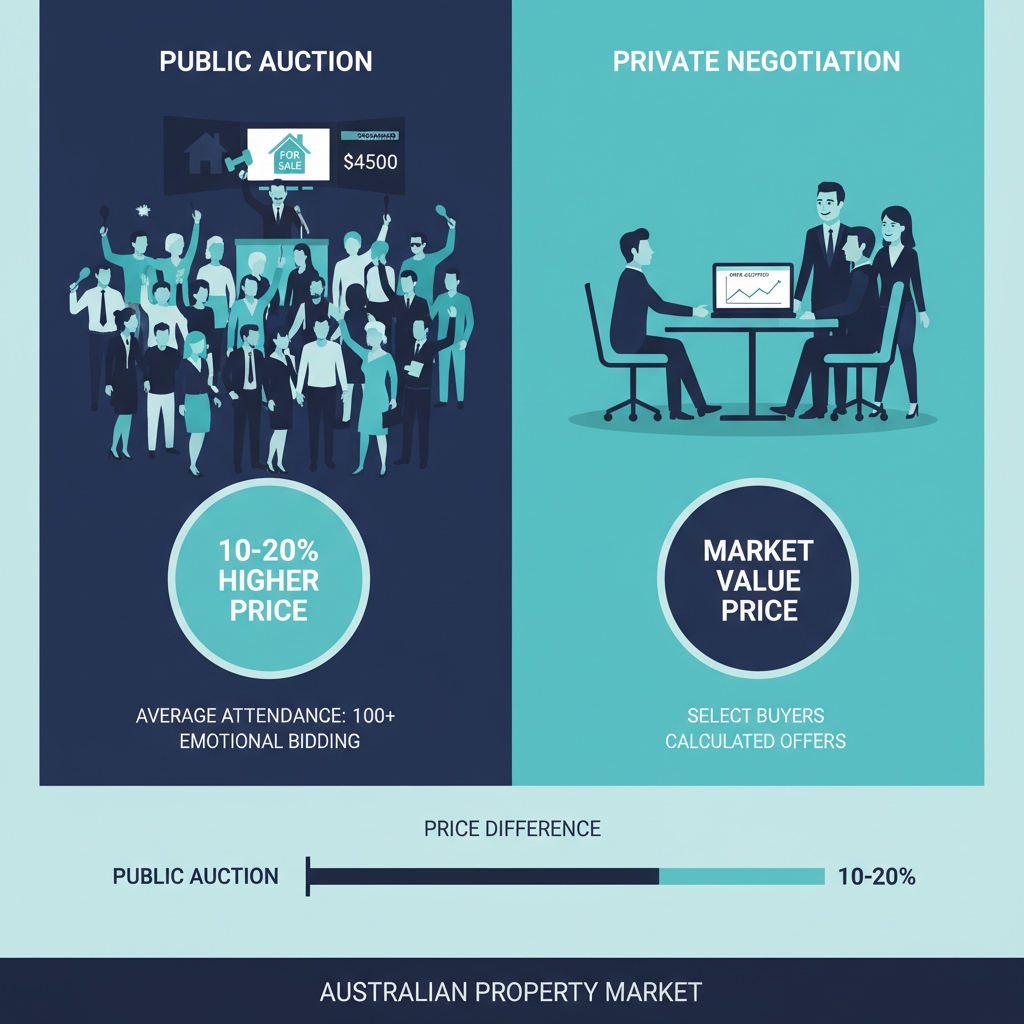
Buyer competition drives property prices higher. The fewer buyers competing for a property, the more negotiating power you have.
Less Competition Equals Better Pricing
Research from buyer's agents shows off-market properties often sell 10-20% below comparable market values. Without auction pressure or multiple buyer scenarios, rational negotiation replaces emotional bidding.
When a property hits Domain, it attracts 20, 50, sometimes 100 interested parties. Off-market deals might have 1-3 serious buyers. That changes everything.
Time to Conduct Proper Due Diligence
Public listings create artificial urgency. Buyers rush building and pest inspections, skip detailed suburb research, and make offers based on limited information.
Off-market transactions allow thorough investigation. You can take weeks to assess flood maps, check easements, review development plans, and ensure the property genuinely matches your investment criteria. At Buyers Agency Australia, we complete comprehensive due diligence before our clients even inspect a property.
First Access to Quality Stock
The best properties attract the most competition. Sellers of premium assets know they'll achieve strong prices, so they often test the off-market waters first. This means quality properties circulate privately before ever reaching public channels.
Accessing these deals requires established relationships with selling agents who trust you'll move quickly and won't waste their time.
How Professional Buyers Agents Access Off-Market Deals

Most buyers assume they can replicate a buyer's agent's network by calling a few agents. They're wrong. Professional access requires years of relationship building and daily market engagement.
Established Industry Networks
Buyer's agents cultivate relationships with hundreds of selling agents across multiple markets. These aren't casual contacts. They're trusted professional relationships built on years of successful transactions.
Selling agents prefer working with buyer's agents because they bring pre-qualified buyers who can move quickly. When an agent has an off-market opportunity, they call their trusted buyer's agent contacts first.
To replicate this yourself, industry research suggests "a buyer would need to call 25 or more agents every single day."
Direct Vendor Approaches
Experienced buyer's agents don't wait for properties to come to market. They proactively approach property owners in target suburbs to gauge selling interest.
This strategy works particularly well for investors building portfolios in specific areas. If you're targeting houses in Brisbane's inner suburbs or units in Melbourne's growth corridors, a buyer's agent can contact owners directly to create opportunities.
Exclusive Agent Databases and Platforms
Buyer's agents maintain access to exclusive databases and platforms unavailable to the public. While platforms like Listing Loop offer some off-market access, professional agents receive first call on truly exclusive opportunities before they reach any platform.
These relationships provide early access to pre-market listings, withdrawn properties being relisted, and vendors testing the market before committing to full campaigns.
Market Intelligence and Timing
Knowing when to approach owners matters as much as knowing who to approach. Buyer's agents track property ownership history, recent sales in the area, and market conditions to identify motivated sellers.
Properties that previously failed to sell, estates being settled, or owners who purchased elsewhere create natural off-market opportunities for agents who monitor these triggers.
Five Ways to Find Off-Market Properties Without a Buyers Agent
If you're determined to search independently, these strategies give you the best chance of accessing off-market deals.
Build Relationships with Local Real Estate Agents
Register with every agent in your target suburb. Not just email registration, actual relationship building. Visit their offices, attend open homes, demonstrate you're a serious buyer with finance ready.
Be specific about your criteria: property type, budget range, settlement timeline. Agents keep databases of buyers and match them to off-market opportunities.
The catch? You need pre-approval ready and must prove you'll act quickly when opportunities arise.
Use Off-Market Property Platforms
Several Australian platforms specialise in off-market listings:
- Listing Loop provides pre-market and off-market properties nationwide
- Property Whispers connects buyers with exclusive opportunities
- Domain's off-market section offers limited access to early listings
These platforms work, but remember you're competing with other subscribers. True off-market deals still circulate privately before reaching platforms.
Network Within Your Target Community
Word travels fast in local communities. Tell friends, family, colleagues, and neighbours you're actively searching. Local businesses, schools, and community groups can surface unexpected opportunities.
Some buyers have success with direct mail campaigns, sending letters to homeowners in desired streets expressing interest in purchasing if they're open to selling.
Monitor Properties Recently Removed from Market
Properties that failed to sell publicly often return as off-market opportunities. Owners who experienced unsuccessful campaigns may accept reasonable private offers to avoid relisting fees and public marketing.
Track listings that withdraw or expire in your target suburbs. Contact the listing agent expressing interest in a private negotiation.
Approach Potential Sellers Directly
If you've identified a specific property you want, nothing stops you from approaching the owner directly. Write a respectful letter explaining your interest, include your contact details, and make it clear you're a genuine buyer.
This approach works best for vacant properties, estates, or obvious renovation candidates where owners might be motivated to sell without marketing costs.
Why 2026 Makes Off-Market Access Critical
Australia's property market continues tightening, making off-market access more valuable than ever.
Supply Constraints Continue
National listings remain below five-year averages despite increased buyer activity. Property market analysis shows "Sydney accounted for 17 of the top 20 residential sales this year, amounting to $1.1 billion in aggregate," with many occurring off-market.
When quality properties are scarce, early access through off-market channels becomes essential.
Investor Competition Increases
Investor lending rose 13.6% in recent quarters, adding heat to an already competitive market. Experienced investors understand off-market advantages and increasingly engage buyer's agents to access these opportunities.
First-home buyers face professional investors with established networks. Levelling the playing field requires professional representation or exceptional relationship building.
Price Growth Continues Despite Challenges
Market forecasts predict "property price growth to slow to around 5-7% in 2026" but that still means rising prices. Off-market purchases help avoid bidding wars that push prices beyond rational investment thresholds.
Brisbane, Perth, and Adelaide lead growth predictions, making off-market access particularly valuable in these markets.
How Buyers Agency Australia Sources Off-Market Opportunities
At Buyers Agency Australia, off-market property forms the foundation of our client service. Our approach differs from standard buyer's agent services.
Decades of Established Relationships
Our principal, Dragan Dimovski, built relationships across all major Australian markets over 20+ years. These aren't transactional connections. They're built on trust, successful settlements, and mutual respect.
When quality off-market opportunities emerge, we receive first call because agents know we bring qualified buyers who close deals efficiently.
Data-Driven Property Selection
We don't chase every off-market opportunity. Our team analyses each property against rigorous investment criteria before presenting it to clients. This includes:
- 10-year growth projections based on infrastructure, employment, and demographic trends
- Rental yield analysis and tenant demand assessment
- Building and pest considerations before inspection
- Comparable sales and genuine market value determination
This screening ensures clients only see off-market properties that genuinely match their investment goals.
Proactive Vendor Engagement
Our team actively approaches property owners in high-growth suburbs before they list publicly. This proactive strategy creates opportunities rather than waiting for them to emerge.
For clients building specific portfolios, this targeted approach proves invaluable. We can focus on exact locations, property types, and price points that align with long-term wealth strategies.
Transparent Fixed-Fee Structure
Unlike commission-based agents, our fixed-fee model eliminates conflicts of interest. We're not incentivised to push higher-priced properties or rush clients into unsuitable purchases.
This transparency matters in off-market negotiations where pricing lacks public benchmarks. Our clients trust we're negotiating in their best interest, not maximising our commission.
Comprehensive Post-Purchase Support
Our service extends beyond settlement. We help clients integrate properties into long-term wealth strategies, connect them with property managers, and provide ongoing portfolio advice.
This holistic approach distinguishes us from transactional buyer's agents focused solely on the next deal.
Off-Market Myths That Cost Buyers Money
Several misconceptions about off-market property prevent buyers from accessing these opportunities effectively.
Myth: All Off-Market Properties Are Bargains
Not every off-market property offers value. Some sellers set unrealistic prices precisely because they're avoiding market scrutiny. Without comparable sales pressure, vendors sometimes overvalue their properties.
Professional buyers agents assess genuine market value before making offers. Just because it's off-market doesn't make it a good deal.
Myth: You Need Insider Connections
Off-market access doesn't require secret handshakes or insider connections. It requires systematic relationship building, market knowledge, and professional representation.
While established agents have advantages, even new entrants can access off-market deals by demonstrating professionalism, quick decision-making, and financial readiness.
Myth: Off-Market Properties Have Hidden Problems
Some buyers assume properties sell privately because they have issues. While this occasionally happens, most off-market sales occur for legitimate privacy, timing, or cost-saving reasons.
Apply the same due diligence to off-market properties as public listings. Building and pest inspections, title searches, and market analysis remain essential.
Myth: Only Expensive Properties Sell Off-Market
Off-market transactions occur across all price brackets. While luxury properties often sell privately, first-home buyer properties and mid-range investments also circulate off-market regularly.
Research indicates "around 20% of homes are sold off-market each year" across all market segments.
The Due Diligence Process for Off-Market Purchases
Off-market purchases require heightened due diligence because you can't benchmark against recent public sales as easily.
Comprehensive Market Analysis
Without public listing data, determining fair market value requires deeper analysis. Compare recent sales of similar properties in the suburb, adjust for condition and features, and account for current market conditions.
Professional valuations provide independent price verification. Many buyers skip this step on public listings but should never skip it off-market.
Building and Pest Inspections
Never waive building and pest inspections on off-market purchases. The lack of public scrutiny means fewer eyes have assessed the property's condition.
Budget $500-$800 for comprehensive inspections covering structural integrity, pest activity, and major system functionality.
Title Searches and Legal Review
Verify the vendor legally owns the property and no unusual encumbrances, easements, or restrictions exist. Off-market transactions sometimes involve complex ownership structures requiring legal expertise.
Engage a conveyancer or solicitor early to review contracts and identify potential issues before commitment.
Suburb and Location Analysis
Just because you're buying off-market doesn't mean you should compromise on location. Analyse:
- Recent infrastructure announcements affecting the suburb
- Employment hub proximity and transport access
- School zones and demographic trends
- Comparable rental yields and vacancy rates
For investment properties, location drives long-term returns more than purchase price discounts.
Common Off-Market Buying Mistakes to Avoid
Even experienced buyers make mistakes when purchasing off-market properties.
Rushing Due Diligence
The reduced competition of off-market deals can create false urgency. Some buyers rush inspections and analysis, assuming they'll lose the opportunity.
In reality, off-market transactions typically allow more time for thorough assessment. Use that advantage rather than rushing into regrettable purchases.
Overpaying Because It Feels Exclusive
The exclusive nature of off-market deals can cloud judgment. Buyers sometimes pay premiums for properties they perceive as special opportunities when public listings offer better value.
Always compare off-market pricing against recent public sales. If the price exceeds market value, exclusivity doesn't justify overpaying.
Skipping Professional Representation
Some buyers attempt off-market purchases independently to save buyer's agent fees. This often costs significantly more through poor negotiations, overpriced purchases, or missed opportunities.
Professional representation provides market knowledge, negotiation expertise, and access to opportunities unavailable to independent buyers.
Limiting Your Search to Off-Market Only
Focusing exclusively on off-market properties restricts your options. The best strategy combines off-market access with public market monitoring.
Some excellent properties do hit the public market. Don't miss opportunities by restricting your search to private sales only.
How to Prepare for Off-Market Opportunities
When off-market opportunities arise, you need to act quickly. Preparation separates successful buyers from those who miss out.
Secure Finance Pre-Approval
Nothing kills off-market deals faster than financing delays. Obtain full finance pre-approval before searching, not just conditional approval.
Lenders offering fast turnaround and flexibility with off-market transactions provide competitive advantages. Speak with a mortgage broker experienced in investment property financing.
Define Your Investment Criteria
Know exactly what you're looking for before opportunities arise. Specific criteria include:
- Target suburbs and property types
- Price range and deposit available
- Rental yield requirements
- Settlement timeline flexibility
- Property condition expectations
Clear criteria allow quick decision-making when off-market properties emerge.
Establish Your Team
Assemble your property team before you need them: buyer's agent, mortgage broker, conveyancer, building inspector. Established relationships enable fast responses when opportunities arise.
Off-market deals often move quickly. Having professionals on standby prevents delays that lose opportunities.
Build Cash Reserves
Off-market purchases sometimes require faster settlements or unconventional terms. Adequate cash reserves provide negotiating flexibility and demonstrate serious buyer intent.
Budget for deposit, purchase costs, immediate repairs or improvements, and 3-6 months holding costs.
The Future of Off-Market Property in Australia
Off-market transactions will likely increase as technology and buyer sophistication evolve.
Digital Platforms Expanding Access
Platforms like Listing Loop democratise off-market access, allowing more buyers to view pre-market opportunities. However, true off-market deals will always circulate through established professional networks first.
Technology improves access but doesn't replace relationships.
Investor Demand Driving Growth
As more investors recognise off-market advantages, demand for buyer's agents with strong networks increases. This professionalization benefits serious buyers while making independent off-market access harder.
Market Conditions Favoring Private Sales
Supply constraints and elevated marketing costs make off-market sales attractive for vendors. Expect this trend to continue, particularly in capital cities where marketing campaigns cost $15,000-$30,000.
Take Action on Off-Market Opportunities
Off-market property access provides genuine competitive advantages in Australia's tight market. Whether you're a first-home buyer tired of auction disappointments or an investor building a portfolio, accessing these hidden opportunities changes your property journey.
The choice is clear: spend months calling agents daily and hoping for opportunities, or engage professionals with established networks who receive first call when quality properties become available.
At Buyers Agency Australia, we've helped hundreds of clients secure off-market properties that never reach public listings. Our established relationships, data-driven approach, and transparent fee structure provide the competitive edge you need.
Ready to access opportunities most buyers never see? Book a free strategy session to discuss how we can help you secure your next property off-market, or visit our FastTrack event to learn our proven property investment strategies.
The best properties are selling right now, privately, to buyers with the right connections. Make sure you're one of them.
Frequently Asked Questions
What percentage of properties sell off-market in Australia?
Approximately 15-20% of all Australian property transactions occur off-market annually, representing billions in hidden opportunities that most buyers never access.
Can I find off-market properties without a buyers agent?
Yes, through building agent relationships, using platforms like Listing Loop, and networking locally, though professional representation provides significantly better access and outcomes.
Are off-market properties cheaper than public listings?
Off-market properties often sell 10-20% below comparable market values due to reduced competition, though not every off-market deal offers value.
How long does it take to buy off-market property?
Off-market transactions typically take 45-60 days from offer to settlement, faster than the 3-4 months required for traditional public listings.
Do first-home buyers have access to off-market properties?
Yes, first-home buyers can access off-market opportunities through buyer's agents or by building relationships with local agents, though competition from investors exists.
 General
Discover how buyers agents access exclusive off-market properties in Australia through industry networks, relationships, and strategies unavailable to...
Capital Growth vs Cash Flow What Actually Builds Wealth in Property Investing Australia
Capital growth builds property portfolios, while cash flow sustains them. For most Australian investors, prioritising capital growth early allows them to scale, build equity, and open up future options, whereas focusing on cash flow too soon often limits long-term wealth creation.
If you're searching for the right investment strategy, you've probably heard these terms thrown around. Some experts swear by high rental yields. Others talk about capital gains like it's the only thing that matters.
Here's the reality: both strategies play critical roles in building wealth through property. The difference lies in understanding when to use each one and how they work together. Most investors don't fail because they picked the wrong strategy. They fail because they didn't have a strategy at all.
This article breaks down the core difference between capital growth and cash flow, how each one affects your portfolio, and how Buyers Agency Australia helps investors build balanced, scalable portfolios that generate both.
What Capital Growth and Cash Flow Actually Mean
Before jumping into which strategy is better, you need to understand what each one actually does for your investment.
Capital Growth Definition
Capital growth is the increase in a property's market value over time. It's measured by comparing what you paid for the property against what it's worth today.
For example, if you bought an investment property for $600,000 in 2020 and it's now valued at $750,000, you've achieved $150,000 in capital growth. That's a 25% increase over five years.
Capital growth is not taxed unless you sell the property. This gives you flexibility in how and when you realise gains. More importantly, capital growth creates equity, which you can use to purchase additional properties without selling your existing assets.
CoreLogic data shows national dwelling values rose 8.6% in 2025, adding approximately $71,360 to the median Australian dwelling value.
Cash Flow Definition
Cash flow refers to the difference between rental income and all property-related expenses. This includes mortgage repayments, council rates, strata fees, property management fees, insurance, maintenance, and land tax.
Positive cash flow means your rental income exceeds your expenses. Negative cash flow (negative gearing) means you're topping up the property from your own pocket each week or month.
A property generating $650 per week in rent with total expenses of $600 per week delivers $50 per week positive cash flow, or roughly $2,600 annually.
Cash flow impacts your borrowing capacity and serviceability. Banks assess your ability to service additional debt based on rental income (minus a buffer) and your current expenses.
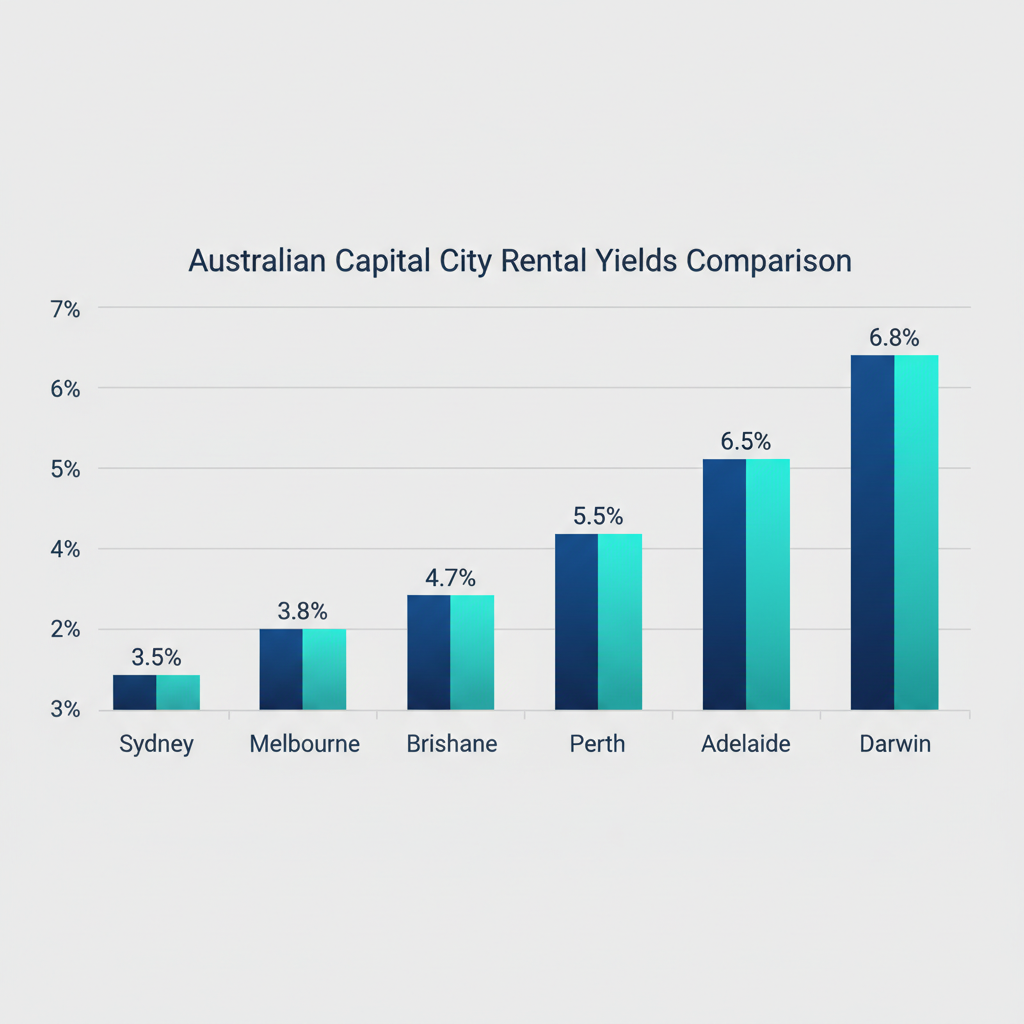
According to SQM Research, national rental yields in 2025 range from 2.9% in Brisbane houses to 7.5% in Darwin units, showing significant variation across markets.
The Core Difference Between the Two
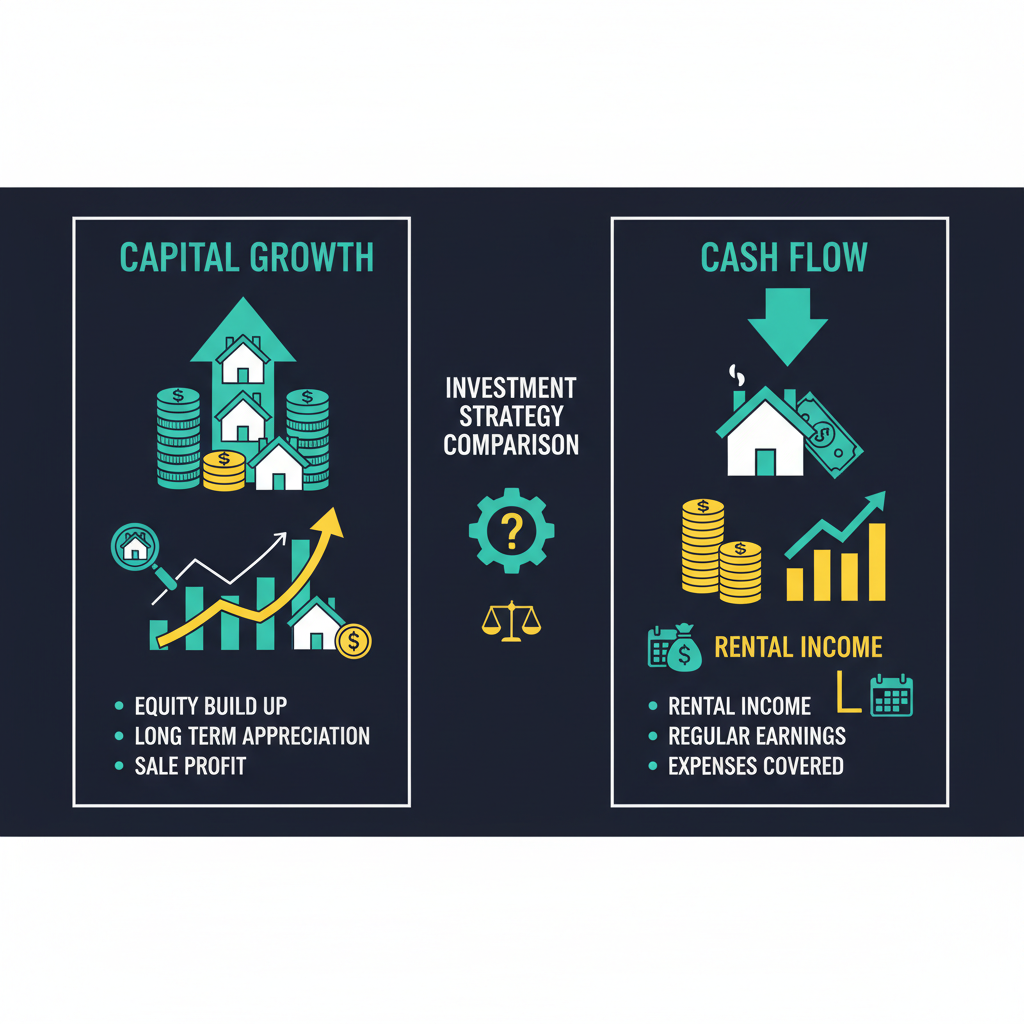
Capital growth compounds over time and builds wealth you can access through equity. Cash flow provides income and helps you hold properties without financial stress.
One builds your net worth. The other sustains your ability to keep investing.
Most property investors assume they must choose one or the other. The reality is that successful portfolios combine both strategies at different stages.
Why Capital Growth Matters More in the Early Stages
If you're building a property portfolio from scratch, capital growth gives you the fastest path to scale.
Equity Is What Funds Your Next Purchase
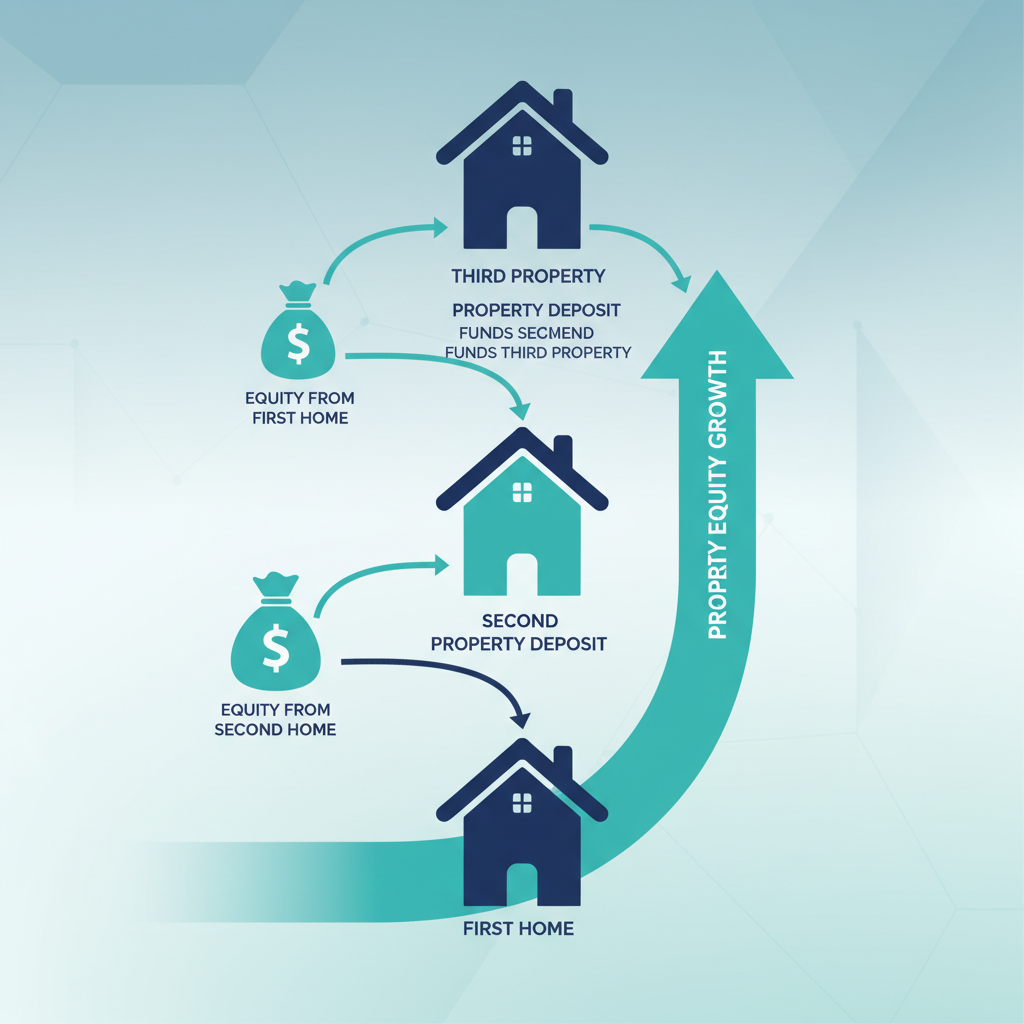
When your property increases in value, you build usable equity. Lenders allow you to borrow against that equity (typically up to 80% of the property's value) to fund your next deposit.
Without capital growth, you're stuck waiting until you save another deposit manually. That can take years.
For example, if your $600,000 property grows to $750,000, you've created $150,000 in equity. At 80% LVR, you can access up to $120,000 in usable equity (after accounting for the original loan balance).
That equity becomes the deposit for your second property. Then your third. This is how investors scale from one property to five or more.
Capital Gains Are Tax-Efficient
Rental income is taxed as ordinary income every year at your marginal tax rate. If you're earning $120,000 per year, rental income is taxed at 37% (plus Medicare levy).
Capital growth, on the other hand, is only taxed when you sell. Even then, if you've held the property for more than 12 months, you receive a 50% CGT discount.
This means capital growth is far more tax-efficient than cash flow for wealth accumulation.
According to the Australian Taxation Office, investors who hold properties long-term and focus on capital growth defer tax and benefit from concessional treatment.
Long-Term Wealth Comes From Appreciation
Over the past 30 years, Australian property values have grown at an average of 6.4% per annum. That means a property purchased for $400,000 in 1995 is now worth approximately $2.5 million.
Cash flow, while helpful, doesn't compound in the same way. A property generating $5,000 per year in positive cash flow will deliver $50,000 over 10 years. A property growing at 6% per year will add $300,000+ in value over the same period.
Historical CoreLogic data confirms that capital city properties have consistently outperformed regional markets in long-term capital growth, despite lower rental yields.
When Cash Flow Becomes Important
Cash flow isn't about getting rich. It's about staying in the game long enough for capital growth to do its job.
Serviceability Limits How Many Properties You Can Buy
Banks assess your borrowing capacity based on your income, existing debts, and the rental income from investment properties.
If every property you own is negatively geared by $200 per week, your serviceability shrinks quickly. After two or three properties, you may not qualify for another loan, even if you have plenty of equity.
Properties with strong rental yields improve your serviceability, allowing you to borrow more and buy more.
Holding Costs Can Force You to Sell
If you can't afford to hold your properties during periods of high interest rates or vacancy, you'll be forced to sell before realising capital gains.
Negative gearing is manageable when you have one property. It becomes a problem when you own multiple properties all losing money every month.
Investors who prioritise cash flow build buffers that protect them during downturns.
Cash Flow Supports Long-Term Portfolio Growth
Once you've built equity through capital growth, switching to cash flow-positive properties allows you to scale further without overextending yourself.
This is the strategy used by portfolio builders who own 5, 10, or 15+ properties. Early properties focus on growth. Later properties focus on income.
According to industry research, investors who balance both strategies are more likely to hold properties long-term and achieve financial independence.
How to Identify High Capital Growth Properties
Not every property grows at the same rate. Certain factors consistently drive above-average capital growth.
Location and Infrastructure Investment
Properties located near major infrastructure projects (new train lines, highways, hospitals, universities) tend to outperform.
Government spending on infrastructure signals long-term confidence in an area and attracts new residents, which drives demand.
For example, suburbs along Brisbane's Cross River Rail corridor have seen significant capital growth since construction began.
Supply and Demand Imbalance
Markets with limited new housing supply and strong population growth deliver the best capital growth.
Perth, Brisbane, and Adelaide all recorded double-digit capital growth in 2025 due to tight supply and strong interstate migration.
Propertyology data shows Perth house values grew 13%, Brisbane 12%, and Adelaide 9% in 2025.
Suburb Gentrification and Uplift
Suburbs experiencing gentrification, new cafes, retail precincts, and demographic shifts often deliver above-average growth.
Investors who buy early in these cycles capture significant capital gains as the suburb matures.
Owner-Occupier Demand
Properties that appeal to owner-occupiers (not just investors) tend to grow faster. Owner-occupiers pay more because they're buying lifestyle, not just yield.
Look for suburbs with good schools, parks, low crime, and proximity to employment hubs.
How to Identify High Cash Flow Properties
If your strategy requires positive cash flow, you need to know where to find it.
Regional and Mining Towns
Regional Western Australia and Queensland deliver some of the highest rental yields in Australia.
Tom Price in WA recorded a 13.2% rental yield for houses in 2025, while Newman delivered 12.4% for units, according to CoreLogic data.
These markets are driven by mining and resource sector employment, which creates strong rental demand.
Unit Markets in Capital Cities
Units typically deliver higher rental yields than houses due to lower purchase prices and strong tenant demand.
Darwin units average 7.5% rental yield, Perth units 5.7%, and Canberra units 5.2%, according to GlobalPropertyGuide.
Affordable Suburbs With Strong Rental Demand
Suburbs with median house prices under $600,000, low vacancy rates, and proximity to universities, hospitals, or industrial estates often deliver strong cash flow.
These areas attract renters who can't afford to buy but have stable employment.
Dual-Income and Granny Flat Properties
Properties with secondary dwellings, granny flats, or dual-occupancy setups generate two rental incomes from one asset.
This significantly improves cash flow and serviceability.
The Balanced Strategy Most Successful Investors Use
You don't have to pick one strategy and stick with it forever. The smartest investors use both at different stages.
Start With Capital Growth
Your first 1-3 properties should prioritise capital growth. This builds equity quickly and gives you the financial leverage to keep buying.
Focus on capital city suburbs or high-growth regional areas with strong fundamentals.
Add Cash Flow to Sustain Your Portfolio
Once you've built equity, add cash flow-positive properties to improve serviceability and reduce financial stress.
This allows you to hold more properties without overextending your income.
Refinance and Repeat
As your properties grow in value, refinance to access equity and reinvest. This is how investors build portfolios of 5, 10, or 15+ properties over 10-20 years.
The key is patience. Property is not a get-rich-quick strategy. It's a long-term wealth-building vehicle.
Example Portfolio Structure
- Property 1: Sydney or Melbourne suburb, strong capital growth, negatively geared
- Property 2: Brisbane or Adelaide suburb, balanced growth and yield
- Property 3: Regional Queensland or WA, high cash flow, positively geared
This structure balances growth, income, and serviceability.
Common Mistakes Investors Make
Understanding the strategy is one thing. Avoiding mistakes is another.
Chasing Yield Without Growth
Buying a property purely because it has a 7% rental yield is dangerous if the area has no growth prospects.
You'll earn income but never build equity. In 10 years, your property might still be worth what you paid for it.
Without capital growth, you can't scale.
Buying Growth Properties You Can't Afford to Hold
On the flip side, buying a high-growth property with terrible cash flow can force you to sell before you realise the gains.
If you can't afford to hold the property through rate rises or vacancies, you'll lose.
Ignoring Market Cycles
Every market moves in cycles. Perth was flat for a decade before booming in 2022-2025. Melbourne delivered strong growth from 2012-2017, then slowed.
Investors who buy at the peak of a cycle often wait years for returns. Those who buy early in the cycle capture the best gains.
Not Having a Long-Term Plan
Most investors buy one property and stop. They don't have a roadmap for property two, three, or four.
Without a plan, you're reacting to market conditions instead of building strategically.
How Buyers Agency Australia Balances Growth and Cash Flow for Clients
At Buyers Agency Australia, we don't believe in one-size-fits-all strategies.
Our process starts with understanding where you are in your investment journey, your borrowing capacity, and your long-term goals.
For early-stage investors, we focus on capital city suburbs with strong growth fundamentals. We identify areas with infrastructure investment, limited supply, and owner-occupier demand.
For portfolio builders, we source properties that balance growth and yield, ensuring your serviceability remains strong while your equity continues to compound.
We also help clients structure their purchases correctly from day one. That means using the right entities, lenders, and tax strategies to maximise long-term returns.
With over 20 years of experience and a $10M+ personal portfolio, Dragan Dimovski understands how to build scalable, sustainable portfolios that deliver both income and growth.
If you're ready to build a portfolio that actually works, book a free strategy session today.
Frequently Asked Questions
Should I prioritise capital growth or cash flow as a first-time investor?
Capital growth. It builds equity faster, allowing you to buy property two and three sooner. Cash flow becomes more important once you own multiple properties.
What is a good rental yield in Australia?
National averages range from 3-6%. Sydney averages 3.1%, while Darwin delivers 6.6%+. Regional areas often exceed 8%, but check growth prospects.
Can a property deliver both capital growth and cash flow?
Yes, but it's rare. Properties in Brisbane, Adelaide, and Perth often deliver balanced growth and yield. Regional QLD and WA offer high cash flow.
How do I calculate net rental yield?
Divide annual rental income by property value, then subtract all expenses (rates, insurance, strata, management, maintenance). Multiply by 100 for percentage.
Is negative gearing still worth it in 2026?
Yes, if the property delivers strong capital growth. Negative gearing reduces your taxable income while equity compounds. It's a long-term wealth strategy.
 General
Discover how capital growth and cash flow strategies work together to build long-term wealth in Australian property investment,...
Co Living with a Normal House No Design and Renovation Needed for Investors
Co-living with a normal house is a property investment strategy where you rent individual rooms in a standard residential home to multiple tenants, generating higher rental yields than traditional single-lease arrangements—without requiring expensive renovations or purpose-built designs.
If you're priced out of commercial co-living developments or rooming house conversions, there's good news. You can achieve similar rental returns using a standard three or four-bedroom house in the right location. This approach, often called house hacking, lets you turn an ordinary property into a cash-flowing asset by renting rooms individually rather than leasing the whole dwelling to one tenant.
The strategy works particularly well in high-demand rental markets near universities, hospitals, or major employment hubs. Unlike purpose-built rooming houses that require council approvals and significant capital outlay, this model uses existing housing stock and leverages strong tenant demand for affordable, flexible accommodation. Buyers Agency Australia helps investors identify properties with co-living potential in growth corridors across Brisbane, Melbourne, and Sydney.
Why Co Living with Standard Houses Is Gaining Momentum in 2026
Australia's housing affordability crisis has created massive demand for shared accommodation. According to Knight Frank research, "co-living has established itself as a genuine alternative to traditional housing types" with national supply surpassing 10,000 units across completed, under-construction, and planned projects.
But here's the thing: you don't need to build a purpose-designed co-living complex to benefit from this trend. Standard houses in the right suburbs can deliver similar outcomes with far less complexity.
Market Forces Driving Demand
Several factors are converging to make room-by-room rental strategies more attractive in 2026:
- Vacancy rates below 2% in most capital cities create intense competition for any affordable rental option
- Rising property prices push single professionals and students toward shared living to split costs
- Remote work flexibility means tenants prioritize location and amenities over dwelling size
- Single-person households growing especially among women aged 25-45, creating a natural tenant pool
The beauty of using a normal house is simplicity. You're not navigating rooming house regulations, building codes for self-contained units, or construction timelines. You're buying a standard residential property and optimizing its rental structure.
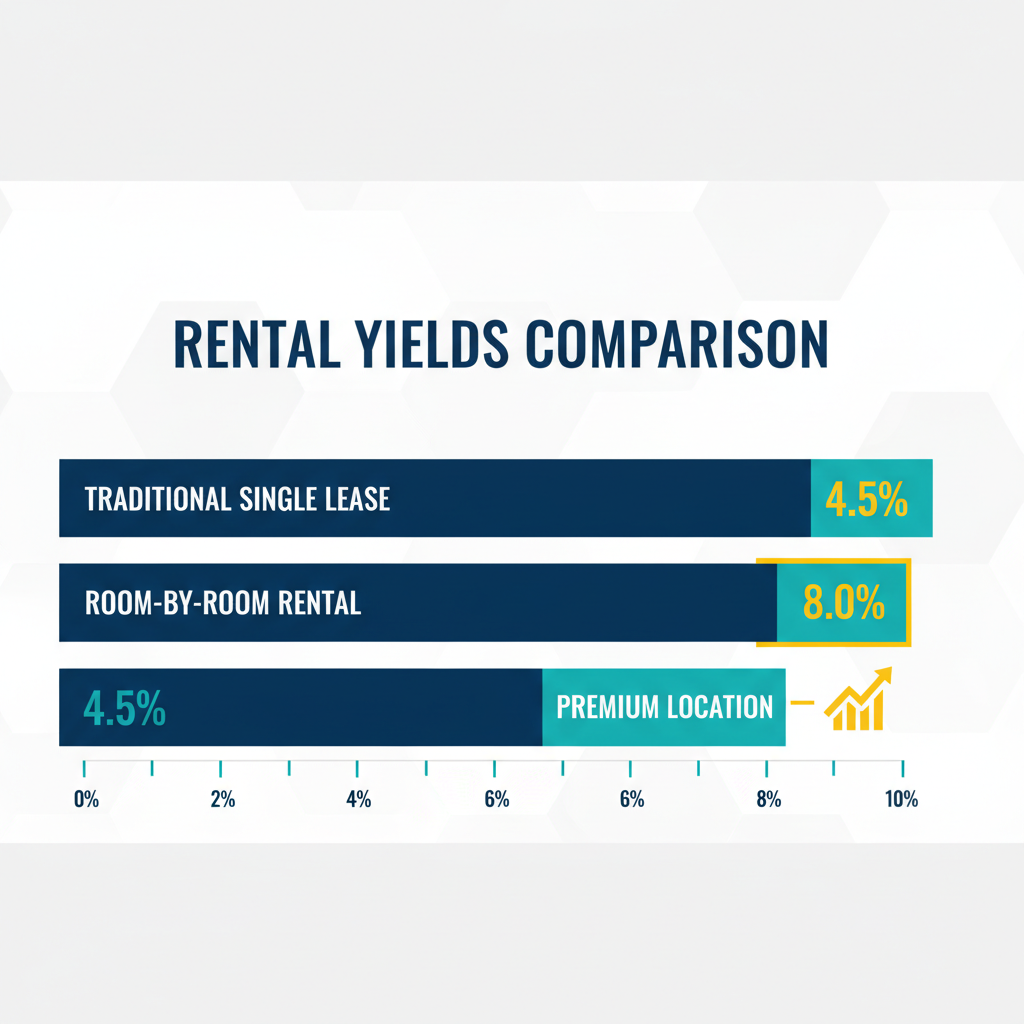
Rental Yield Comparison: Traditional vs Room-by-Room
Let's look at real numbers from a typical Brisbane suburb:
| Rental Strategy |
Weekly Income |
Annual Income |
Gross Yield (on $650k property) |
| Traditional single lease (4-bed house) |
$560 |
$29,120 |
4.5% |
| Room-by-room rental (4 bedrooms at $200/week each) |
$800 |
$41,600 |
6.4% |
| Premium location rooms (4 at $250/week) |
$1,000 |
$52,000 |
8.0% |
That's potentially double the gross yield without changing the physical property. The difference comes entirely from rental structure and tenant selection.
Data from SQM Research shows average rental yields for houses in major capitals hover around 3-4%, while investors using shared accommodation models report 6-8% gross yields on similar properties.
How House Hacking Works Without Major Renovations
House hacking is a real estate investment strategy where you purchase a property, live in part of it, and rent out the remaining space to offset your mortgage. When done with a standard house, you're essentially becoming a live-in landlord or converting the property to multiple individual leases.
The Basic House Hacking Model
Here's how the simplest version works:
- Purchase a standard 3-5 bedroom house in a high-demand rental area
- Live in one bedroom (if owner-occupied) or rent all rooms separately
- Lease remaining bedrooms individually to working professionals or students
- Collect rent from multiple tenants that collectively exceeds what a single-family lease would generate
- Cover your mortgage and expenses from rental income while building equity
The strategy is legal across Australia when done correctly. According to Odin Mortgage, "House hacking is legal in Australia. There are no laws that specifically prohibit it," though you may need council permits in some areas.
What Makes a House Suitable for Co-Living
Not every property works for room-by-room rentals. Look for these features:
- Multiple bathrooms (minimum 2 for 4-5 tenants)
- Good-sized bedrooms (at least 9-12 square meters per room)
- Functional common areas including kitchen and living space
- Adequate parking (check council requirements)
- Location near transport, universities, or employment hubs
- Zoning that permits this use (most residential zones allow it)
Dragan Dimovski from Buyers Agency Australia frequently advises clients: "The best house-hacking properties aren't the cheapest—they're in locations where young professionals want to live. Proximity to cafes, gyms, and public transport matters more than the age of the kitchen."
Room Configuration Strategies
You have several options for structuring room rentals:
Shared Facilities Model: All tenants share kitchen, bathrooms, and living areas. This is the simplest setup requiring zero modifications. Rent ranges from $150-250/week per room depending on location.
Enhanced Privacy Setup: Add locks to bedroom doors, install separate fridges in a common area, create bathroom schedules. Minor upgrades under $2,000 total. Rent increases 10-15% due to added convenience.
Utilities Management: Decide whether to include utilities in rent (simpler but less profit) or split bills (more management but higher margins). Most successful house hackers include utilities to attract quality tenants and simplify accounting.
Property Selection Criteria for Maximum Returns
Finding the right property is 80% of success with this strategy. You're not just buying any house—you're buying a future income-producing asset.
Location Selection Framework
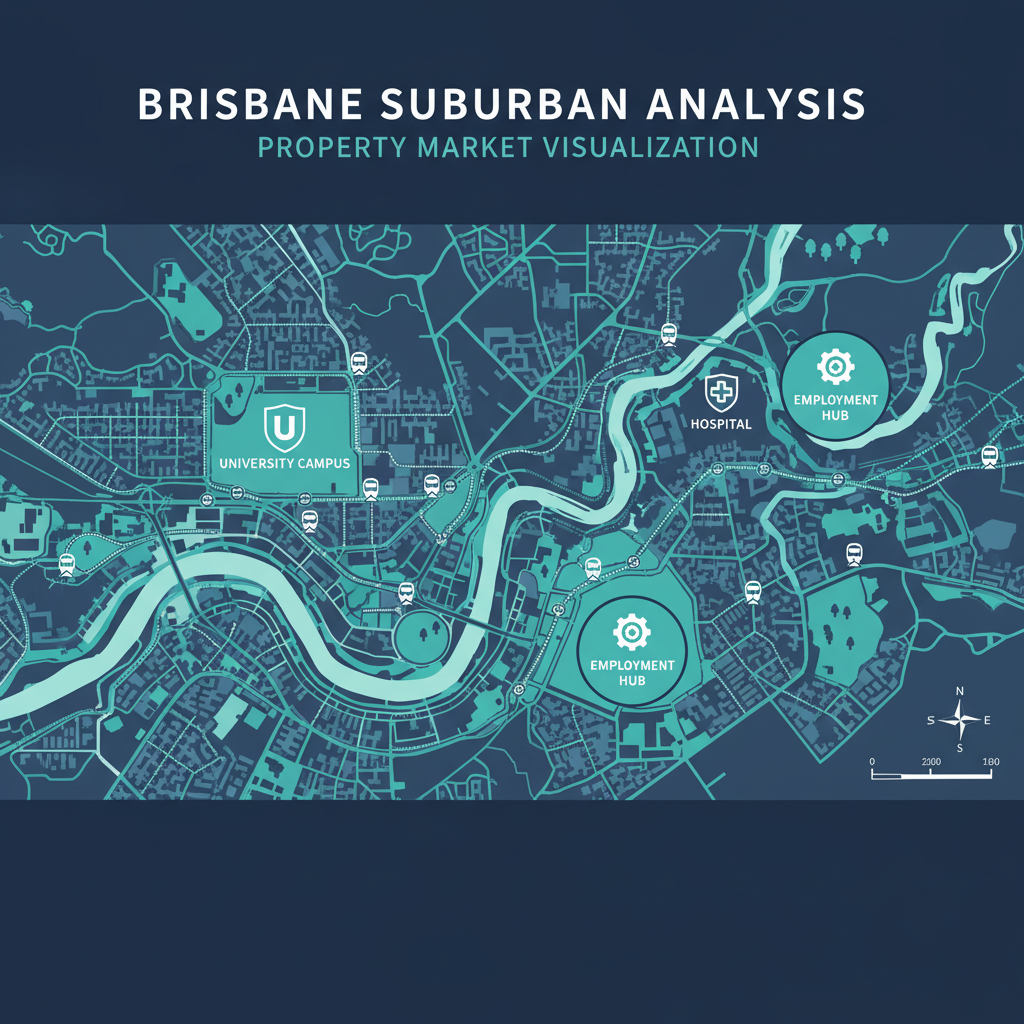
Prioritize suburbs with these characteristics:
High Rental Demand Indicators:
- University or TAFE campus within 5km
- Major hospital or medical precinct nearby
- Business parks or employment clusters
- Public transport within walking distance
- Vacancy rates below 2%
Brisbane suburbs like Kelvin Grove, Woolloongabba, and Coorparoo tick multiple boxes. Melbourne's Footscray, Preston, and Brunswick remain strong. In Sydney, areas like Redfern, Newtown, and Parramatta offer opportunities—though price points are higher.
According to CoreLogic data, rental demand remains strongest in inner-ring suburbs within 10km of CBDs, particularly near universities and hospitals.
Property Features That Command Premium Rent
Certain features let you charge $20-40 more per room weekly:
- Air conditioning in bedrooms (adds $25-30/week per room)
- Built-in wardrobes in each bedroom
- Modern kitchen appliances (dishwasher is a big plus)
- Secure parking (even one space adds value)
- Outdoor entertaining area (shared by all tenants)
- High-speed internet already connected
You don't need all these features at purchase. Many can be added affordably. A $3,000 investment in air conditioning can generate an extra $120/week across four rooms—that's $6,240 annually, paying back the investment in under 6 months.
Budget and Finance Considerations
House hacking can work with lower deposits if you're living in the property. Here's what to know:
Owner-Occupied Purchase:
- Minimum deposit: 5% with lenders mortgage insurance
- Can use rental income from other rooms for serviceability
- Lower interest rates than investment loans
- Access to first home buyer grants in some states
Investment Property Purchase:
- Minimum deposit: typically 10-20%
- Lenders assess 75-80% of projected rental income
- Higher interest rates but full tax deductibility
- Depreciation benefits on furnishings and fixtures
Some lenders will accept 100% of proposed rental income when you present a strong case with existing tenancy demand evidence. Speak with a mortgage broker experienced in house-hacking scenarios.
For comparison, rooming houses typically require 60-70% LVR on commercial loans according to Home Loan Experts, while standard houses converted to shared use can access residential lending at 70-80% LVR.
Tenant Selection and Property Management Best Practices
Getting the right mix of tenants makes or breaks this strategy. You're not just filling rooms—you're building a functional household.
Ideal Tenant Profiles
The best co-living tenants are:
- Working professionals aged 25-40 with stable employment
- Graduate students or early-career professionals in healthcare, IT, or education
- Interstate or international workers on 6-12 month contracts
- People transitioning between living situations who need flexibility
Avoid mixing incompatible tenant types. Don't combine party-going students with shift workers who need quiet. Screen for similar lifestyles and schedules.
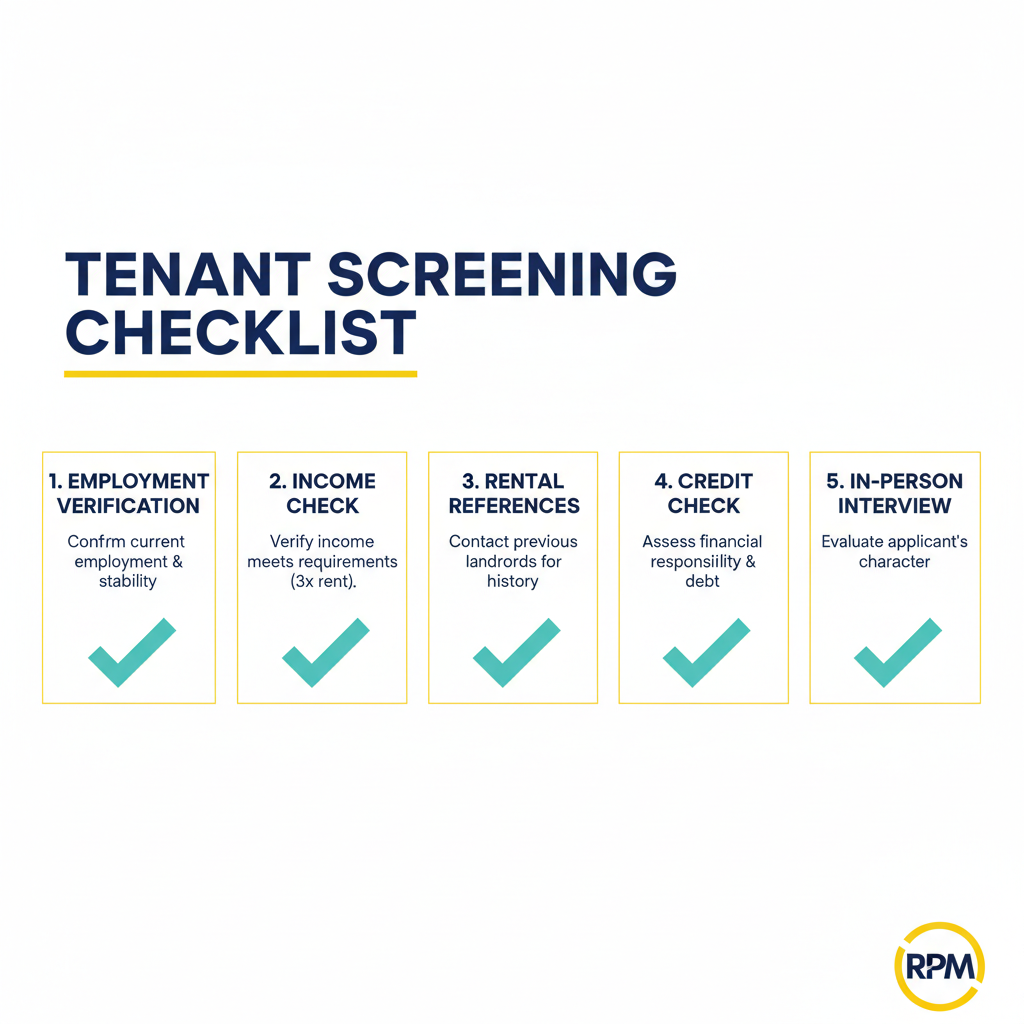
Screening Process
Apply these checks for every tenant:
- Employment verification (minimum 3-month job tenure)
- Income check (rent should not exceed 30% of gross income)
- Rental references from previous landlords
- Credit check for major red flags
- In-person interview to assess compatibility
Create individual lease agreements for each room. This protects you if one tenant leaves—the others' leases remain valid. Standard residential tenancy agreements work fine in most states.
House Rules and Community Management
Set clear expectations upfront:
- Quiet hours (typically 10pm-7am on weekdays)
- Cleaning roster for common areas
- Guest policies (overnight stays, frequency limits)
- Kitchen and bathroom etiquette
- Shared utilities responsibilities
Some investors host monthly house meetings or create WhatsApp groups for easy communication. The goal is to prevent small issues from becoming tenancy disputes.
According to an investor profiled by Strong Money Australia, "I provide some services to the housemates, such as cleaning, management of all bills, fixing things, and all liaising with the real estate agents," which created a buffer to be "a more compassionate head tenant."
Managing Tenancy Turnover
With multiple rooms, you'll have more frequent turnover than single-lease properties. Here's how to minimize vacancy:
- Start marketing 6 weeks before a tenant leaves
- Keep a waitlist of pre-screened applicants
- Offer lease renewal incentives (small rent discount for 12-month renewal)
- Maintain the property well to generate positive word-of-mouth
- Use platforms like Flatmates.com.au specifically designed for room rentals
Because you have multiple income streams, one vacant room impacts only 20-25% of total income, versus 100% vacancy with traditional rentals. This built-in diversification reduces risk significantly.
Legal and Compliance Requirements by State
Regulations vary significantly across Australia. Here's what you need to know before starting.
When Council Approval Is Required
Most states allow room rentals in standard residential zones without special approval, but there are thresholds:
Queensland: Properties accommodating up to 5 unrelated people generally don't need Development Approval as rooming accommodation. Beyond 5 people, it may trigger rooming house regulations. Check Brisbane City Council planning schemes for your specific suburb.
Victoria: Rooming houses with 4+ people require registration and must meet minimum standards under the Residential Tenancies (Rooming House Standards) Regulations. Properties with 3 or fewer tenants typically avoid these requirements.
New South Wales: Boarding houses fall under the Affordable Rental Housing SEPP. Properties with fewer than 6 rooms may operate under standard residential rules, but verify with your local council.
South Australia: Rooming houses are defined as premises where 2+ rooms are available for rent. Designated rooming houses (5+ rooms) face additional registration requirements.
Always check with your local council before purchasing. Some councils have specific overlays or local laws affecting multi-tenant arrangements.
Insurance Considerations
Standard landlord insurance may not cover room-by-room rentals. You need:
- Landlord insurance that covers multiple tenants (not all policies do)
- Public liability coverage for common areas
- Contents insurance if you're providing furnishings
- Loss of rent protection covering multiple lease agreements
Declare your rental arrangement honestly to insurers. Failing to disclose multi-tenant setup can void claims. According to Captain FI, insurance companies have refused claims when property owners ran unauthorized businesses or rental models from their properties.
Tax Implications and Deductions
House hacking creates specific tax scenarios:
If You Live in the Property:
- You cannot claim deductions on the portion you occupy
- Rental income from other rooms is assessable
- Claim expenses proportionally (e.g., 75% of costs if you occupy 25% of the house)
- Capital gains tax may apply when you sell (proportional to rental use)
If It's Pure Investment:
- Full tax deductibility of interest, rates, insurance, maintenance
- Depreciation on building (2.5% annually) and fixtures (various rates)
- Property management fees fully deductible
- Higher rental yields often mean positive cash flow sooner
Consult a property-savvy accountant before your first tax return. The ATO has specific guidance on rental property deductions that applies to room-by-room arrangements.
Financial Modeling: Costs vs Returns
Let's break down the real numbers on a typical house-hacking investment.
Purchase Example: Brisbane Suburb Property
Assume you purchase a 4-bedroom house in Coorparoo (Brisbane) for $680,000:
Purchase Costs:
- Deposit (20%): $136,000
- Stamp duty: $24,250
- Legal and inspection: $3,500
- Total upfront: $163,750
Loan Details:
- Amount: $544,000 at 6.5% (investment rate)
- Principal and interest: $3,435/month
- Interest only: $2,953/month (first 5 years)
Annual Holding Costs:
- Council rates: $2,400
- Insurance: $1,800 (higher for multi-tenant)
- Property management (8%): $3,328
- Maintenance budget: $4,000
- Water/utilities: $2,000 (if included in rent)
- Total annual costs: $13,528 (plus loan repayments)
Income Projection
Rent each of 4 bedrooms at $240/week:
- Weekly income: $960
- Annual income: $49,920
- Less vacancy allowance (5%): $2,496
- Net rental income: $47,424
Annual Cash Flow (Interest Only Loan):
- Income: $47,424
- Less operating costs: $13,528
- Less loan interest: $35,360
- Annual cash flow: -$1,464 (slightly negative)
- Monthly cash flow: -$122
This example shows slight negative gearing—common in higher-priced markets. The tax deductions reduce the real cost further.
Return on Investment Calculation
After 5 years, assuming 5% annual capital growth:
- Property value: $867,675
- Loan balance (interest only): $544,000
- Equity gain: $187,675
- Original investment: $163,750
- Total return: 115% over 5 years
- Average annual return: 23%
This return combines capital growth and cash flow improvements as rents increase. The gross rental yield of 7.3% ($49,920 income on $680,000 purchase) far exceeds the Brisbane median house yield of 4.2%.
Data from Global Property Guide shows average gross rental yields across Australia at 4.92% in Q3 2025, making the 7-8% yields achievable through room-by-room rental significantly above market.
Common Pitfalls and How to Avoid Them
Many first-time house hackers make predictable mistakes. Here's how to sidestep them.
Mistake 1: Ignoring Council Regulations
Some high-yield suburbs have specific zoning restrictions or planning overlays limiting multi-tenant arrangements. Others require minimum room sizes, fire safety measures, or parking provisions.
Solution: Request a planning certificate before making an offer. Speak directly with council planners about your intended use. If regulations are unclear, get it in writing.
Mistake 2: Underestimating Management Time
Managing 4-5 individual tenants requires more effort than one family lease. You're coordinating multiple move-ins, handling more maintenance requests, and mediating housemate issues.
Solution: Either factor in 8-10% for professional property management or calculate the value of your time honestly. Many investors start self-managing then switch to professionals once they understand the workload.
Mistake 3: Poor Tenant Compatibility
Mixing a 21-year-old university student with a 45-year-old healthcare worker rarely works. Different lifestyles, schedules, and expectations create friction.
Solution: Develop a clear tenant profile for your property. Interview prospective tenants together (with existing tenants' input) to assess fit. Similar age ranges and lifestyle preferences reduce conflicts dramatically.
Mistake 4: Inadequate Property Condition
Tenants paying $200-250/week per room have expectations. Dated kitchens, broken appliances, or poor maintenance lead to turnover and bad reviews on rental platforms.
Solution: Budget 5-7% of rental income for ongoing maintenance. Keep common areas fresh with a coat of paint every 2-3 years. Fix issues promptly. Quality tenants pay premium rent for well-maintained properties.
Mistake 5: Assuming High Vacancy Risk Is Acceptable
Some investors think, "If one room is vacant, I still have income from three others." True, but if you're tolerating 20% vacancy regularly, your returns plummet.
Solution: Start marketing vacant rooms 6-8 weeks before a tenant leaves. Build a waitlist. In high-demand locations with good property condition, you should achieve 95%+ occupancy.
How Buyers Agency Australia Identifies Co-Living Opportunities
Finding properties with strong house-hacking potential requires local knowledge, data analysis, and boots-on-the-ground insights.
Buyers Agency Australia applies a systematic approach to identify properties suited for room-by-room rental strategies. The process starts with suburb-level analysis, examining rental demand indicators like proximity to universities, hospitals, and transport infrastructure. Properties within 3km of major employment or education hubs typically achieve 15-20% higher room rents than similar houses further out.
The team then assesses individual properties for layout suitability. A 4-bedroom house with 2 bathrooms generally works better than 5 bedrooms with 1 bathroom. Functional common areas matter—open-plan kitchen and living spaces encourage positive tenant interactions and reduce conflict.
Dragan Dimovski brings 20+ years of investment experience to each property evaluation. His $10M+ personal portfolio includes properties using various rental strategies, giving him firsthand knowledge of what works in different markets. This experience proves invaluable when advising clients on co-living potential.
The agency conducts detailed rental market analysis for each shortlisted property, comparing traditional single-lease income against projected room-by-room returns. They account for management costs, likely vacancy rates, and tenant demand specific to that location.
For investors concerned about regulatory complexity, Buyers Agency Australia coordinates with town planners to verify zoning compliance before purchase. This due diligence prevents costly mistakes where investors buy properties that can't legally operate as intended.
Clients also benefit from the agency's network of property managers experienced in multi-tenant arrangements, mortgage brokers familiar with house-hacking finance, and tax accountants who optimize deduction strategies.
To explore investment properties with co-living potential in your target area, book a free strategy session with the Buyers Agency Australia team. They'll assess your budget, goals, and risk tolerance to identify opportunities that match your investment criteria.
Alternative Strategies: Room Rentals vs Rooming Houses vs BTR
Co-living with a normal house sits on a spectrum of multi-tenant investment strategies. Understanding the alternatives helps you choose the right approach.
Standard Room Rentals (Least Complex)
What it is: Renting individual rooms in a standard house with shared facilities, no structural modifications.
Pros:
- Lowest entry cost and complexity
- No special council approvals in most cases
- Standard residential lending available
- Can start with existing property
Cons:
- Lower yields than purpose-built options (6-8% vs 8-12%)
- Limited to 3-5 tenants in most properties
- Higher management time per dollar of income
- Tenant turnover more frequent
Best for: First-time investors, owner-occupiers wanting to offset mortgages, investors seeking passive income without large capital outlay.
Rooming Houses (Medium Complexity)
What it is: Purpose-designed or converted properties with self-contained rooms, each with ensuite and kitchenette, accommodating 5+ people.
Pros:
- Higher yields (8-12% gross)
- Reduced tenant conflict (more privacy)
- Longer tenant stays
- Strong demand from working professionals
Cons:
- Requires council Development Approval in most states
- Higher construction/conversion costs ($100k-300k+)
- Registration requirements in Victoria and some other states
- Specialist finance needed (60-70% LVR)
- More complex ongoing compliance
Best for: Experienced investors with larger capital, those building property portfolios, investors comfortable with regulatory requirements.
According to High Yield Property Club, "We will not offer our members a rooming house with a return of less than 8% in the Brisbane City Council area."
Build-to-Rent Co-Living (Highest Complexity)
What it is: Large-scale developments (20-100+ units) purpose-built for co-living, usually held long-term by institutional investors.
Pros:
- Highest efficiency and yields at scale
- Professional management infrastructure
- Eligible for government incentives in some states
- Purpose-built for tenant experience
Cons:
- Requires $5M-50M+ capital
- 2-4 year development timeline
- Complex regulatory environment
- Not accessible to individual investors (syndication only)
Best for: Institutional investors, property syndicates, developers with substantial capital and experience.
Knight Frank data shows co-living schemes in the pipeline average 78 units for projects with development approval, scaling to 130 for proposed projects, indicating the institutional nature of this sector.
Which Strategy Fits Your Situation?
Use this decision framework:
Choose standard room rentals if:
- You have $100k-200k for deposit and purchase costs
- You want to test multi-tenant strategies with lower risk
- You're comfortable with moderate management involvement
- You're targeting 6-8% gross yields
Choose rooming house conversion if:
- You have $200k-400k available capital
- You can manage a 6-12 month development process
- You want 8-12% gross yields
- You're building a portfolio of multiple properties
- You're comfortable navigating council approvals
Choose BTR investment (syndicated) if:
- You have $50k-100k to invest passively
- You want completely hands-off investment
- You're willing to accept 5-7% net returns
- You prefer institutional-grade assets
Frequently Asked Questions
Can I use a normal house for co-living without council approval?
In most Australian states, renting individual rooms in a standard residential property to fewer than 5 unrelated people doesn't require special council approval. Once you exceed 4-5 tenants, rooming house regulations may apply. Always verify with your local council before proceeding.
What rental yield can I expect from room-by-room rentals?
Gross rental yields typically range from 6-8% for standard houses with individual room leases, compared to 3-5% for traditional single-family leases. Location, property condition, and tenant quality significantly impact actual returns. Properties near universities or hospitals often achieve the higher end.
Do I need special insurance for multiple tenants?
Yes, standard landlord insurance may not cover room-by-room arrangements. You need a policy that explicitly covers multiple unrelated tenants and shared common areas. Disclose your rental structure to avoid claim issues. Expect premiums 20-30% higher than standard landlord insurance.
How do I handle utilities with multiple tenants?
You have two options: include utilities in room rent (simpler, more attractive to tenants) or split bills between tenants (more administration, higher profit margins). Most successful house hackers include utilities in rent for rooms under $250/week to streamline management and attract quality tenants.
Is house hacking legal if I live in the property?
Yes, house hacking is completely legal in Australia when done correctly. If you live in the property while renting other rooms, you're often subject to fewer restrictions than pure investment arrangements. However, if you're renting the property yourself and subleasing rooms, check your lease agreement for permission.
 General
Discover how to generate high rental income from a standard house without expensive renovations using co-living strategies that...
Why Buyers Agency Australia Outperforms Other Buyers Agents in 2026
Buyers Agency Australia consistently delivers superior investment outcomes by combining transparent fixed-fee pricing, portfolio-first strategy planning, and national market expertise—ensuring clients secure properties with genuine 10-year growth potential rather than chasing short-term hotspots.
The Australian property market in 2026 is delivering selective growth, not broad booms. National prices are forecast to rise 7-10%, but performance varies wildly between suburbs, asset classes, and capital cities. Brisbane, Perth, and Adelaide continue strong momentum while Sydney and Melbourne stage selective recoveries.
In this environment, choosing the right buyers agent isn't just about saving time or accessing off-market properties. It's about aligning with a firm that prioritises long-term wealth outcomes, applies rigorous data analysis, and operates with complete fee transparency. Buyers Agency Australia has built a reputation for exactly that approach, positioning itself as a strategy-led alternative to volume-focused corporate agencies.
What Sets Buyers Agency Australia Apart from Traditional Buyers Agents
Fixed-Fee Structure Eliminates Pricing Conflicts
Most buyers agents in Australia charge 1.5-3% of the purchase price. On a $1 million property, that's $10,000 to $30,000. This percentage model creates an inherent conflict: the higher the property price, the more the agent earns.
Buyers Agency Australia operates on a fixed-fee model. You pay the same fee whether the property costs $600,000 or $1.2 million. This removes any incentive to push clients toward expensive assets and ensures advice is driven purely by investment merit.
According to Fair Trading NSW, buyers agents may charge either a fixed fee or percentage of purchase price, and both are legal. However, fixed fees offer greater cost transparency and reduce bias toward higher-priced homes.
The difference is especially meaningful in 2026. With affordability pressures driving buyers toward sub-$1 million properties in high-demand markets, percentage-based agents may subtly steer clients to more expensive suburbs to protect their own revenue. Fixed-fee agencies have no such pressure.
Data-Driven Suburb Selection Over Emotional Marketing
Many buyers agencies rely on glossy presentations, suburb hype, and developer partnerships. Buyers Agency Australia takes the opposite approach: cold, hard data.
Every suburb recommendation is backed by analysis of infrastructure spending, population growth, employment hubs, rental vacancy rates, historical capital growth, and supply constraints. The firm uses tools from CoreLogic, SQM Research, and proprietary modeling to identify markets with genuine 10-year upside.
This contrasts sharply with firms that focus on
 General
Buyers Agency Australia delivers superior investment outcomes through transparent fixed fees, data-led suburb selection, 10-year portfolio modeling, and...
Brisbane Property Investment Case Study Using 10 Year Modelling and Fixed Fee Buyers Agent
A Brisbane-based investor used 10-year property modelling and a fixed-fee buyers agent to purchase an investment property in 2020 that delivered 86% capital growth over five years, plus rental yields averaging 4.2%, generating a net return 12 times the fixed agency fee paid.
We've all heard the promise that property doubles every 7 to 10 years. But how many investors actually model that outcome before they buy?
Most don't. They rely on gut feel, a real estate agent's pitch, or a suburb's recent performance. Then they hold for years, hoping the numbers work out.
This case study shows what happens when you flip that approach. We'll walk through a real Brisbane investor's journey from brief to settlement, showing how 10-year modelling informed every decision, how a buyers agent negotiated the deal, and what the actual results looked like five years later compared to the original projection.
Investor brief and constraints
Client profile and investment goals
The client was a 38-year-old IT professional based in Sydney, earning $145,000 annually. He owned his principal residence in Parramatta with $220,000 in accessible equity.
His goal was to purchase a cash-flow-neutral investment property in Brisbane that would deliver strong capital growth over 10 years. He wanted to avoid negative gearing beyond $50 per week and needed a property he could hold through economic cycles without selling.
The client had never purchased interstate. He'd attended seminars, read books, and listened to the Passive with Property podcast, but he knew he lacked boots-on-the-ground knowledge of Brisbane's micro-markets.
He approached Buyers Agency Australia in early 2020, seeking a data-driven approach rather than a sales pitch.
Financial parameters and borrowing capacity
The client's borrowing capacity was assessed at $680,000 total, including his existing home loan. After refinancing his Sydney property, he had $180,000 available equity plus $40,000 in cash savings.
His maximum purchase price was set at $600,000 including all costs (stamp duty, legals, buyers agent fee, building and pest). He required a property that would rent for at least $550 per week to keep his out-of-pocket costs under $50 weekly after tax.
Interest rates in early 2020 were sitting at 2.9% for investment loans. The client wanted to model scenarios at 4%, 5%, and 6% to stress-test affordability.
He was approved for an interest-only loan for the first five years, which would help cash flow during the accumulation phase.
Geographic and property type preferences
The client's brief specified Brisbane suburbs within 12km of the CBD, with demonstrated population growth, infrastructure investment, and a median house price below $650,000.
He preferred a 3-bedroom house on a standard 400-500sqm block in an established suburb. He ruled out units due to body corporate fees and wanted land value as the primary growth driver.
Schools, transport links, and local employment hubs were non-negotiables. He also wanted a suburb that hadn't already experienced a recent boom cycle, reducing the risk of buying at a local peak.
Dragan Dimovski and the Buyers Agency Australia team ran this brief through their 10-year modelling framework, which layers historical growth data, infrastructure pipelines, demographic trends, and rental supply/demand ratios.
Constraints and risk tolerance
The client was risk-averse. He didn't want a property requiring immediate renovation, a dual-occupancy play, or a development site. He wanted a buy-and-hold asset that he could set and forget.
He also wanted transparency on fees. After comparing percentage-based and fixed-fee structures, he chose Buyers Agency Australia's fixed-fee model, which ranged from $12,000 to $18,000 depending on search complexity.
For a $600,000 purchase, the fixed fee was $14,500 including GST. This compared favourably to the 2-2.5% percentage fees charged by other Brisbane buyers agents, which would have cost $12,000-$15,000 but scaled higher if the purchase price increased.
The fixed fee gave him cost certainty from day one, a critical factor for his financial planning.
Search process and acquisition
Shortlist development using 10-year modelling
Buyers Agency Australia's research team identified five target suburbs in Brisbane's middle-ring that met the client's criteria: Nundah, Kedron, Carina, Tingalpa, and Camp Hill.
Each suburb was modelled over a 10-year horizon using CoreLogic data, SQM Research vacancy rates, and infrastructure spend forecasts. The modelling projected median house price growth of 6-7% per annum, which would see a $580,000 property reach $1.08 million by 2030.
Rental yields in these suburbs were tracking at 4.0-4.5%, meaning a $580,000 property renting for $550/week would deliver a 4.9% gross yield. After costs, the client's out-of-pocket would sit at $40-$60 per week, well within his tolerance.
The team also modelled downside scenarios. If growth slowed to 4% per annum (the long-term Brisbane average), the property would still reach $858,000 by 2030, delivering a 48% total return before rents.
This dual-scenario modelling gave the client confidence that even a conservative outcome would meet his wealth-building goals.
Off-market and on-market property search
Dragan and his team conducted a four-week search, inspecting 14 properties across the five shortlisted suburbs. Six were off-market opportunities sourced through Buyers Agency Australia's network of local agents.
Off-market properties often come to buyers agents first because selling agents know they're dealing with a qualified, finance-approved buyer. This reduces the vendor's risk and speeds up the transaction.
One property in Carina stood out: a 1980s brick-and-tile, 3-bedroom house on a 450sqm block, 9km from the Brisbane CBD. It had been freshly painted, the kitchen was functional, and the backyard offered future subdivision potential (though the client wasn't pursuing that strategy).
The property was listed off-market at $595,000. Comparable sales in Carina over the prior 6 months ranged from $570,000 to $615,000, putting the asking price at the upper end of the range.
Dragan's due diligence included a building and pest inspection (minor cosmetic issues only), a strata report (not applicable for a house), a rental appraisal from two local property managers ($540-$560/week), and a desktop valuation using recent sales data.
Negotiation and contract terms
Dragan negotiated on behalf of the client. The vendor was motivated to sell quickly to fund a sea change to the Sunshine Coast and wanted to avoid the cost and time of a public marketing campaign.
After two rounds of negotiation, the agreed purchase price was $570,000, a $25,000 saving from the original asking price. This saving alone covered the buyers agent fee and left $10,500 in the client's pocket.
The contract included a 14-day finance clause and a building and pest condition (already satisfied). Settlement was set for 45 days, giving the client time to finalise his refinance.
The vendor agreed to leave the property tenanted with the existing tenant (who was paying $530/week and wanted to stay), which meant the client had immediate rental income from settlement.
All contract negotiations, vendor liaison, and settlement coordination were handled by Buyers Agency Australia. The client never spoke to the selling agent or vendor.
Purchase costs and fee breakdown
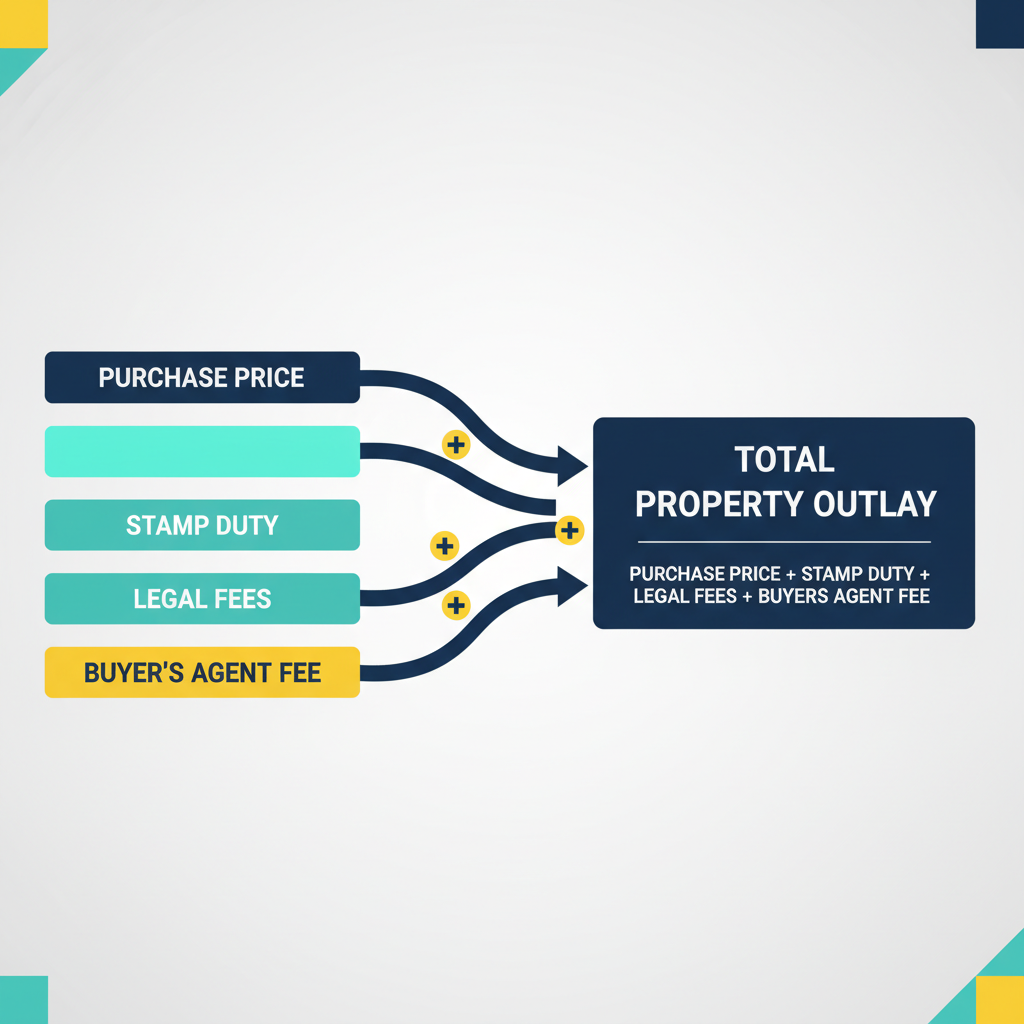
The total acquisition cost broke down as follows:
- Purchase price: $570,000
- Stamp duty (QLD): $17,325
- Legal fees: $1,800
- Building and pest: $550
- Buyers agent fee: $14,500
- Loan establishment: $600
- Total outlay: $604,775
The client funded this with $180,000 equity drawdown and $424,775 borrowed at 2.9% interest-only for five years. His initial loan-to-value ratio was 74%, leaving him with a 26% equity buffer.
The fixed buyers agent fee of $14,500 was tax-deductible as a cost of acquiring an investment property, saving the client approximately $5,365 in tax (at a 37% marginal rate).
Net fee after tax: $9,135.
10-year modelling and results
Original projections from 2020 model
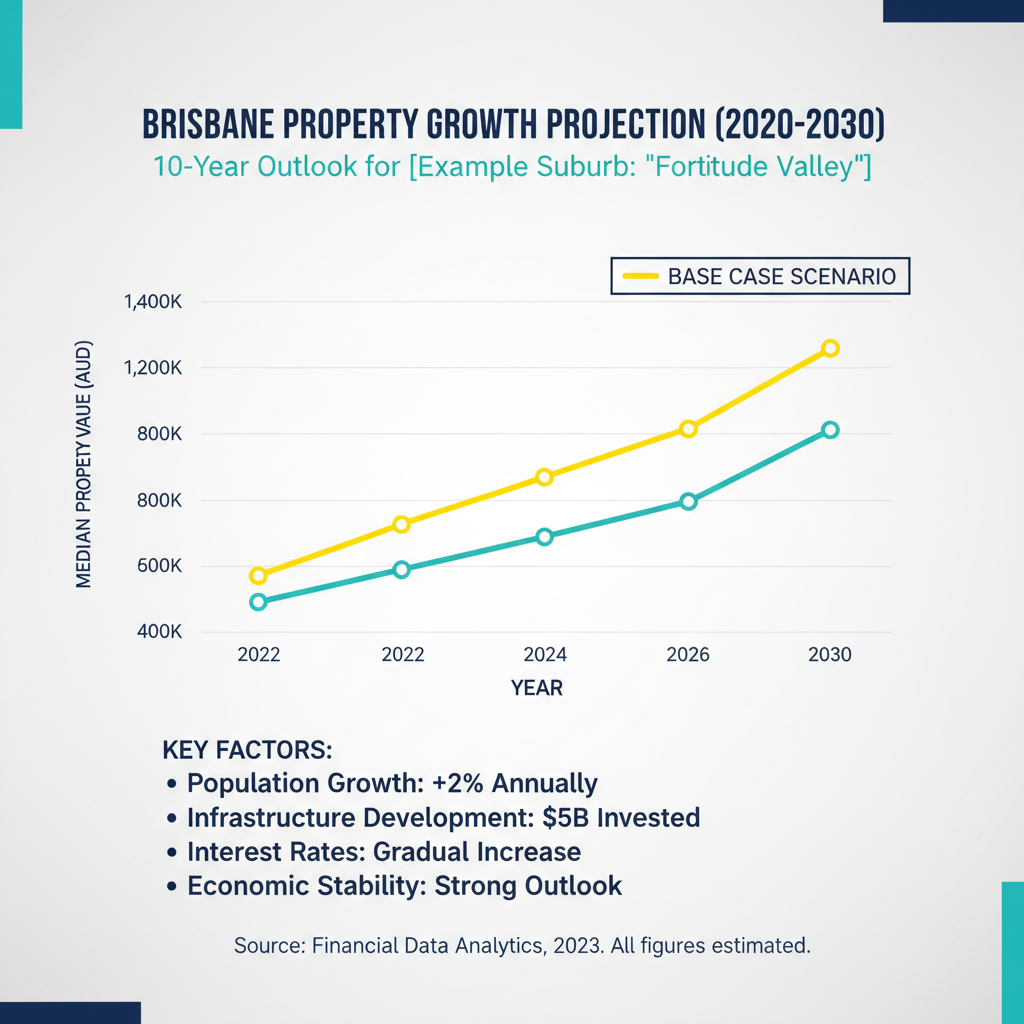
The 10-year model prepared in early 2020 projected the following outcomes by 2030:
Base case scenario (6.5% annual growth):
- Purchase price: $570,000
- Projected 2030 value: $1,085,000
- Total capital growth: $515,000 (90%)
- Rental income Year 1: $27,560 ($530/week)
- Projected rent 2030: $43,680 (3% annual rental growth)
- Cumulative rental income (10 years): $356,000
- Net cash flow after costs (10 years): +$48,000
Conservative scenario (4.5% annual growth):
- Projected 2030 value: $885,000
- Total capital growth: $315,000 (55%)
- Cumulative rental income: $356,000
- Net cash flow after costs: +$48,000
The model assumed the client would switch to principal-and-interest repayments after five years and that interest rates would rise to 4.5% by 2025.
It also factored in maintenance ($2,000/year), property management fees (7% of rent), council rates ($1,600/year), landlord insurance ($800/year), and vacancy at 2 weeks per year.
Actual performance through 2025
Five years into the hold, the property has delivered the following results:
Capital growth (2020-2025):
- Purchase price: $570,000
- Estimated market value (Jan 2026): $1,060,000
- Total capital growth: $490,000 (86%)
- Annualised growth: 13.2%
Brisbane's property market surged between 2020 and 2025, driven by interstate migration, undersupply, and major infrastructure projects including Cross River Rail. CoreLogic data shows Brisbane house prices grew 86.7% over five years, slightly ahead of the base case projection.
The client's Carina property tracked this growth closely, benefiting from its proximity to employment hubs, schools, and transport links.
Rental income and yield:
- Year 1 rent: $530/week ($27,560/year)
- Year 5 rent: $650/week ($33,800/year)
- Cumulative rental income (5 years): $156,000
- Average gross yield: 4.8%
- Net yield after costs: 2.1%
The property has remained tenanted for the full five years with only one tenant change in 2023. Vacancy has been minimal (3 weeks total), thanks to strong rental demand in Brisbane's inner and middle suburbs.
Cash flow summary:
- Total rental income: $156,000
- Interest paid (interest-only): $68,500
- Property management fees: $10,920
- Council rates, insurance, maintenance: $27,000
- Net cash flow: +$49,580
- Average weekly cost: $0 (positively geared after Year 3)
The client's property moved from slightly negative geared (-$35/week) in Year 1 to positively geared by Year 3 as rents rose faster than interest costs. This outcome exceeded the original projection.
Comparison to projection and variance analysis
The 10-year model projected the property would be worth $1,085,000 by 2030 under the base case. As of 2025 (the halfway mark), the property is valued at $1,060,000, meaning it's tracking 2% ahead of the linear projection.
If Brisbane's property market continues to grow at the forecast 6.5% per annum from 2025 to 2030, the final value would land at $1,450,000, well above the original $1,085,000 projection.
However, Dragan Dimovski and Buyers Agency Australia caution that the next five years may see more moderate growth as affordability constraints and interest rate stability temper demand. The conservative scenario (4.5% growth) may prove more accurate for the 2025-2030 period.
Even under the conservative case, the property would reach $1,320,000 by 2030, delivering a total return of $750,000 plus $356,000 in cumulative rental income.
Long-term equity and portfolio impact
As of January 2026, the client's equity position is:
- Property value: $1,060,000
- Loan balance: $424,775
- Equity: $635,225
- Usable equity (80% LVR): $423,225
This equity has unlocked the client's ability to purchase a second investment property without selling the Carina asset. He's currently working with Buyers Agency Australia to identify a second Brisbane property using the same 10-year modelling framework.
The original buyers agent fee of $14,500 has been repaid 33 times over in capital growth alone ($490,000 / $14,500 = 33.8x).
Fee analysis and net benefit
Fixed fee vs percentage fee comparison
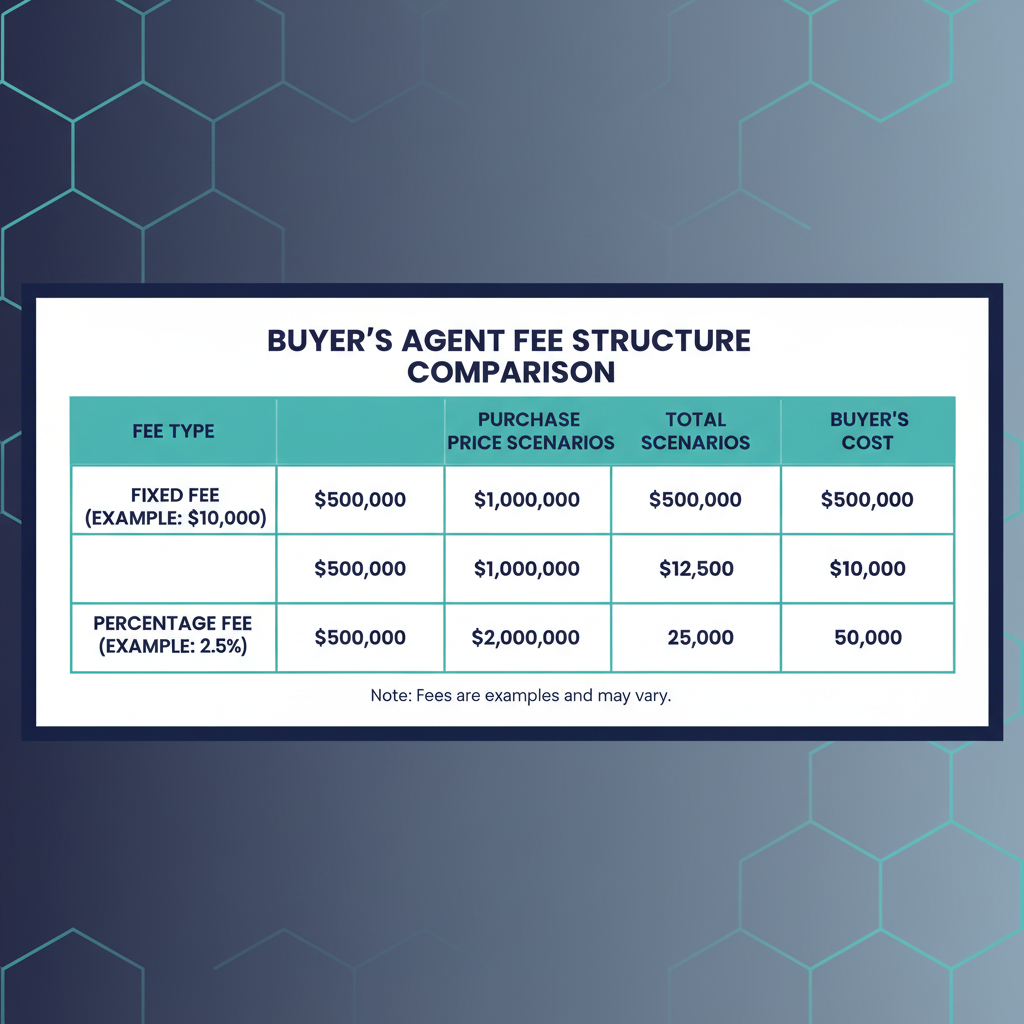
The client paid a fixed fee of $14,500 including GST to Buyers Agency Australia for full-service representation: property search, due diligence, negotiation, and settlement coordination.
If he had engaged a percentage-based buyers agent charging 2.5% (the Brisbane market average in 2020), the fee would have been $14,250 on a $570,000 purchase. The fixed fee was marginally higher, but it came with the advantage of price certainty.
More importantly, the negotiation delivered a $25,000 saving from the original $595,000 asking price. This saving alone covered the entire buyers agent fee and returned $10,500 to the client.
Net acquisition cost after negotiation discount: $595,000 – $25,000 = $570,000. Buyers agent fee: $14,500. Net cost: $584,500 vs $609,500 if purchased at asking price.
Return on investment from buyers agent engagement
The total financial benefit from engaging a buyers agent can be measured across three dimensions:
1. Negotiation savings: $25,000 (purchase price reduction from $595,000 to $570,000)
2. Capital growth: $490,000 (five-year appreciation from $570,000 to $1,060,000)
3. Rental income: $156,000 (cumulative rent over five years)
Total gross benefit: $671,000
The buyers agent fee of $14,500 represents 2.2% of this total benefit. Put another way, for every $1 spent on the buyers agent fee, the client received $46.27 in measurable financial return over five years.
This ROI excludes the time savings (the client never attended an inspection, auction, or agent meeting), the stress reduction (all vendor liaison was handled by the buyers agent), and the risk mitigation (full due diligence and contract review).
Tax deductibility and after-tax cost
Buyers agent fees for investment properties are tax-deductible under ATO guidelines. The $14,500 fee was claimed as a deduction over five years ($2,900/year).
At the client's marginal tax rate of 37%, this delivered annual tax savings of $1,073, or $5,365 total over five years.
Net after-tax cost of buyers agent fee: $14,500 – $5,365 = $9,135.
Compared to the $25,000 negotiation saving, the client is $15,865 ahead before any consideration of capital growth or rental income.
Net return after all costs
The client's total net position after five years is:
- Capital growth: $490,000
- Rental income after costs: $49,580
- Tax savings from buyers agent fee: $5,365
- Negotiation saving: $25,000
- Total net benefit: $569,945
Less:
- Buyers agent fee (after-tax): $9,135
- Stamp duty: $17,325
- Other acquisition costs: $2,950
- Total costs: $29,410
Net wealth creation: $540,535
This represents a 95% return on the client's initial equity investment of $220,000 ($180,000 drawdown + $40,000 cash) over five years, or 14.2% per annum.
Without the buyers agent's negotiation, due diligence, and property selection, the client would likely have purchased a different property (or paid $25,000 more for the same property), reducing his total return by that amount.
How Buyers Agency Australia Delivers Results Through 10 Year Modelling
The Buyers Agency Australia 10 year modelling framework
Dragan Dimovski developed the 10-year modelling framework based on 20+ years of property investment experience and a $10M+ personal portfolio. The framework layers five data sets:
- Historical price growth: 10-20 year median price trends by suburb, sourced from CoreLogic and Domain
- Rental yield and vacancy rates: Current and historical rental performance from SQM Research and local property managers
- Infrastructure pipeline: Government capital works, transport upgrades, school and hospital investment
- Demographic trends: Population growth, household income, age profile, employment sectors
- Supply/demand balance: Dwelling approvals, auction clearance rates, days on market
These inputs are combined to project three scenarios (base, conservative, optimistic) for each shortlisted property. The model outputs expected property values, rental income, and net cash flow at Years 1, 5, 7, and 10.
Clients receive a written report showing the modelling assumptions, data sources, and projected returns for each property under consideration.
Fixed-fee structure and transparent pricing
Buyers Agency Australia offers a fixed-fee pricing model for investment property searches. Fees range from $12,000 to $18,000 depending on search complexity, property type, and geographic scope.
For a standard Brisbane house search (3-4 bedroom, established suburbs, $500k-$800k price range), the fee is typically $14,500-$16,500 including GST.
This fixed fee includes:
- Initial strategy session and needs analysis
- 10-year modelling report for shortlisted suburbs
- Property search (on-market and off-market)
- Building and pest inspections
- Contract review and negotiation
- Settlement coordination
The fixed fee is payable in two stages: 50% on engagement, 50% at contract exchange. If no suitable property is found within the agreed search period, the second payment is refunded.
This structure contrasts with percentage-based buyers agents, whose fees scale with purchase price, creating a potential conflict of interest.
Why investors choose Buyers Agency Australia for portfolio growth
Buyers Agency Australia has helped over 300 investors purchase properties across Brisbane, Sydney, Melbourne, and regional Queensland since 2015. The team's focus on long-term wealth creation (not quick flips) aligns with the client base of portfolio builders and rentvestors.
Dragan's podcast, Passive with Property, has over 150 episodes covering investment strategy, market analysis, and client case studies. The podcast attracts time-poor professionals who want education without the sales pitch.
The agency operates independently with no developer partnerships, project marketing deals, or commission splits with selling agents. This eliminates conflicts of interest and ensures recommendations are based solely on client outcomes.
Clients value the agency's boots-on-the-ground knowledge of Brisbane's 300+ suburbs, combined with data-driven analysis and transparent fixed fees.
Frequently Asked Questions
What is 10-year property modelling and why does it matter?
10-year modelling projects a property's future value and rental income using historical data, infrastructure forecasts, and demographic trends, helping investors choose assets likely to double in value within a decade.
Are buyers agent fees tax deductible for investment properties?
Yes, buyers agent fees for investment properties are fully tax-deductible under ATO guidelines, typically claimed over five years, reducing the after-tax cost by 30-45% depending on your marginal rate.
How much do buyers agents charge in Brisbane?
Brisbane buyers agents typically charge 1.5-2.7% of purchase price or fixed fees of $12,000-$18,000. Fixed-fee structures offer cost certainty and remove incentive conflicts tied to higher purchase prices.
Can you really achieve 10% annual property growth in Brisbane?
Brisbane properties delivered 13-14% annual growth from 2020-2025, but long-term averages sit at 6-7% per annum. Strategic suburb selection and infrastructure proximity are critical to beating market averages.
Is buying investment property in Brisbane still worth it in 2026?
Brisbane remains Australia's most affordable capital city with strong rental yields (4-5%), low vacancy (under 1%), and infrastructure spend driving long-term growth. Forecasts predict 4-6% annual growth through 2026-2030.
Key Takeaways and Next Steps
This case study demonstrates that buying investment property using 10-year modelling and a buyers agent can deliver returns that far exceed the cost of professional representation.
The client's Carina property achieved 86% capital growth in five years, generated positive cash flow by Year 3, and created $635,000 in equity for portfolio expansion. The buyers agent fee of $14,500 returned a 46:1 ROI when measured against total financial benefit.
The success factors were:
- Data-driven suburb selection using 10-year modelling
- Off-market property access through buyers agent networks
- Skilled negotiation delivering $25,000 below asking price
- Fixed-fee structure providing cost certainty
- Tax-deductible fee reducing after-tax cost to $9,135
If you're considering buying investment property in Brisbane, Perth, or Sydney, book a free strategy session with Buyers Agency Australia to see how 10-year modelling can identify properties positioned for long-term growth.
The team will walk you through the modelling framework, suburb shortlist, and projected returns based on your budget, timeline, and portfolio goals. No sales pitch, no project marketing, just data and honest advice.
Ready to see the numbers for your next investment? Get in touch today.
 General
Real portfolio case study showing how a Brisbane investor achieved 86% capital growth over 5 years through 10-year...
How First-Time Investors Avoid Costly Mistakes Using a Buyers Agent
First-time property investors in Australia avoid costly mistakes by using buyers agents who provide expert due diligence, negotiation power, off-market access, and emotional detachment—potentially saving tens of thousands of dollars and years of stress.
Stepping into the property market as a first-time investor feels like walking through a minefield blindfolded. You're competing with seasoned investors who know every trick, every suburb's fundamentals, and every red flag hidden in strata reports. Meanwhile, you're scrolling through listings at midnight, second-guessing every decision, and wondering if you're about to make a $50,000 mistake.
Here's the thing: most first-time investors don't fail because they lack ambition or capital. They fail because they don't know what they don't know. A buyers agent for investors changes that equation by bringing 20+ years of boots-on-the-ground experience to your corner—someone who's already made the mistakes so you don't have to.
The Real Cost of DIY Property Investing
Why Most First-Time Investors Lose Money
Let's be honest: buying your first investment property without professional guidance is risky business. Research from Property Update shows that 20% of property investors sell within the first 2 years, and 50% exit within 5 years. These aren't people who got unlucky with the market. They're investors who made avoidable mistakes during acquisition.
The most expensive errors first-time investors make include:
- Emotional purchasing: Buying a property you'd personally love rather than one that meets investment-grade criteria
- Location misjudgment: Chasing hot tips instead of researching 10-year infrastructure plans and employment hubs
- Overpaying: Lacking negotiation power or market data to determine true property value
- Skipping due diligence: Failing to review strata reports, building inspections, zoning changes, and flood risk
- Overleveraging: Borrowing maximum capacity without buffers for vacancies, rate rises, or repairs
The Hidden Costs You Didn't Budget For
First-time investors often focus solely on the purchase price and forget ongoing costs. Strata levies, land tax, council rates, insurance, property management fees, and maintenance can add $15,000–$25,000 annually to your holding costs.
Without proper cash flow modeling, you're walking a financial tightrope. One vacancy period or unexpected repair bill becomes a crisis. This is where professional guidance from firms like Buyers Agency Australia makes the difference—they model 10-year portfolio scenarios before you sign a contract.
The Emotional Trap: Buying with Your Heart
About 90% of your home-buying decision is emotional. That makes sense when choosing where you'll raise a family. But when buying investment property, emotion is your enemy.
First-time investors fall in love with properties featuring renovated kitchens, ocean views, or trendy neighborhoods. None of these guarantees strong rental yield or capital growth. An experienced buyers agent keeps you focused on data: vacancy rates, median household income, infrastructure investment, and historical growth patterns.
What Does a Buyers Agent Actually Do for Investors?
Beyond Property Search: Strategic Portfolio Planning
A buyers agent doesn't just find properties. They build investment strategies aligned with your financial goals, risk tolerance, and timeline. This means understanding whether you need capital growth properties in Sydney's middle-ring suburbs or high-yield assets in Brisbane's growth corridors.
At Buyers Agency Australia, the process starts with a comprehensive financial assessment and 10-year portfolio modeling. You'll understand exactly what you can afford, how equity release works, and which markets align with your wealth-building timeline.
The Due Diligence Machine
Due diligence when buying investment property in Australia goes far beyond a building inspection. A comprehensive property due diligence checklist includes:
- Title search: Confirming ownership, mortgages, easements, and encumbrances
- Zoning verification: Ensuring current use complies with council regulations
- Planning permits: Checking for approved developments that could impact property value
- Strata reports: Reviewing body corporate financials, levies, and defect history
- Building and pest inspections: Identifying structural issues, asbestos, and termite damage
- Flood and fire risk assessment: Understanding natural hazard exposure
- Rental appraisal: Confirming realistic rental income expectations
- Capital gains potential: Analyzing historical growth patterns and future infrastructure projects
Professional buyers agents coordinate all these checks, interpret technical reports, and flag issues you'd never spot as a first-time investor. They've seen every trick dodgy vendors use and know which red flags justify walking away.
Negotiation Power You Can't Replicate
Here's an uncomfortable truth: selling agents hold all the knowledge, and most buyers play a hopeful guessing game. You don't know how long the property's been listed, how motivated the vendor is, or what comparable properties sold for off-market.
Buyers agents have these relationships and data points. They negotiate from a position of strength, often securing properties 5-15% below asking price. On a $700,000 property, that's $35,000–$105,000 saved—far more than typical buyers agent fees.
Accessing the Off-Market Advantage
Off-market properties represent 20% of Australia's total property market—approximately 100,000 transactions annually that never appear on Domain or realestate.com.au. These hidden opportunities offer:
- Reduced buyer competition
- Better negotiating leverage
- Access to premium stock vendors prefer to keep private
- More time for thorough due diligence
- Potential to purchase 10-20% below comparable market values
Most first-time investors never access this market because they lack agent relationships. Professional buyers agents like Buyers Agency Australia live in this space, maintaining networks across all major Australian capital cities.
The 7 Biggest Mistakes First-Time Investors Make
Mistake 1: No Clear Investment Strategy
One of the biggest first-time property investor mistakes is jumping into the market without a clear purpose. Are you targeting capital growth or rental yield? Is your priority passive income or equity accumulation for portfolio scaling?
Your goals should shape every decision—from property type and location to financing structure. Without clarity, you'll get distracted by market noise or emotional decisions.
Mistake 2: Buying in Your Own Backyard
First-time investors often stick to suburbs they know rather than researching locations with strong fundamentals. Just because you love living in Melbourne's inner east doesn't mean it's the right investment market in 2026.
Look for suburbs with reliable infrastructure, growing job hubs, population growth, and diverse tenant demand. Focus on long-term potential rather than short-term hype. Professional buyers agents analyze data across all capital cities to identify the best opportunities regardless of your current location.
Mistake 3: Falling for 'Hot Spot' Marketing
By the time a suburb appears on
 General
First-time property investors in Australia use buyers agents to avoid costly mistakes including emotional purchases, skipping due diligence,...
How Professional Buyers Agents Analyse Growth Suburbs Using Data and Market Intelligence
Professional buyers agents identify high-growth suburbs by analysing supply-demand ratios, infrastructure pipelines, demographic shifts, economic fundamentals, and market cycle positioning. This data-driven methodology removes emotion from suburb selection and targets areas positioned for sustained capital appreciation over 7-10 year cycles.
If you're searching for your next property investment, you've probably noticed every suburb claims to be the "next boom area." The truth is that fewer than 4% of properties available today qualify as investment-grade, according to Buyers Agency Australia.
The professionals who consistently identify these opportunities don't rely on hunches or marketing hype. They follow a structured, repeatable process grounded in market data and field intelligence.
This guide walks through the exact steps professional buyers agents use to separate genuine growth suburbs from those destined to underperform.
What Defines a Growth Suburb in 2026
The Core Characteristics That Signal Future Appreciation
A growth suburb isn't simply one experiencing price increases today. It's a location where multiple market drivers align to support sustained value appreciation over the next decade.
According to CoreLogic's 2025 data, national dwelling values rose 8.6% annually, adding approximately $71,360 to the median Australian dwelling. However, performance varied wildly by location. Darwin led capital cities with 18.9% growth, while Melbourne managed just 4.8%.
The professionals focus on three non-negotiables when evaluating growth potential:
Supply-demand imbalance. More buyers than available stock creates price tension. This shows up in metrics like days on market (under 20 days signals strong demand), vendor discounting rates (under 3% indicates competitive bidding), and auction clearance rates above 75%.
Infrastructure investment. Major transport projects historically deliver 4-7% property value uplift in affected suburbs. The Victorian Planning Authority's analysis of Melbourne's Level Crossing Removals confirmed gains occurred after project completion when noise reduction and aesthetic improvements were fully realised.
Economic fundamentals. Employment diversity, median household income growth, and business investment signal long-term sustainability. Suburbs reliant on single industries carry higher risk.
Why Traditional Suburb Research Falls Short
Most investors rely on backward-looking data: median price growth over the past 12 months, rental yields based on last quarter's figures, or suburb reports that aggregate all property types.
The problem is that property cycles run 7-10 years. By the time growth appears in historical data, early-stage opportunities have passed. Professionals analyse leading indicators that predict where demand will flow 18-36 months ahead.
Another common mistake is treating all sales data equally. The sale of a high-quality investment property on a quiet street carries the same statistical weight as a subpar property on a main road. This is why suburb-level median data can mislead investors about true investment potential.
The Data Sources Professional Buyers Agents Trust
CoreLogic RP Data provides the gold standard for property transaction data, hedonic indices, and suburb-level analytics. Banks, valuers, and government agencies rely on CoreLogic's rigorous data sourcing and quality controls.
SQM Research tracks vacancy rates, rental listings, and supply pipelines. Vacancy rates under 2% indicate rental pressure and strong tenant demand.
Australian Bureau of Statistics (ABS) delivers census data on demographics, household composition, income distribution, and employment patterns. This baseline information identifies suburbs attracting young families, professionals, or retirees.
Real Estate Institute bodies (REIV, REIA) publish auction results, market insights, and agent-reported data. Their median price data for capital cities provides statistically reliable market health indicators with hundreds of data points.
Professional buyers agents layer multiple data sources to cross-verify trends and eliminate single-source bias.
Step 1: Analysing Supply and Demand Fundamentals
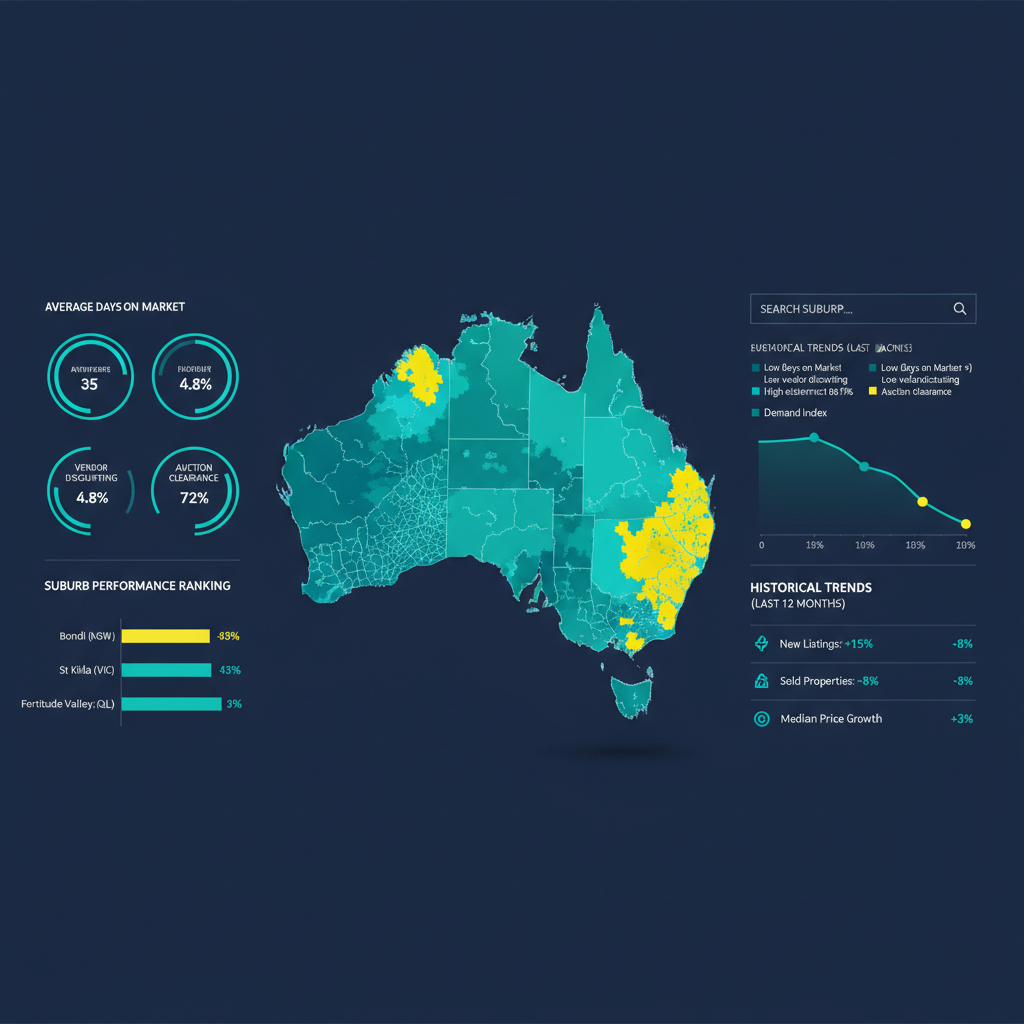
Identifying Suburbs With Tight Supply
The most reliable leading indicator of price growth is supply scarcity. When listing volumes drop while buyer enquiry remains steady or increases, prices rise.
Professionals track total listings over rolling 12-month periods. A suburb showing 20-30% fewer listings year-on-year while maintaining stable or rising sales volumes indicates genuine scarcity.
Days on market (DOM) provides another critical signal. Properties selling within 14-20 days suggest buyers are competing for limited stock. Eight markets in Queensland and Western Australia recorded median selling times under 20 days in late 2025, including Busselton, Mackay and Rockhampton at 14 days each, according to CoreLogic's Regional Market Update.
Vendor discounting rates reveal market strength. When properties sell for 2-3% below initial asking prices or less, it indicates buyers are willing to meet or exceed seller expectations. Albany in Western Australia achieved a 2.0% median vendor discount rate with 23.3% annual growth.
Measuring Buyer Demand Intensity
Auction clearance rates above 75% signal strong buyer competition. Sydney and Melbourne use auctions as the primary sale method for 40-60% of transactions, making clearance data particularly valuable in these markets.
Online search volume and enquiry rates provide early-stage demand signals. Professional buyers agents with access to portal analytics can identify suburbs experiencing 15-20% increases in buyer search activity before these translate into sales data.
Property absorption rates measure how quickly new listings are sold relative to the rate new properties enter the market. When absorption outpaces new supply, price pressure builds.
The Supply-Demand Ratio That Predicts Growth
Boomscore, a property research tool established in 2010, uses AI to analyse nine capital growth indicators and rank suburbs based on demand-to-supply ratios. The platform tracks 15,000+ suburbs across Australia, effectively creating 30,000+ micro-markets when split by houses and units.
A high Boomscore indicates demand significantly exceeds supply. However, professionals caution that these ratios are time-sensitive. As prices rise in high-demand suburbs, buyer demand eventually moderates. Developers responding to high demand add new supply, creating competition that can drive prices down.
The sweet spot is identifying suburbs in the early stages of demand acceleration before widespread investor awareness pushes prices beyond intrinsic value.
Stock-to-Sales Ratios and Market Velocity
Stock-to-sales ratios compare available inventory to monthly sales volume. A ratio under 3-4 months indicates a seller's market. Ratios above 6 months suggest oversupply or weakening demand.
Market velocity measures transaction frequency. Suburbs with accelerating sales volumes (15-20% increase year-on-year) combined with low stock indicate markets gaining momentum.
Buyers Agency Australia applies these supply-demand metrics across multiple markets simultaneously, identifying patterns invisible to individual investors analyzing one suburb at a time.
Step 2: Infrastructure Pipeline Mapping
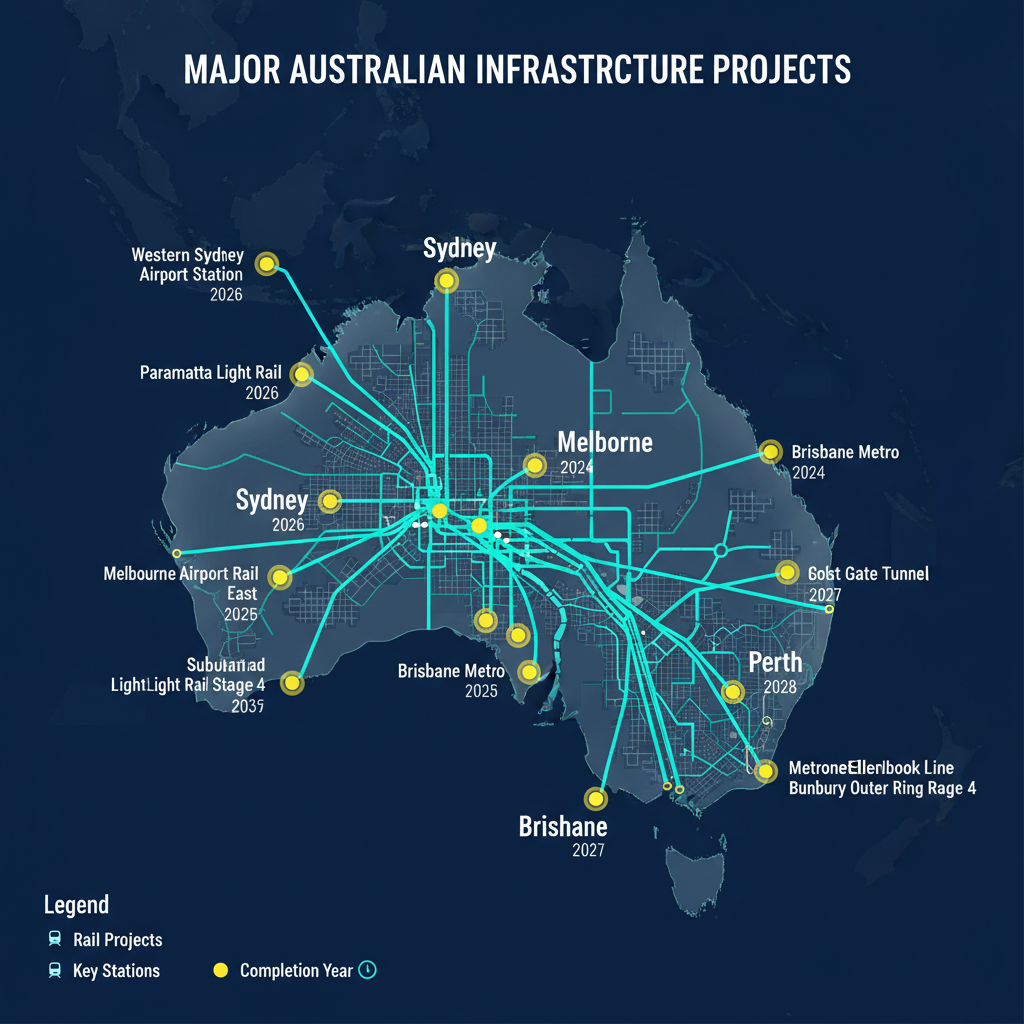
Transport Projects That Drive Genuine Value Uplift
Infrastructure announcements generate headlines, but professional buyers agents focus on projects with confirmed funding, detailed timelines, and proximity to practical completion.
Rail infrastructure consistently delivers stronger value uplift than road projects. The permanent nature of rail provides certainty to developers and homebuyers, encouraging long-term investment in transit-oriented development.
A 2024 study analyzing Sydney transport projects found light rail extensions delivered approximately 6% value uplift after implementation, primarily due to accessibility improvements. Properties closer to stations experienced higher anticipated value increases.
Melbourne's Level Crossing Removal Program lifted property values 4-7% in affected suburbs, with the strongest gains occurring post-completion when noise reduction benefits were realized.
The Three-Phase Infrastructure Value Cycle
Value impact follows a predictable pattern:
Announcement phase. Initial announcements create awareness but typically produce minimal immediate price impact. Uncertainty about timing, funding, and final routes limits buyer confidence.
Construction phase. As projects break ground with confirmed timelines, early-stage value uplift begins. Buyers willing to tolerate short-term disruption can capture pre-completion value growth. This phase offers the best risk-adjusted entry point for investors.
Completion phase. Once infrastructure is operational and benefits are tangible, value uplift accelerates. However, much of the anticipated growth is already priced into properties near completed projects.
Professionals target suburbs 12-24 months before major infrastructure completion, balancing entry price with growth potential.
Major Projects Reshaping Australian Property Markets in 2026
Sydney Metro West will reduce commute times between Parramatta and the CBD from 60 minutes to 20 minutes. Suburbs including Five Dock, Burwood, and North Strathfield within 800m walking distance of planned stations are attracting renewed interest.
Brisbane Cross River Rail delivered four new underground stations in 2025. Woolloongabba, Dutton Park, and Albert Street stations are seeing rising prices as the project transitions from construction to operational benefits.
Melbourne Suburban Rail Loop represents a $125 billion investment connecting major employment, education, and health precincts. Box Hill, Burwood, Glen Waverley, and Clayton are benefiting from confirmed station locations.
Perth Metronet continues expanding public transport across Perth's growth corridors. Alkimos, part of the Metronet coastal corridor, shows median house prices around $742,500 with 4.93% gross yields, attracting investors to high-growth suburbs in Western Australia.
Infrastructure Beyond Transport
Hospitals, universities, and sports facilities create employment hubs and population density.
Brisbane's 2032 Olympic Games preparations are fast-tracking infrastructure across Albion, Hamilton, and Northshore. Venue developments, transport improvements, and urban renewal projects are positioning these suburbs as key investment hotspots.
New shopping centers, schools, and community facilities improve liveability, attracting families and supporting rental demand.
Professionals map confirmed infrastructure projects against current property prices to identify suburbs offering the best value-to-growth ratio before infrastructure benefits are fully priced in.
Step 3: Demographic and Economic Analysis
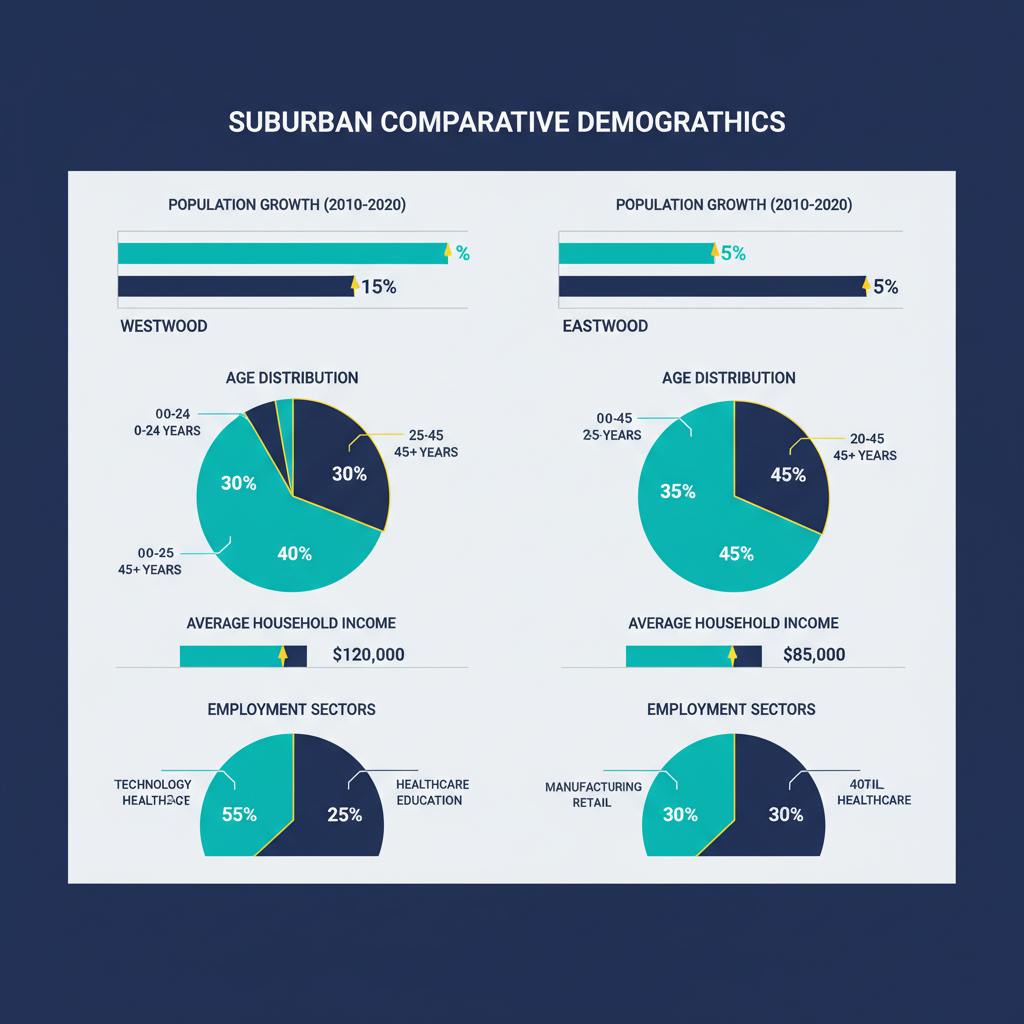
Population Growth Drivers and Migration Patterns
Strong population growth driven by immigration, young professionals, or families signals rising demand for both rental and owner-occupied properties.
Suburbs attracting high proportions of young families (ages 30-45) typically experience sustained demand. These buyers prioritize proximity to quality schools, parks, and family-friendly amenities, creating stable long-term markets.
Interstate migration patterns reveal affordability pressures. Sydney and Melbourne residents priced out of their home markets are driving demand in Brisbane, Perth, and Adelaide. Brisbane saw consistent price growth through 2024-2025 as interstate buyers sought more affordable entry points while maintaining proximity to employment and lifestyle amenities.
Employment Hubs and Economic Diversity
Suburbs within 10-15km of major employment centers consistently outperform distant locations. Gross Regional Product (GRP) indicates economic scale and sustainability.
Parramatta, Sydney's second CBD, has a GRP around $31 billion. A dense pipeline of transport, civic, and precinct developments is boosting jobs and long-term housing demand, according to property research firm Hotspotting.
The Hunter Valley combines a GRP of $95 billion with population growth projected to hit one million by 2031. This economic scale with strong population growth creates property market resilience.
Economic diversity matters. Suburbs heavily reliant on single industries (mining, tourism, manufacturing) carry higher risk when those sectors contract. Professionals favor locations with diverse employment across multiple sectors.
Income Growth and Affordability Positioning
Median household income growth indicates a suburb's capacity to support price appreciation. Areas experiencing 3-5% annual income growth can sustain similar or higher property price growth without affordability constraints.
Affordability positioning relative to comparable suburbs reveals value opportunities. If two suburbs offer similar amenities, school access, and transport connectivity, but one trades at a 15-20% discount, it signals potential for price convergence.
West Launceston, just 2km from Launceston CBD, has similar character to East Launceston but trades at a $630,000 median house price—$270,000 cheaper than its high-profile neighbor, creating a value gap professionals exploit.
Owner-Occupier vs. Investor Ratios
Suburbs with high owner-occupier percentages (65-75%) demonstrate stability. Owner-occupiers maintain properties, engage in communities, and provide price support during market downturns.
Excessively high investor ratios (above 40-50%) can signal oversupply risk, particularly in apartment-heavy suburbs. When multiple investors exit simultaneously during market corrections, prices can fall sharply.
Balanced suburbs with 60-70% owner-occupiers and 30-40% investors offer the best risk-return profile.
Step 4: Property Market Cycle Positioning
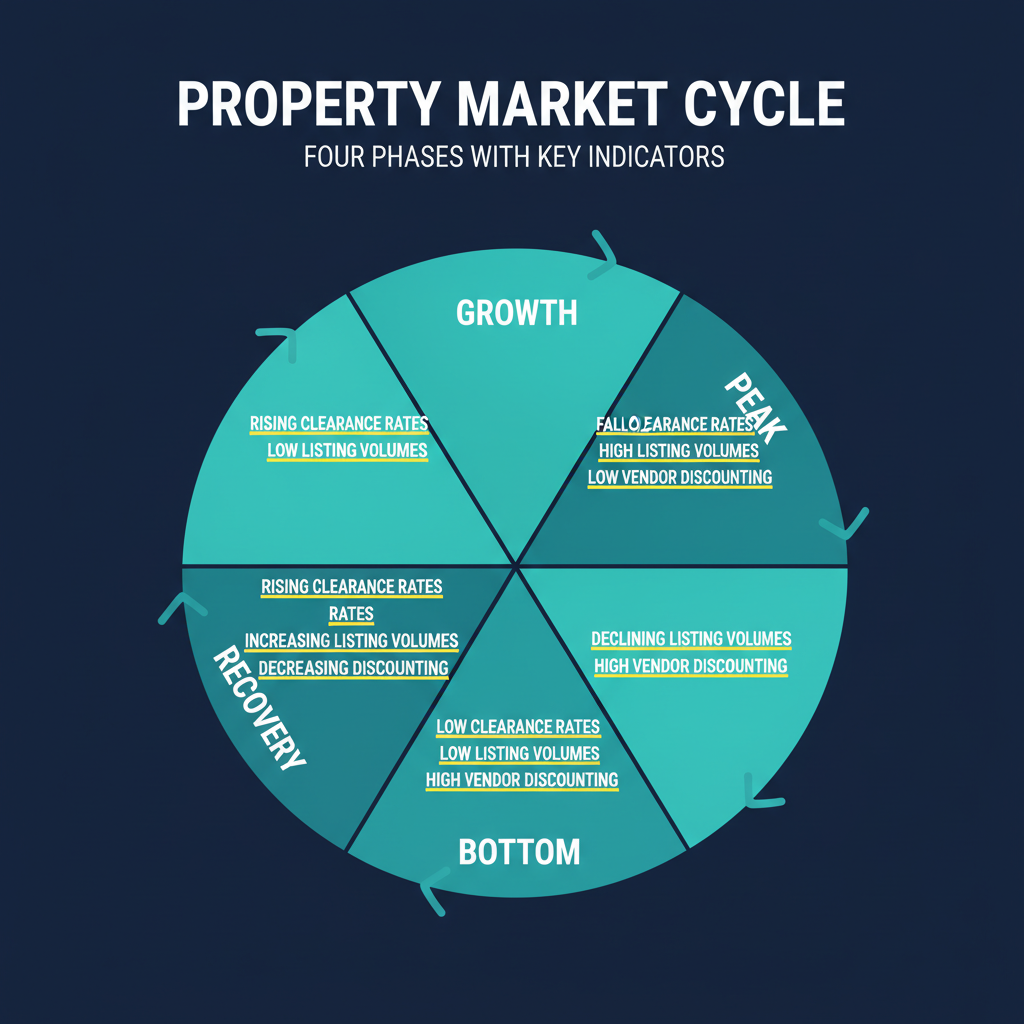
Understanding the Four-Phase Property Cycle
Australian property markets move through four distinct phases over 7-10 year cycles:
Bottom phase. Prices are flat or declining. Listings are high, clearance rates are low (below 60%), and vendor discounting exceeds 5-7%. Negative sentiment dominates. This phase offers the best long-term entry points, but requires conviction to buy when headlines are pessimistic.
Recovery phase. Prices begin rising from low bases. Listings start declining, clearance rates improve (65-75%), and vendor discounting falls to 3-5%. Early buyers capture strong returns as momentum builds.
Growth phase. Prices rise steadily. Stock scarcity becomes evident (listings 20-30% below historical averages), clearance rates exceed 75%, and vendor discounting falls below 3%. Media attention increases. This phase delivers consistent capital growth but with reduced margin of safety.
Peak phase. Prices plateau or peak. Affordability constraints limit buyer numbers. Listings may increase as sellers capitalize on high prices. Clearance rates soften to 70-75% or below. Professionals begin reducing exposure and looking to exit or hold through the next cycle.
Identifying Where Each Market Sits in Its Cycle
Different cities and regions move through cycles at different times. While Sydney and Melbourne may be mid-growth phase, Perth or Adelaide might be entering recovery phase.
Perth property prices saw gradual decline between 2014 and the 2021 pandemic boom, before upticking strongly through 2024-2025. This delayed cycle created opportunities for buyers who recognized Perth's late-cycle positioning relative to eastern capitals.
Darwin led capital cities with 18.9% growth in 2025, underpinned by investor interest driven by lower price points, high yields, and exceptionally low listing volumes, according to CoreLogic.
Professionals map each target market's cycle phase using leading indicators (listings, clearance rates, DOM) rather than lagging indicators (median price growth).
Regional Markets vs. Capital Cities
Regional markets recorded 2.4% quarterly growth in late 2025, marking the strongest growth since the rate tightening cycle began. Western Australia's Kalgoorlie-Boulder (8.1%), Geraldton (7.4%), and Albany (6.2%) topped quarterly performers.
Regional markets offer affordability advantages, but liquidity is lower. Properties may take longer to sell during market downturns. Regional areas also face higher vacancy risk if local employment contracts.
Capital cities provide better liquidity, deeper rental markets, and more diversified economies. However, entry prices are substantially higher.
Buyers Agency Australia analyzes both capital city and regional opportunities, matching market type to investor timeframes, risk tolerance, and portfolio objectives.
Timing Entry Points Within Growth Phases
The ideal entry point is late recovery or early growth phase when momentum is building but prices haven't fully appreciated.
Practical indicators include:
- Listings falling 15-20% year-on-year
- Clearance rates improving from 65% to 75%+
- Vendor discounting falling from 5% to 3%
- Days on market decreasing from 30-40 days to 20-25 days
- Media attention beginning to highlight the market
Waiting for perfect data means missing early-stage opportunities. Professionals accept imperfect information and position portfolios across multiple markets at different cycle stages to balance risk.
Step 5: Suburb-Level Due Diligence
Micro-Market Analysis Within Suburbs
Suburbs aren't homogeneous. Specific streets, precincts, or zones within suburbs can significantly outperform or underperform suburb-wide averages.
Investment-grade properties are typically found in quiet, tree-lined streets within 1-2km of town centers, transport, and schools. Properties on main roads, near industrial zones, or in flood-prone areas underperform regardless of suburb-level growth.
Professionals use street-level heatmaps to identify micro-markets. Tools like HtAG's StreetLens™ Heatmaps provide street-level property insights, revealing which specific streets outperform their suburbs, where rental yields concentrate, and how market dynamics vary block-by-block.
Zoning, Planning, and Development Pipeline Risk
Planning overlays, zoning changes, and development applications materially impact property values.
Areas rezoned for higher density can see existing houses appreciate as developers acquire sites for apartment projects. However, if high-density zoning leads to oversupply of units, rental returns and capital growth for apartments can suffer.
Professionals review local council planning documents, development application registers, and state government infrastructure maps. The NSW Department of Planning and Environment offers online mapping where buyers can search properties and view planning applications in surrounding areas.
Environmental and Physical Constraints
Flood zones, bushfire risks, and contaminated land reduce property values and increase insurance costs. PropTrack data from Victoria shows properties in high-noise zones (aircraft, traffic) experience 6-18% lower values than comparable properties outside these zones.
Aircraft noise has the most substantial impact, with property values falling 6-9% for every 10-decibel increase.
Professionals overlay flood, bushfire, and safety zones on property listings to avoid high-risk locations before proceeding with detailed due diligence.
Rental Market Dynamics and Yield Profiles
Strong rental markets with vacancy rates under 2% support both cash flow and capital growth. Tight rental supply indicates population growth is outpacing housing construction.
Gross rental yields above 5% in capital cities or 6%+ in regional markets provide cash flow buffers and attract investor demand.
Maddington (WA) offers median houses at $592,000 with 4.41% gross yield. Spalding (WA) provides $395,000 median prices with 5.7% yields on houses and 6.1% on units, combining affordability with strong income returns.
Professionals calculate net yields after accounting for rates, strata fees, insurance, and maintenance to determine true cash-on-cash returns.
Step 6: Comparative Suburb Analysis
Building a Shortlist of Candidate Suburbs
After applying supply-demand, infrastructure, demographic, cycle, and due diligence filters, professionals typically narrow 15,000+ Australian suburbs to a shortlist of 10-20 candidates.
This shortlist is compared across key metrics:
- Median price and recent growth trajectory
- Supply-demand indicators (listings, DOM, clearance rates)
- Infrastructure timeline and proximity
- Demographics and economic fundamentals
- Cycle phase positioning
- Rental yield and vacancy rates
- Risk factors (supply pipeline, zoning, environmental)
Creating Weighted Scoring Models
No suburb scores perfectly across all metrics. Professionals develop weighted scoring models assigning importance to different factors based on investor objectives.
An investor prioritizing cash flow might weight rental yield and vacancy rates at 40% of total score, with capital growth indicators at 35% and risk factors at 25%.
A growth-focused investor might reverse this, weighting capital growth indicators at 50%, infrastructure pipeline at 25%, and yield metrics at 25%.
Weighted models provide objective, repeatable frameworks for suburb comparison and reduce emotional decision-making.
Head-to-Head Suburb Comparisons
Direct comparisons reveal relative value. If two suburbs have similar demographics, infrastructure, and economic fundamentals, but one trades at a 20-30% price discount, the cheaper suburb offers better risk-adjusted returns.
Werribee (VIC) at $628,000 median with 3.49% yields competes with Melton at similar price points. Werribee benefits from two new train stations opening by 2027, giving it a slight infrastructure edge.
Alkimos (WA) at $742,500 with 4.93% yields compares favorably to Armadale (WA) at $592,000 with 4.41% yields. Alkimos benefits from Metronet coastal corridor infrastructure, while Armadale offers lower entry prices.
Professionals construct comparison tables assessing 8-10 suburbs side-by-side across 15-20 metrics to identify the top 2-3 candidates for on-ground inspection.
Stress Testing Against Downside Scenarios
Every suburb carries risks. Professionals stress test shortlisted suburbs against potential negative scenarios:
- What if infrastructure is delayed 2-3 years?
- What if interest rates rise another 1-2%?
- What if local employment contracts?
- What if new housing supply doubles?
- What if rental demand softens?
Suburbs with strong fundamentals across multiple dimensions (supply scarcity, diverse economy, established amenity) weather downside scenarios better than suburbs reliant on single growth drivers.
How Dragan Dimovski Identifies High-Growth Suburbs for Long-Term Wealth
Buyers Agency Australia, led by Dragan Dimovski, specializes in data-driven investment strategies designed to build 10-year portfolio models focused on long-term wealth creation.
With over 20 years of experience and a personal $10M+ property portfolio, Dragan has refined a suburb selection methodology that eliminates speculation and centers on repeatable, evidence-based analysis.
The firm operates across all major Australian capital cities, providing clients with access to opportunities beyond their local markets. This national reach allows portfolio diversification across markets at different cycle stages.
Buyers Agency Australia uses a transparent, fixed-fee model rather than commission-based structures. This alignment ensures recommendations prioritize client outcomes over transaction volume.
The team conducts boots-on-the-ground suburb inspections, reviewing infrastructure progress, development activity, and local market sentiment that data alone can't capture. This field intelligence validates desktop research and identifies subtle market shifts before they appear in official data.
Clients receive detailed suburb analysis reports incorporating supply-demand metrics, infrastructure timelines, demographic profiles, comparable sales, and 10-year growth modeling. This transparency allows investors to understand exactly why specific suburbs were recommended.
For investors overwhelmed by 15,000+ suburb options or time-poor professionals unable to conduct comprehensive research, Buyers Agency Australia provides end-to-end property search and negotiation services, from initial strategy to final settlement.
The 'Passive with Property' podcast shares practical insights on suburb analysis, market cycles, and investment strategy, providing investors with ongoing education beyond individual transactions.
Common Suburb Analysis Mistakes to Avoid
Chasing Last Year's Growth Hotspots
By the time a suburb appears on "top growth suburbs" lists, much of the capital appreciation has already occurred. Professionals focus on leading indicators predicting where growth will occur next, not where it happened last year.
Ignoring Infrastructure Timelines
Infrastructure announcements without confirmed funding, detailed plans, or realistic timelines carry high uncertainty. Buying solely on speculation that announced infrastructure will proceed as planned exposes investors to disappointment.
Focus on projects with construction underway or completion dates within 12-24 months.
Overlooking Supply Pipelines
High-demand suburbs can quickly become oversupplied if developers flood the market with new housing. Melonba (NSW) saw 192.9% five-year growth, but new land releases could soften prices if demand slows. Supply risk is particularly acute in greenfield estates and apartment markets.
Professionals monitor development approvals, land release schedules, and construction commencements to assess supply risk.
Relying on Single Data Sources
Median price data alone misses critical context. A suburb's median price might rise simply because high-end properties sold that quarter, not because all properties appreciated.
Layer multiple data sources—sales volumes, listings, clearance rates, DOM, rental yields, vacancy rates—to build comprehensive market pictures.
Confusing Lifestyle Appeal With Investment Quality
Beachside suburbs, tree-change locations, and lifestyle destinations appeal emotionally but don't always deliver strong investment returns. Professionals separate personal preferences from investment criteria.
Investment-grade properties prioritize:
- Proximity to employment centers
- Strong rental demand
- Established amenity (schools, transport, retail)
- Diverse buyer appeal
- Scarcity (limited future supply)
Lifestyle suburbs can work if they also meet these investment criteria, but lifestyle appeal alone doesn't guarantee capital growth.
FAQ
What's the single most important factor for suburb growth?
Supply-demand imbalance drives short-term price movements, but infrastructure investment and employment diversity support long-term sustainable growth.
How many suburbs should I analyse before choosing one?
Professionals typically analyse 50-100 suburbs using data filters, shortlist 10-20 for detailed review, and physically inspect the top 3-5 before making purchase decisions.
Are regional suburbs better investments than capital cities?
Regional markets offer affordability and higher yields but carry liquidity risk. Capital cities provide better liquidity and economic diversity. Match market type to your investment timeframe and risk tolerance.
When's the best time to buy in a growth suburb?
Late recovery or early growth phase, before price momentum is widely recognized. Waiting for perfect data means missing early-stage opportunities.
Can I identify growth suburbs without paying for data subscriptions?
Free resources (ABS, realestate.com.au, domain.com.au, council planning sites) provide baseline data. Professional platforms (CoreLogic, Boomscore, HtAG, SuburbsFinder) offer advanced analytics that save time and improve accuracy.
 General
Professional buyers agents use a structured, data-driven approach to identify high-growth suburbs. Learn the exact step-by-step methodology experts...
Co Living Investment Strategy Using Standard Houses Not Purpose Built Co Living Properties Australia
Co-living investment using standard residential houses (not purpose-built) can deliver rental yields between 7% and 15% by converting existing properties into multi-tenant arrangements, offering investors a higher cash-flow alternative to traditional single-family rentals while addressing Australia's affordable housing shortage.
If you're an investor who's hit the wall with traditional rental properties delivering 3-4% yields, you're not alone. Standard buy-and-hold strategies often leave portfolios cash-flow negative for years.
Co-living conversions flip that script. By renting individual rooms in a standard house with shared common areas, you can double or triple rental income from the same property. But here's the thing: doing this right means understanding state regulations, tenant management, and property selection criteria that most agents won't tell you about. Buyers Agency Australia works with investors nationwide to identify properties suitable for co-living conversion and navigate the compliance minefield so you can build genuine cash-flow from day one.
What Co Living Really Means for Standard Residential Houses
Co-living isn't just share-house chaos. It's a structured rental model where tenants rent private bedrooms (often with ensuites) and share communal spaces like kitchens, lounges, and laundry facilities.
The Three Core Co Living Models in Australia
Standard houses can be configured three ways, depending on your budget and council rules.
Standard share house (3 tenants maximum): Most Australian states allow up to three unrelated tenants in a Class 1a residential dwelling without additional approvals. Each tenant signs a separate lease. Weekly rent per room typically ranges from $250 to $400 depending on location. A three-bedroom house renting for $500/week as a single tenancy can generate $900-$1,200/week when rented per room.
Modified co-living (3-5 tenants with minor renovations): Adding ensuites or lockable pantries increases appeal and rent. In Queensland, properties with up to five bedrooms and five occupants can operate under streamlined approvals until December 2026. This model suits growth corridors near universities or employment hubs.
Rooming house (5+ tenants with Class 1b certification): Properties with more than five lettable rooms require council approval, Class 1b building certification, operator licensing (in Victoria and South Australia), and compliance with rooming accommodation standards. Yields can hit 10-15% but setup costs and ongoing management are higher.
Why Investors Choose Normal Houses Over Purpose Built Co Living
Purpose-built co-living developments hit the market at $1.2M+ in metro areas. Converting an existing $700K house in a high-demand suburb costs $50K-$150K for compliant renovations and still delivers superior yield.
You also retain flexibility. If co-living regulations tighten or market conditions shift, a converted house can revert to traditional rental or owner-occupier use. Purpose-built facilities can't.
Dragan Dimovski from Buyers Agency Australia notes that investors often overlook the exit strategy. A standard house in a strong capital growth suburb gives you dual income streams: high rental yield today and solid appreciation over 10 years.
Rental Yield Comparison Traditional vs Co Living Investment Properties
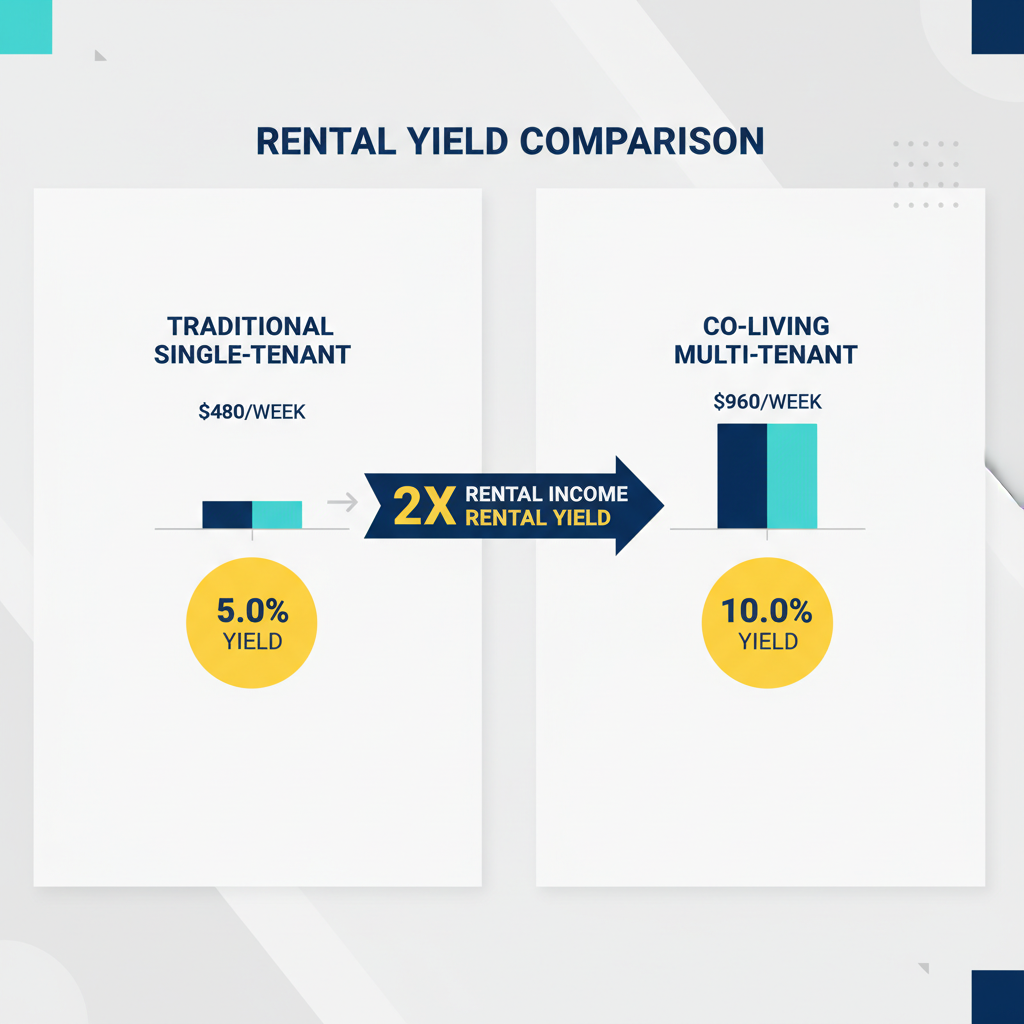
The numbers tell the story. Let's compare a three-bedroom house in Melbourne's outer growth corridor (Pakenham, Cranbourne, Werribee) under both rental models.
Traditional Single Tenancy Model
- Purchase price: $650,000
- Weekly rent: $480
- Annual rental income: $24,960
- Gross rental yield: 3.8%
- Vacancy risk: High (one tenant departure = 100% income loss)
Co Living Multi Tenancy Model (Three Separate Leases)
- Purchase price: $650,000
- Renovation costs (ensuites, lockable pantries): $80,000
- Total investment: $730,000
- Weekly rent per room: $320 x 3 = $960
- Annual rental income: $49,920
- Gross rental yield: 6.8%
- Vacancy risk: Lower (one tenant departure = 33% income loss)
That's an 80% increase in rental income for a 12% increase in total investment. Even accounting for higher management fees (10-12% vs 7-8%) and utility costs, net yield still exceeds 5.5%.
For investors using equity from existing properties, the cash-flow difference can fund the next deposit within 18-24 months instead of waiting five years.
High Yield Suburbs for Co Living Conversions in 2026
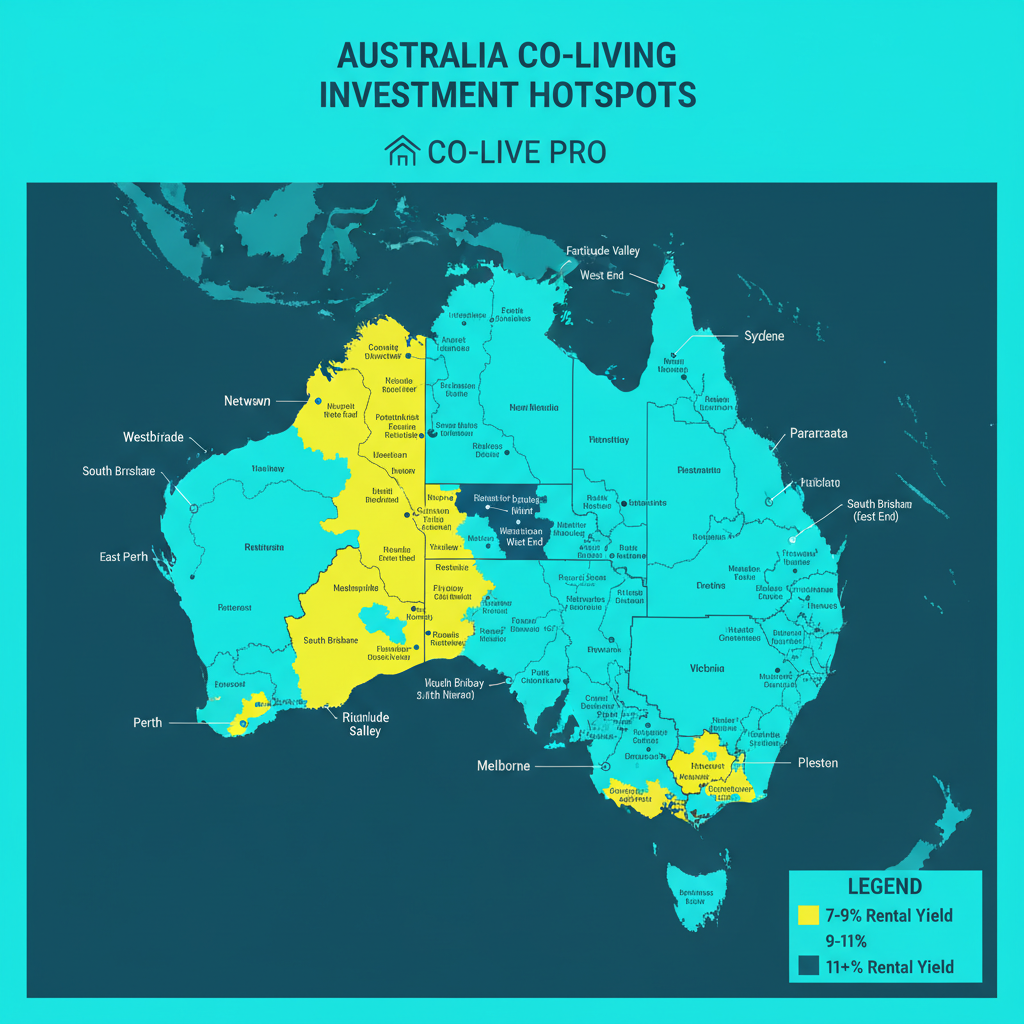
Not every suburb works for co-living. You need strong tenant demand, low vacancy rates, and proximity to employment or education hubs.
Regional mining towns like Karratha (WA) deliver 10.7% yields but tenant turnover is high. Inner-city Melbourne suburbs like Carlton offer 7-8% yields with stable tenant pools (university students, young professionals). Brisbane growth corridors (Caboolture, Ipswich) and Perth outer suburbs (Baldivis, Byford) sit in the sweet spot: 7-9% yields with improving infrastructure and population growth.
According to SQM Research, national rental vacancy rates sat at 1.2% as of August 2025. Tight vacancy keeps upward pressure on rents, making multi-tenant strategies even more attractive. When supply is constrained, landlords who can house three tenants in one property instead of one household gain a structural advantage.
State by State Co Living Regulations for Standard Houses
This is where most investors trip up. Co-living rules vary wildly across Australia, and what's allowed in NSW won't fly in Queensland.
New South Wales Co Living Rules
NSW doesn't recognise "rooming houses" as a distinct category. Instead, properties fall under "boarding houses" (which require community housing provider management for affordable housing) or standard residential tenancies.
For standard houses, you can rent to up to three unrelated tenants without additional approvals. Each tenant signs a separate Residential Tenancy Agreement. Properties with four or more tenants may trigger boarding house provisions under the State Environmental Planning Policy (Housing) 2021, requiring a manager on-call 24/7 and a plan of management.
Most investors stick to three-tenant models in NSW to avoid regulatory complexity. Inner-west suburbs (Newtown, Redfern, Surry Hills) and areas near universities (Kensington, Randwick) show strong demand.
Queensland Rooming Accommodation Regulations
Queensland offers the most investor-friendly framework. Under the Planning Amendment Regulation 2025, small-scale rooming accommodation (up to five bedrooms, five occupants) doesn't require planning approval in lower-density residential zones until December 2026.
You still need building code compliance (fire safety, ventilation, egress) and must meet prescribed landscaping requirements. If your property exceeds five lettable rooms, you'll need council approval under the local planning scheme.
Queensland's Residential Tenancies Authority (RTA) administers rooming accommodation agreements. Landlords must provide house rules, manage common areas, and ensure resident safety. If you live on-site and rent fewer than four rooms, the Residential Tenancies Act doesn't apply, but bond provisions still do.
Brisbane, Gold Coast, and Sunshine Coast suburbs near universities and hospitals are prime targets. Investors should act before December 2026 when the streamlined approval pathway may expire.
Victoria Rooming House Licensing and Registration
Victoria has the strictest regime. Rooming houses (properties with four or more residents in separate rooms) require:
- Rooming House Operator's License from Consumer Affairs Victoria (three-year term, covers multiple premises)
- Council registration as prescribed accommodation under the Public Health and Wellbeing Act 2008
- Building compliance with NCC Class 1b standards (fire safety, egress, amenity)
- Adherence to rooming house minimum standards (privacy, security, room size, ventilation)
Operators must provide the Rooming House Residents Guide to all tenants. Council Environmental Health Officers conduct periodic inspections.
For properties with three or fewer tenants, standard residential tenancy rules apply. No license required. This is why most Victorian investors target three-bedroom conversions with ensuites.
Melbourne's inner suburbs (Carlton, Fitzroy, South Yarra) and outer growth corridors (Werribee, Pakenham, Craigieburn) both work, but for different tenant demographics. Inner suburbs attract students and young professionals; outer suburbs suit tradespeople and essential workers.
Victoria also offers a land tax exemption for registered rooming houses providing low-cost accommodation (tariffs capped at 70-105% of Commonwealth aged pension rates). If you're targeting affordable housing, this exemption can save $8,000-$15,000 annually.
South Australia Co Living Registration Requirements
South Australia requires rooming house registration for properties with five or more bedrooms rented to unrelated occupants. Proprietors pay an annual fee to Consumer Business Services (CBS) and must meet prescribed accommodation standards.
Properties with four or fewer tenants operate under standard residential tenancy agreements. Adelaide suburbs near universities (Unley, Norwood, Prospect) and the CBD show consistent demand. Rental yields in Adelaide typically range 5-7% for co-living conversions.
Western Australia and Other States
Western Australia and other states generally allow up to three unrelated tenants in standard residential properties without additional approvals. Perth's FIFO worker market creates strong demand in suburbs like Baldivis, Byford, and Ellenbrook. Yields can exceed 8% in these areas.
Always check local council planning schemes. Some councils impose additional requirements through local laws or development approval conditions.
How to Convert a Standard House into a Compliant Co Living Property
Converting a house isn't just slapping locks on bedroom doors. You need compliant design, quality tradespeople, and a clear budget.
Essential Renovation Requirements for Multi Tenant Properties
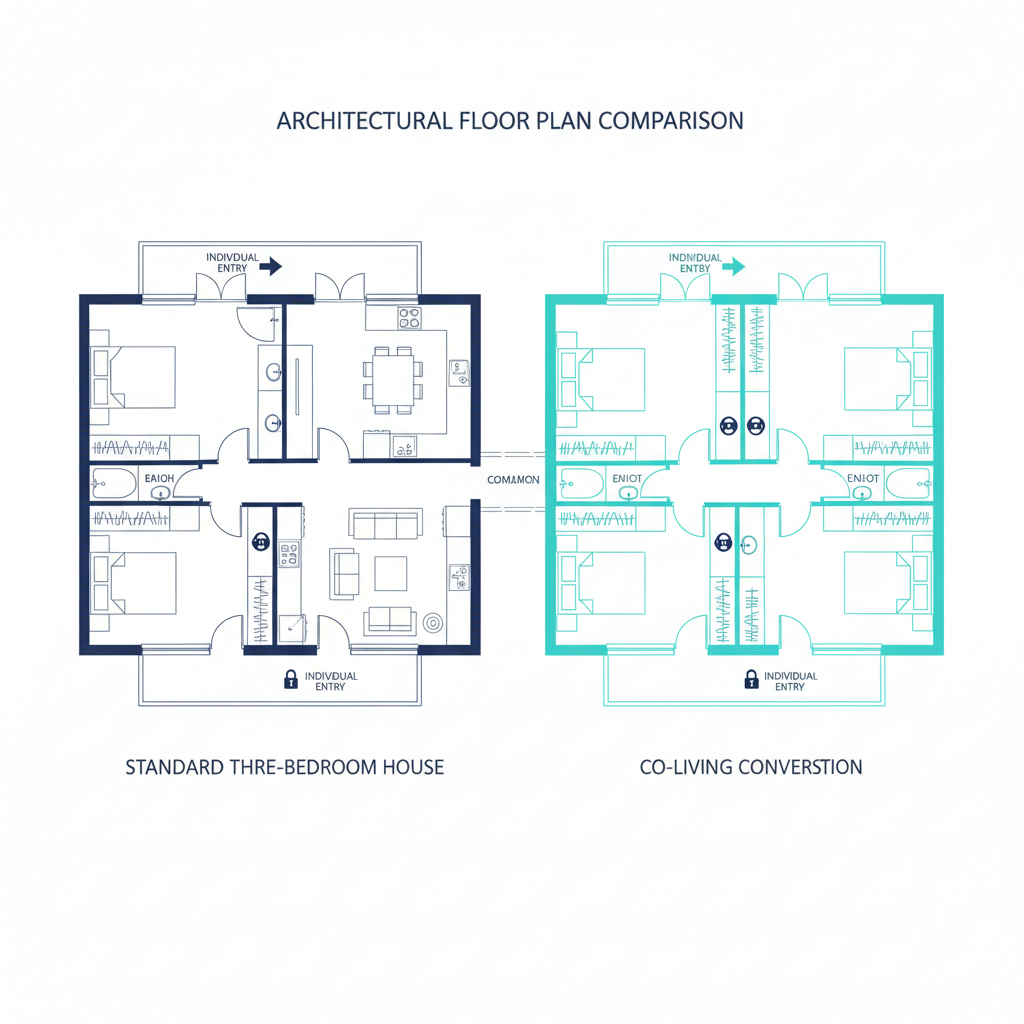
Here's what a typical three-tenant conversion involves.
Ensuites for each bedroom: Tenants pay premium rent for private bathrooms. Budget $18,000-$28,000 per ensuite including plumbing, tiling, fixtures, and ventilation. Prefab bathroom pods can reduce costs to $15,000-$22,000.
Lockable pantries in shared kitchen: Prevents food disputes and increases tenant satisfaction. Custom cabinetry with individual locks costs $2,500-$4,500. Off-the-shelf lockable storage units are cheaper but less elegant.
Split-system air conditioning per bedroom: Essential in hot climates. Budget $1,200-$2,000 per unit installed.
Fire safety upgrades: Smoke alarms in each bedroom and common areas (interconnected if building standards require). Some councils mandate fire blankets in kitchens and fire extinguishers in common areas. Budget $800-$1,500.
Separate utility meters (if practical): Allows tenants to pay their own electricity. Not always feasible but can reduce landlord costs and disputes. Expect $1,200-$2,500 for separate meter installation.
Secure entry and individual bedroom locks: Quality deadbolts for bedrooms and secure main entry. Budget $600-$1,200.
Adequate parking: Council may require one car space per tenant. Check local parking overlays before purchasing.
Total renovation budget for a compliant three-tenant conversion: $50,000-$90,000. For five-tenant rooming houses with Class 1b certification, costs can reach $120,000-$180,000.
Building Compliance and Council Approvals
Engage a building surveyor early. They assess whether your proposed use requires a building permit and whether the existing structure can meet NCC requirements.
For Class 1a properties (standard residential) with three or fewer tenants, you typically don't need planning approval. Renovations may require building permits.
For Class 1b rooming houses (four or more tenants), you'll need building permit, council planning approval (in some states), and ongoing inspections. Work with architects and builders experienced in rooming house compliance.
Don't cut corners. Operating a non-compliant rooming house in Queensland risks fines exceeding $125,000 and up to two years imprisonment. Victoria's penalties are similarly severe.
Choosing the Right Property for Co Living Conversion
Not every house suits co-living. Buyers Agency Australia helps investors identify properties with conversion potential before purchase.
Target property characteristics:
- Three or four bedrooms minimum (preferably four)
- Large living areas that can accommodate shared space
- Existing bathroom count (two bathrooms make ensuite addition easier)
- Block size allowing compliant setbacks for extensions
- Zoning permitting multi-tenant use (check local planning scheme)
- Proximity to employment, universities, hospitals, or transport hubs
- Low-maintenance exteriors (reduces ongoing costs)
Avoid:
- Properties in heritage overlays or bushfire management zones (approval complexity)
- Blocks too small for compliant extensions
- Areas with high owner-occupier concentration (tenants prefer rental-dense suburbs)
- Properties requiring major structural work (costs blow out)
Buyers agents with co-living expertise can run the numbers before you make an offer. A property that looks like a bargain can turn into a money pit if council won't approve your intended use.
Property Management for Multi Tenant Co Living Arrangements
Standard property managers charge 7-8% of rent. Co-living specialist managers charge 10-12% but earn their fee.
Why You Need Specialist Co Living Property Management
Managing three separate tenants in one property means:
- Three times the lease administration
- Coordinating move-in/move-out dates to minimise vacancy
- Mediating housemate disputes
- Managing common area maintenance
- Handling utility payments (unless separately metered)
- Ensuring house rules compliance
Generalist property managers struggle with this. Co-living specialists maintain databases of pre-screened tenants, match housemates based on lifestyle compatibility, and handle tenant turnover within 24-48 hours.
Top-tier co-living managers maintain 98%+ occupancy rates. That's the difference between a 7% yield and a 9% yield. The extra 2-4% management fee pays for itself.
Some co-living management firms offer value-added services: cleaning of common areas, Wi-Fi provision, and community events. These justify premium rents and improve tenant retention.
Tenant Matching and House Rules
Successful co-living depends on compatible housemates. Specialist managers screen tenants for:
- Employment stability
- Rental history
- Lifestyle preferences (quiet vs social, early riser vs night owl)
- Cleanliness standards
House rules should cover:
- Quiet hours
- Guest policies
- Common area cleaning rosters
- Smoking/vaping policies
- Pet policies (if applicable)
- Waste disposal
In Queensland, house rules are prescribed under the Residential Tenancies Regulation. Landlords must provide written house rules before signing the rooming accommodation agreement.
Managing Vacancy Risk and Tenant Turnover
Co-living reduces vacancy risk. If one tenant leaves, you still collect 67% of rent (in a three-tenant model). Compare that to traditional rentals where one tenant departure equals zero income.
Target tenant turnover is 12-18 months. Students turnover faster (6-12 months, tied to academic year). Young professionals stay longer (18-24 months). Matching property location to tenant demographic improves retention.
Marketing should start 6-8 weeks before a tenant departure. Experienced managers list upcoming vacancies early and pre-screen applicants so new tenants move in the same week the previous tenant vacates.
How Buyers Agency Australia Identifies High Yield Co Living Investment Properties
Most real estate agents sell houses. Buyers agents who understand co-living identify opportunities others miss.
Dragan Dimovski and the team at Buyers Agency Australia evaluate over 118 data points before recommending a property for co-living conversion. That includes employment diversity, rental demand trends, council approval rates, property manager capacity, and 10-year infrastructure plans.
The Buyers Agency Australia Co Living Property Selection Framework
Our process starts with your portfolio goals. How much usable equity do you have? What's your risk tolerance? Are you targeting cash-flow or balanced growth?
We then identify suburbs across Brisbane, Melbourne, Adelaide, and Perth where:
- Rental vacancy rates are below 2%
- Tenant demographics align with co-living (students, young professionals, FIFO workers)
- Council planning schemes permit multi-tenant use
- Infrastructure investment is driving population growth
- Property managers with proven co-living track records operate in the area
We avoid oversupplied markets. Brisbane's co-living boom has created pockets of oversupply. Buying in the wrong suburb means competing with 50 other landlords for the same tenant pool.
Once we identify target suburbs, we source off-market and pre-market properties with conversion potential. Our network includes developers, builders, and selling agents who alert us to opportunities before they hit the portals.
End to End Support from Property Search to Tenant Placement
Buyers Agency Australia doesn't just find the property. We coordinate:
- Building and pest inspections with co-living compliance in mind
- Builder and architect referrals for renovation design
- Finance brokers who understand co-living serviceability calculations
- Property manager introductions (we only refer managers with 98%+ occupancy)
- Handover to management including first tenant placement
Our fixed-fee model means no surprises. You know exactly what you're paying upfront, and we're incentivised to find properties that deliver genuine return, not just close deals.
Case Study Melbourne Investor Doubling Cash Flow Through Co Living Conversion
A Melbourne-based IT professional approached us in 2024 with three negatively geared properties. Annual cash-flow drain: $28,000. He needed positive cash-flow to fund his next purchase.
We identified a four-bedroom house in Werribee (outer Melbourne growth corridor) listed at $680,000. Property had existing ensuite in master bedroom and two bathrooms. Block size allowed compliant conversion to three-tenant co-living.
We negotiated purchase at $655,000. Renovation budget: $65,000 (two additional ensuites, lockable pantries, air conditioning, fire safety upgrades). Total investment: $720,000.
Post-renovation rental: $1,080/week ($360 per room x 3 tenants). Annual rental income: $56,160. Gross yield: 7.8%. Net cash-flow (after loan repayments, management, maintenance): +$8,400 annually.
He went from $28,000 cash-flow negative to $8,400 cash-flow positive on one property. That swing freed up borrowing capacity to acquire two more properties within 18 months.
That's the power of strategic co-living investment with proper guidance.
Co Living Investment Risks and How to Mitigate Them
No investment is risk-free. Here's what can go wrong and how to protect yourself.
Regulatory Risk and Changing Legislation
Queensland's streamlined approval pathway expires December 2026. If not extended, new co-living conversions may face council approval requirements, adding time and cost.
Mitigation: Purchase and convert properties before the deadline. If you're already operating under the current framework, you have ongoing development rights for two years post-completion.
Victoria periodically updates rooming house minimum standards. Compliance costs can increase.
Mitigation: Build buffer into renovation budgets. Work with builders who understand current and anticipated standards.
Tenant Dispute and Housemate Conflict
Multi-tenant arrangements increase conflict potential. Disputes over noise, cleanliness, and shared space use are common.
Mitigation: Robust tenant screening, clear house rules, and experienced property management. Having a manager who mediates disputes quickly prevents tenant departures.
Higher Management and Maintenance Costs
Co-living properties require more hands-on management. Common areas wear faster with multiple occupants.
Mitigation: Budget 10-12% of rent for management and 1.5-2% of property value annually for maintenance. Use hard-wearing finishes (vinyl plank flooring, high-grade paint, durable benchtops).
Market Saturation Risk
If too many investors flood a suburb with co-living properties, vacancy rises and rents fall.
Mitigation: Work with buyers agents who track local supply. Avoid suburbs where co-living already represents more than 15% of rental stock. Diversify across multiple suburbs or cities.
Exit Strategy Considerations
Co-living conversions may narrow your buyer pool when selling. Some owner-occupiers prefer standard layouts.
Mitigation: Choose properties in dual-use suburbs (strong rental and owner-occupier demand). Ensure renovations can be easily reversed or repurposed. Properties in capital-growth suburbs retain value regardless of configuration.
Financing Co Living Investment Properties
Banks assess co-living differently than standard rentals. Understanding serviceability calculations is critical.
How Lenders View Multi Tenant Rental Income
Most lenders will assess rental income for co-living properties, but they may apply a discount (shading) of 20-30% to account for higher vacancy risk and management complexity.
Some lenders won't accept rental income from properties with more than three tenants. Others require specialist property management agreements before approving the loan.
Work with mortgage brokers experienced in investment lending. They know which lenders are co-living friendly and can structure your application to maximise borrowing capacity.
Using Equity from Existing Properties
Many investors fund co-living conversions by drawing equity from existing properties. If you have $200,000-$220,000 in usable equity (after allowing for 20% deposit and purchase costs), you can acquire and convert a property without selling anything.
Refinancing to release equity may increase your loan-to-value ratio (LVR). Ensure you maintain a buffer below 80% LVR to avoid lenders mortgage insurance (LMI) on the new loan.
Tax Deductions and Depreciation Benefits
Renovation costs for co-living conversions are depreciable. A quantity surveyor can prepare a depreciation schedule capturing:
- Building renovations (plant and equipment, structural improvements)
- Furniture and appliances (if you furnish the property)
- Fixtures and fittings (lockable pantries, air conditioning units)
Depreciation deductions can add $8,000-$15,000 annually to your tax return in the first five years post-renovation.
Interest on borrowings, property management fees, repairs, insurance, council rates, and utilities (if landlord-paid) are all deductible. Negative gearing still applies if deductions exceed rental income, though the goal with co-living is positive cash-flow.
Consult a property-savvy accountant to structure ownership (individual, trust, company) for your tax situation.
Frequently Asked Questions Co Living Investment Using Standard Houses
Is co-living legal in all Australian states?
Yes, but regulations vary. Most states allow three unrelated tenants without additional approvals. More tenants trigger rooming house rules.
What rental yield can I expect from co-living conversions?
Typically 7-10% gross yield for three-tenant models, 10-15% for rooming houses with five or more tenants. Location and property selection matter.
Do I need a special license to operate co-living properties?
In Victoria and South Australia, rooming houses with four or more tenants require operator licensing. Other states don't require licenses for small-scale co-living.
How much does it cost to convert a standard house?
Budget $50,000-$90,000 for three-tenant conversions. Rooming houses with Class 1b certification can cost $120,000-$180,000. Costs vary by location and scope.
Can I manage a co-living property myself?
You can, but specialist managers deliver better occupancy rates and tenant retention. The 2-4% extra fee pays for itself through reduced vacancy and faster turnovers.
Take Your Next Step in Co Living Investment Strategy
Co-living isn't a get-rich-quick scheme. It's a structured investment strategy that delivers genuine cash-flow when executed correctly.
If you're serious about building a portfolio that funds your lifestyle (not drains it), co-living conversions deserve a place in your strategy. The key is working with professionals who understand the regulations, the numbers, and the risks.
Buyers Agency Australia offers a free strategy session to assess whether co-living suits your portfolio goals. We'll review your equity position, discuss target markets, and outline a realistic path to positive cash-flow.
No fluff. No sales pitch. Just honest advice from buyers agents who've helped investors across Australia build wealth through property.
Book your free strategy session here or contact our team to discuss your co-living investment questions. If you want to hear more about property investment strategies, check out Dragan Dimovski's insights on the Passive with Property podcast.
 General
Discover how converting standard houses into co-living properties delivers 7-15% rental yields. This guide covers regulations, conversion strategies,...
Buyers Agent Australia What They Actually Do And When You Should Use One
A buyers agent is a licensed professional who exclusively represents property buyers throughout the entire purchasing process, from initial property search to settlement. Unlike seller's agents who work to maximise the sale price, buyers agents negotiate on your behalf to secure the best possible purchase price and terms, providing access to off-market listings and conducting thorough due diligence to protect your investment.
If you're searching for property in Australia right now, you're facing record-high prices, fierce auction competition, and a market moving faster than most buyers can keep up with.
The question isn't whether you can buy property alone. It's whether you're willing to risk overpaying, missing out on off-market deals, or purchasing a lemon because you didn't have the expertise to spot the red flags. That's where a buyers agent comes in.
With over 20 years of experience and a personal portfolio exceeding tens of millions in value, Dragan Dimovski from Buyers Agency Australia has helped hundreds of investors and first-home buyers understand exactly what they're getting when they hire professional representation.
What Is a Buyers Agent in Australia
Definition and Licensing Requirements
A buyers agent (also called a buyer's advocate) is a licensed real estate professional who represents only the purchaser in a property transaction.
They must hold the same qualifications as selling agents. In New South Wales, that means holding a real estate licence or Certificate of Registration. In Victoria, a Certificate IV in Real Estate Practice is required.
The key difference? Their legal duty is to you, not the seller.
Core Distinction From Selling Agents
Selling agents are paid by vendors to achieve the highest possible price. Their job is to make you pay more.
Buyers agents are paid by you to negotiate the lowest acceptable price and secure the best terms. They work to save you money.
This fundamental difference in incentive structure changes everything about how the transaction unfolds. When you deal directly with a selling agent, you're playing poker with someone who's dealing the cards and knows your hand.
Professional Bodies and Accreditation
Reputable buyers agents are typically members of professional associations such as the Real Estate Buyers Agents Association of Australia (REBAA) or the Property Investment Professionals of Australia (PIPA).
These memberships require adherence to a professional code of conduct. Members must declare any conflicts of interest and cannot accept rebates or commissions from selling agents or developers.
Always verify your buyer's agent holds a current licence through your state's consumer protection agency before engaging their services.
The Complete Service Breakdown What Buyers Agents Actually Do
Initial Buyer Brief and Strategy Session
The process starts with understanding your goals. Are you an investor seeking high rental yield? A first-home buyer prioritising lifestyle? An expat purchasing remotely?
A good buyers agent spends time defining your budget, must-have features, preferred locations, and long-term objectives. They'll also assess your borrowing capacity and pre-approval status.
This brief becomes your property search blueprint. It ensures every property presented aligns with your actual needs, not just what happens to be listed that week.
Buyers Agency Australia conducts detailed 10-year portfolio modelling during this phase, projecting potential capital growth and cash flow scenarios based on your specific financial position.
Property Market Research and Suburb Analysis
Buyers agents analyse market data that most purchasers never access. They track median prices, days on market, auction clearance rates, rental yields, and demographic trends across multiple suburbs.
They identify emerging growth corridors before the broader market catches on. This might mean spotting infrastructure projects, rezoning proposals, or employment hubs that will drive future demand.
For investors, this research is critical. Buying in the wrong suburb can cost you hundreds of thousands in foregone capital growth over a decade.
According to CoreLogic data, Australian home values rose 8.6% nationally in 2025, but growth varied dramatically by location. Brisbane gained 12%, while Melbourne lagged significantly behind.
Property Search and Shortlisting
Once your brief is finalised, your buyers agent scours the market. They monitor new listings daily, attend inspections on your behalf, and maintain relationships with selling agents to hear about properties before they're publicly advertised.
They filter out properties that look good online but have fatal flaws in person. Poor floor plans, structural issues, difficult body corporate situations, or unfavourable planning overlays are all eliminated before you waste time inspecting.
For interstate or overseas buyers, this service is invaluable. You receive a curated shortlist of genuinely suitable properties, complete with detailed inspection reports and video walkthroughs.
Access to Off-Market Properties
This is where experienced buyers agents demonstrate their true value. Off-market properties are never advertised publicly and account for approximately 15-20% of all transactions in major Australian cities.
Selling agents often present these silent listings to trusted buyers agents first. Why? Because buyers agents bring pre-qualified purchasers who can move quickly, reducing the seller's risk and marketing costs.
You're not competing against 50 other buyers at a Saturday open home. You're often one of a handful of parties given the opportunity to make an offer.
Buyers Agency Australia has secured multiple off-market deals for clients in Brisbane and Perth over the past 18 months, allowing investors to acquire high-growth assets below market value before public competition drove prices higher.
Due Diligence and Property Appraisal
Once you've identified a property of interest, due diligence begins. Your buyers agent will:
- Order building and pest inspections
- Review strata reports and body corporate minutes (for units)
- Analyse comparable sales to determine fair market value
- Check planning overlays and zoning restrictions
- Assess rental potential and likely tenant demand
- Calculate genuine returns after all expenses
They're looking for problems. Water damage, structural movement, hidden defects, upcoming special levies, or poor construction quality.
This process prevents costly mistakes. Buying a property with $80,000 worth of hidden defects because you didn't conduct proper inspections is an avoidable disaster.
Negotiation and Auction Bidding
When it's time to make an offer, your buyers agent handles all communication with the selling agent. They know how to read the market, understand vendor motivation, and apply pressure at the right moments.
For private treaty sales, they'll negotiate price, settlement terms, and special conditions. Their experience means they know when to push harder and when an offer is genuinely the seller's bottom line.
At auction, they bid on your behalf with emotional detachment. They're not caught up in the adrenaline of the moment and won't exceed your pre-determined limit just to
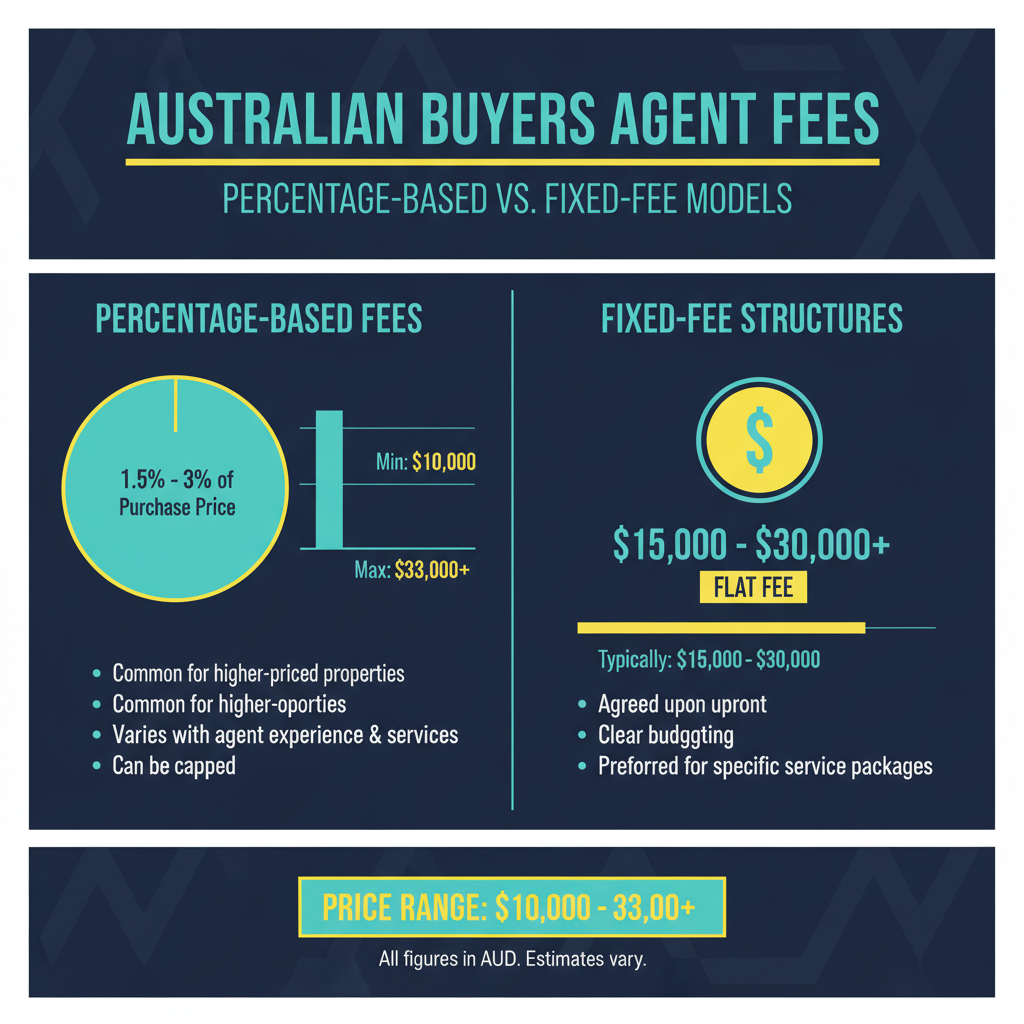

 General
Complete guide to buyers agents in Australia, covering their role, typical fees, off-market access, and when hiring one...